


Why South Hills Homes Experience Sudden Late-Summer Pressure Drops
You turn on the shower on a hot morning expecting a strong, refreshing spray, but instead, you are met with a weak, frustrating trickle—a moment that means you are suddenly addressing end-of-summer low water pressure in South Hills neighborhoods. Your kitchen faucets take twice as long to fill a simple glass of water, and trying to run the dishwasher while the washing machine is on seems completely impossible. If you are experiencing this right now, you are not alone. This sudden drop in water pressure is a known, recurring phenomenon that specifically impacts the older housing stock throughout our region as August draws to a close.
As the season winds down, homeowners face a critical decision point: determining whether this frustrating trickle is a temporary municipal supply issue that will resolve itself, or a permanent sediment clog lodged deep within the home's aging plumbing system. Understanding the root cause of the pressure drop is the key to getting your home's water flow back to normal. You do not have to wait weeks hoping the pressure magically returns. When you need reliable residential plumbing services, scheduling a professional plumbing inspection can help you diagnose and resolve the issue without the guesswork.
Many homeowners assume that a sudden loss of water pressure means a pipe has burst or a major leak has formed under the foundation. While leaks are always a possibility, a sudden, house-wide drop in late summer is often tied to external factors shifting the dynamics of your local water supply. By learning how city maintenance interacts with your private plumbing, you can make informed decisions about when to wait it out and when to call a professional to clear out a stubborn blockage.
The Mechanics of Municipal Water Line Flushing
To understand why your shower is suddenly underperforming, you have to look past your own property line and into the streets. Municipal water line flushing is a routine, necessary maintenance procedure performed by local water authorities to ensure water quality and system health. Over time, natural mineral deposits, fine sediment, and rust accumulate along the bottom of large city water mains. If left unchecked, this buildup can degrade water quality and restrict the flow needed for emergency fire services.
The late-summer overlap: In Western Pennsylvania, high municipal water demand from constant lawn watering, agricultural needs, and topping off swimming pools begins to overlap with end-of-season city maintenance schedules. As the peak seasonal demand shifts in late summer, municipalities often take advantage of the changing weather to open up fire hydrants and flush the distribution lines. The sheer force of the water pushing through the open hydrants scours the inside of the municipal pipes, clearing out the accumulated debris.
Neighborhood-wide pressure drops: When a city crew opens a hydrant on your street, thousands of gallons of water rush out of the system in a matter of minutes. This massive diversion of water temporarily lowers the available water pressure for entire blocks or neighborhoods. If you happen to turn on your tap while the crew is actively flushing the lines on your street, you will experience a significant, noticeable drop in pressure.
Temporary inconveniences: The good news is that municipal-driven pressure drops are strictly temporary. Because the loss of pressure is caused by the open hydrant diverting the water volume, your home's pressure will typically return to normal the moment the city crew closes the hydrant and completes their local flushing route. If the pressure returns within a few hours, the issue was entirely external.
How Dislodged Sediment Travels to Your Residential Plumbing
While the pressure drop from an open hydrant is temporary, the physical debris stirred up by the flushing process can create long-lasting problems inside your home. Bridging the gap between municipal actions and residential consequences requires understanding how water travels from the street to your sink.
When municipal flushing occurs, it creates a high-velocity current that disturbs settled debris in the city mains. This sediment does not just flow out of the hydrants; it gets suspended in the water supply. From there, it follows the path of least resistance, which often leads directly into the residential service lines connected to those mains.
1. High-velocity disturbance: The rapid movement of water during city flushing acts like a heavy storm in a shallow pond, churning up minerals, rust flakes, and dirt that have sat dormant in the city pipes for months or years.
2. Migration into service lines: As you and your neighbors continue to use water during or immediately after the flushing event, you unknowingly draw this sediment-heavy water out of the city main and into your private residential service line.
3. Distribution through the home: Once the sediment passes your water meter, it travels through your home's internal pipe network. The heavier particles settle in horizontal pipe runs, while the finer grit is carried all the way to your fixtures.
4. Accumulation at exit points: The debris eventually hits narrow exit points—like showerheads, faucet aerators, and internal appliance valves—where it becomes trapped, severely restricting water flow.
The Impact on Hot Water Systems
Significant sediment surges do more than just clog your bathroom sink. When sediment-laden water enters your home, a large portion of it flows directly into your water heater tank. As the water sits in the tank and heats up, the heavy municipal sediment drops to the bottom, adding to the scale buildup already present. Over time, this sudden influx of debris can drastically impact your overall water heater performance, forcing the burner or heating elements to work twice as hard to heat the water through a thick layer of insulating sludge. If your hot water pressure specifically drops after late August, trapped sediment in the tank or the outlet valve is a highly likely culprit.
Aging Infrastructure: The Vulnerability of Older Homes
Not every home reacts to municipal flushing the same way. A newly constructed house a few miles away might experience a brief drop in pressure and a few minutes of discolored water, while a historic home in your neighborhood might lose pressure for days. The difference lies entirely in the age and material of the plumbing infrastructure.
Newer residential builds are typically plumbed with modern materials like PEX (cross-linked polyethylene) or PVC. These modern pipes have incredibly smooth interior walls that resist mineral buildup. When municipal sediment enters a PEX system, it generally flows right through without catching on the walls, eventually flushing out through the larger fixtures like bathtubs or outdoor spigots.
In contrast, the historic, aging plumbing infrastructure common in established local neighborhoods presents a much rougher path. Older galvanized steel or aging copper pipes naturally develop internal mineral buildup, known as scale, over decades of use. This internal scale creates a jagged, uneven surface inside the pipe. When sediment from a late-summer municipal flush enters an older plumbing system, the rough internal walls act like a net, catching and holding the incoming debris.
Furthermore, older plumbing layouts often feature multiple narrow points, sharp elbows, and outdated valve styles that create natural bottlenecks. When sediment hits these bottlenecks, it easily compacts into a solid blockage. What is a minor, five-minute inconvenience for a new build can quickly become a complete, house-wide blockage in an older property. Working with a team that has deep local expertise means your technicians understand exactly how regional municipal water systems interact specifically with older residential plumbing infrastructure. We know the architecture of these neighborhoods, and we know exactly where these sediment bottlenecks form, which is one of the key services provided by a residential plumber who truly knows the area.
The Critical Role of Pressure Reducing Valves (PRVs)
When investigating a sudden loss of water pressure that doesn't resolve itself, the prime suspect in an older home is almost always the Pressure Reducing Valve (PRV). This essential component is the gatekeeper of your home's plumbing system, and it is highly susceptible to late-summer sediment surges.
What is a PRV?
Municipal water is often pumped through city mains at very high pressures—sometimes exceeding 100 PSI—to ensure it reaches all elevations and provides adequate fire protection. However, this pressure is far too high for standard residential pipes, appliances, and fixtures, which are designed to operate safely at around 50 to 60 PSI. The PRV is a bell-shaped brass valve installed on your main water line, usually right after the water meter. Its essential function is to slow down and step down that high city pressure to a safe, usable level for your home.
The unintentional catch-point:
To protect its sensitive internal springs and diaphragms, a PRV contains a small, fine mesh screen designed to catch large debris. During a municipal flushing event, this screen acts as an unintentional catch-point for the massive amount of dislodged sediment entering the home. Because aging residential pressure reducing valves (PRVs) and aerators already have years of minor buildup, a sudden surge of city sediment can completely coat the PRV's internal screen.
Permanent restriction:
A sediment-clogged PRV permanently restricts water flow into the entire house. It perfectly mimics a city-wide pressure drop, but because the physical blockage is trapped inside the valve on your property, it will never resolve on its own. While small aerators on individual sinks can also clog, a whole-house pressure drop points directly to a compromised PRV or a blocked main line.
These older valves often hide secondary issues that only become apparent when they fail. For example, during a service call last fall for a failing pressure regulator that had restricted flow to a trickle, the technician clearing the valve also identified and addressed an unmentioned safety issue on the home's hot water tank. By resolving both the primary PRV clog and the hidden hot water tank safety concern at the same time, the homeowner was able to restore their water pressure and gain complete peace of mind before winter arrived.
Addressing End-of-Summer Low Water Pressure in South Hills Neighborhoods: Diagnosing the Drop
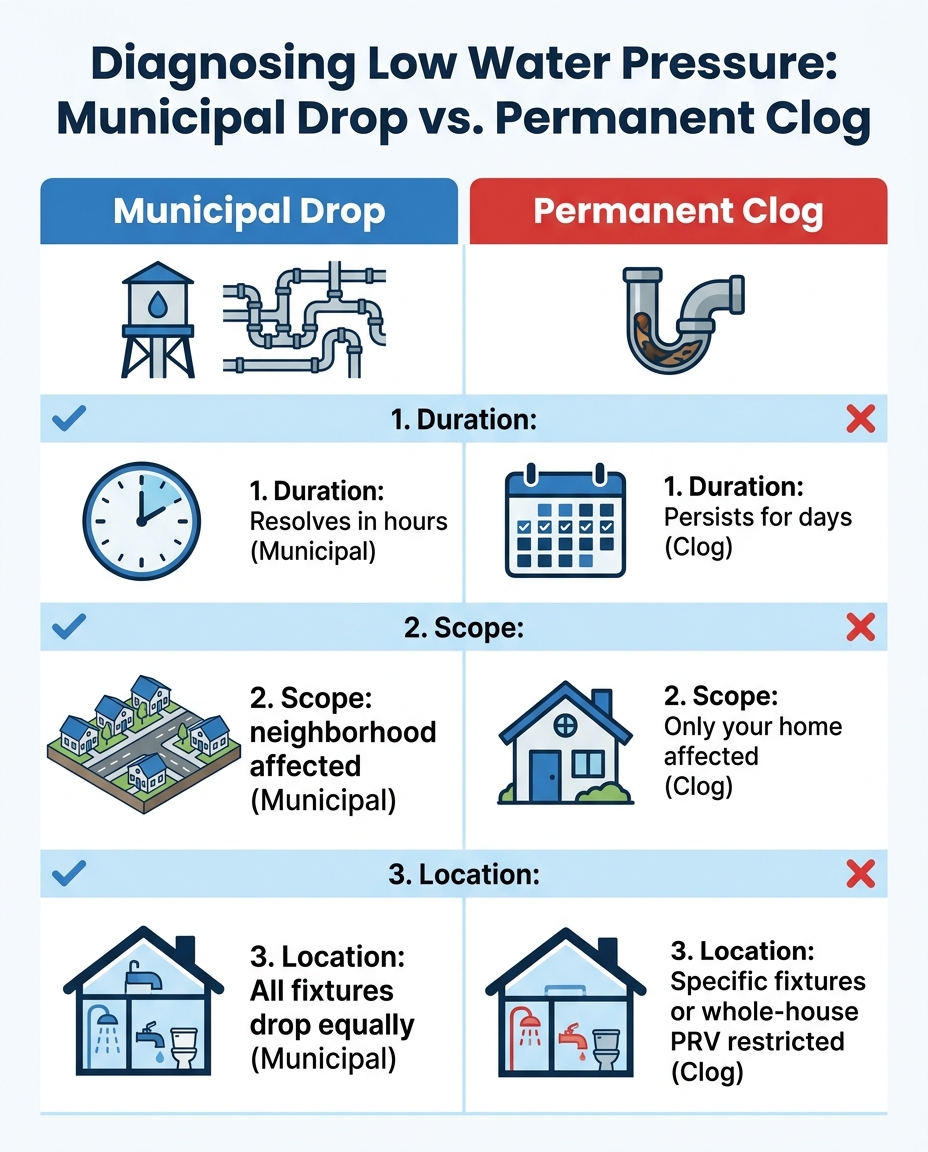
When your water pressure drops to a trickle, knowing when to wait and when to call a professional can save you days of frustration. Diagnosing the difference between a temporary municipal event and a permanent residential clog comes down to timing and scope.
Provide a timeline: The most reliable diagnostic tool is the clock. Municipal flushing usually takes a few hours to complete in a specific neighborhood. If your low pressure persists for more than a day after the city has finished working in your area, the issue is no longer external. A pressure drop lasting longer than 24 hours means the sediment is permanently trapped inside your home's plumbing.
Check the scope of the problem: Advise homeowners to walk through the house and test multiple fixtures. If the pressure drop is isolated to just one fixture—like the kitchen sink or the master bathroom shower—the problem is likely a localized clog in that specific aerator or showerhead cartridge. However, if the pressure drop is house-wide, affecting the washing machine, the toilets, and every sink equally, the blockage is located at the main entry point, likely the PRV.
• Duration — Temporary Municipal Issue: Resolves within a few hours — Permanent Sediment Clog (PRV): Persists for more than 24 hours
• Scope — Temporary Municipal Issue: Entire neighborhood is affected — Permanent Sediment Clog (PRV): Only your specific home is affected
• Water Quality — Temporary Municipal Issue: Briefly discolored or cloudy, then clears — Permanent Sediment Clog (PRV): Water may remain clear, but flow is restricted
• Location — Temporary Municipal Issue: All fixtures drop equally — Permanent Sediment Clog (PRV): Whole-house drop or specific fixtures blocked
The dangers of DIY: We strongly caution against attempting to clean, adjust, or replace a PRV without a proper plumbing license. The PRV holds back immense municipal pressure. Improper handling, incorrect adjustments, or failing to seat the valve correctly can cause dangerous pressure spikes inside your walls, leading to blown appliance hoses, ruptured pipes, and catastrophic water damage.
Instead of risking thousands of dollars in water damage, we recommend scheduling routine plumbing maintenance. Professional evaluations can safely clear trapped sediment, test the incoming PSI, and ensure the longevity of your aging plumbing components without putting your home at risk.

Frequently Asked Questions About Local Water Pressure
Why is my water pressure suddenly low in the summer?
Sudden low water pressure in the summer is frequently caused by peak seasonal demand combined with municipal line flushing. As water authorities flush hydrants to clear mineral deposits, it temporarily diverts water volume away from residential neighborhoods. Additionally, heavy neighborhood water usage for lawns and pools can lower overall system pressure during peak afternoon hours.
How long does low water pressure last after municipal flushing?
A pressure drop caused directly by municipal flushing usually resolves within a few hours once the city crew finishes their route and closes the hydrants. If your low water pressure persists into the next day, it strongly indicates that sediment stirred up by the flushing has created a localized clog inside your home's plumbing system.
How do I know if my PRV is clogged with sediment?
You can tell your PRV is clogged if you experience a permanent, whole-house pressure drop that doesn't improve overnight. Unlike a clogged sink aerator that only affects one faucet, a clogged PRV restricts water flow to every fixture and appliance in the home simultaneously. This requires professional diagnosis and replacement.
Why is water pressure low in my older home but not my neighbor's?
Older homes are built with aging galvanized or copper pipes that naturally develop internal scale, which easily catches and holds incoming municipal sediment. Furthermore, older pipes and aging PRVs create narrow bottlenecks that trap debris much faster than the smooth, modern PEX piping found in newer neighboring installations.
Does municipal line flushing cause permanent plumbing damage?
Municipal flushing itself shouldn't cause direct damage to your pipes, but it can expose underlying vulnerabilities in aging fixtures. The sudden surge of sediment can permanently clog older pressure reducing valves (PRVs) and appliance inlet screens, which will require professional attention to clear or replace in order to restore normal water flow.
Restore Your Home's Water Flow Before Fall
Addressing end-of-summer low water pressure in South Hills neighborhoods doesn't have to be a guessing game. Understanding the critical difference between a temporary city flushing event and a permanently clogged PRV saves you significant time, stress, and frustration. When the issue is trapped inside your own pipes, waiting it out will not solve the problem.
You can rest assured that a professional diagnosis will quickly pinpoint the exact location of the blockage, whether it is a single aerator or a failing main line valve. By relying on licensed experts to handle the heavy lifting, you protect your home from dangerous pressure spikes. Encourage yourself to act proactively—schedule an inspection today to clear out the late-summer sediment and restore your home's full water pressure before the colder seasons set in.






.svg)
.avif)


