


The Panic of a Tripped AC Breaker on a 90-Degree Day
You walk into your living room expecting a blast of cool air, but instead, the house feels like an oven, and the vents are completely silent. In our years of restoring comfort to local homes, our team at Sureway Heating Cooling Plumbing has seen firsthand that Diagnosing an AC circuit breaker that trips during peak heatwaves is one of the most stressful challenges a homeowner can face. When ambient temperatures over 90 degrees bake the outside of your home, losing your cooling system abruptly elevates a minor inconvenience into a full-blown emergency.
When an air conditioning system suddenly shuts down on a scorching afternoon, the electrical panel is usually the first place you check. Finding a tripped breaker often brings a momentary sense of relief. You flip it back to the "on" position, hoping the problem is solved. But when that breaker immediately snaps back to the "off" position, or trips again ten minutes later, that relief quickly turns to dread.
A tripped breaker is not a nuisance; it is a critical safety mechanism doing its exact job. It cuts the flow of electricity to prevent wires from overheating, melting their insulation, and potentially starting an electrical fire. However, determining exactly why that safety mechanism engaged requires understanding how extreme high heat impacts both your home's electrical infrastructure and the mechanical components of your cooling system. You are faced with a crucial decision point: is your electrical panel simply weak and reacting poorly to the heat, or is your expensive AC compressor suffering a catastrophic mechanical failure?
Finding the right answer requires patience, observation, and a solid understanding of how these systems interact under heavy loads. For a comprehensive look at how your cooling system functions under stress, you can explore our air conditioning resources.
Why Your AC Circuit Breaker Keeps Tripping (And the One-Reset Rule)
To understand why your ac circuit breaker keeps tripping, you first need to understand how circuit breakers function. Your electrical panel is the central nervous system of your home's power supply. Each breaker is rated for a specific amount of electrical current, measured in amperes (amps). Your air conditioner sits on a dedicated circuit, usually requiring a 20, 30, or 40-amp breaker depending on the size of the unit.
When the electrical current flowing through that circuit exceeds the breaker's safe capacity, the breaker automatically opens the circuit, halting the flow of electricity. This is a deliberate, protective action. The breaker is protecting the wires hidden inside your walls from melting.
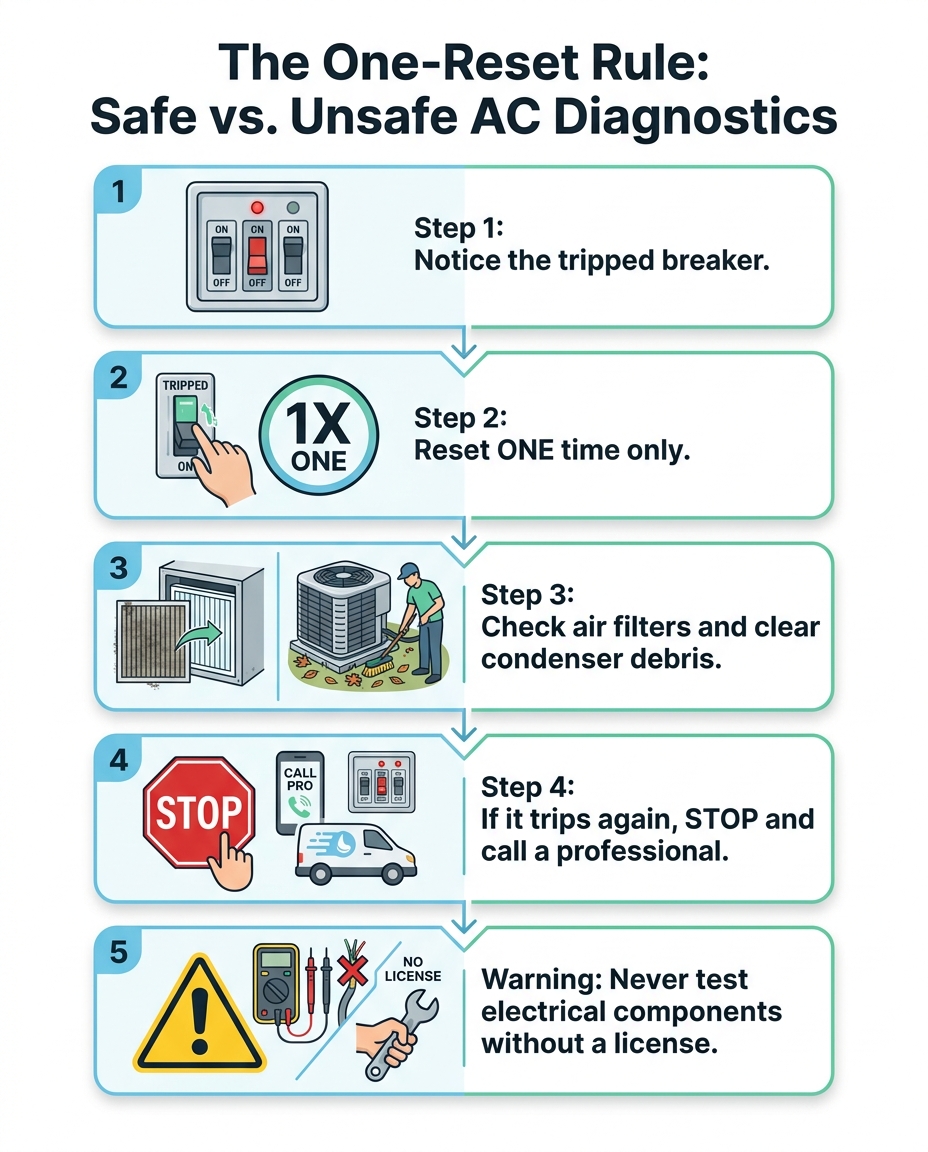
Because homeowners often search for answers when their ac circuit breaker keeps tripping, we strongly advise following the strict "One-Reset Rule." This rule is the baseline for electrical safety in your home:
1. Locate the tripped breaker: It will be sitting in the middle position, between "ON" and "OFF."
2. Turn it fully off: You must push the breaker firmly to the "OFF" position until you hear a click.
3. Turn it back on: Push it firmly to the "ON" position.
4. Observe the result: If the breaker stays on and the AC runs normally, it may have been a temporary power surge. If it trips again—whether immediately or after a few minutes—stop resetting it.
The Danger of Ignoring a Tripping Breaker
A circuit breaker is a vital safety device, not a suggestion switch. When a homeowner violates the One-Reset Rule and repeatedly forces a breaker closed against a fault, the consequences can be severe and expensive.
Every time a breaker trips, a small electrical arc occurs inside the breaker itself. Repeatedly forcing the breaker on degrades its internal components. More importantly, if your air conditioner has a short circuit, repeatedly sending massive surges of electricity into the system will destroy the compressor terminals. What might have started as a minor wiring issue or a failing capacitor can quickly escalate into a destroyed compressor, requiring a complete system replacement. Furthermore, bypassing a tripping breaker continuously heats the wires inside your walls, destroying the protective insulation and creating a severe fire hazard.

How Extreme Summer Heat Weakens Your Electrical Panel
Sometimes, the air conditioner is running perfectly fine, but the electrical panel itself is the culprit. Most residential electrical panels utilize thermal-magnetic circuit breakers. These devices rely on two different mechanisms to trip: a magnetic electromagnet that responds instantly to massive short circuits, and a bimetallic strip that responds to gradual heat buildup from electrical current.
As electricity flows through the breaker, it generates heat. If the air conditioner pulls slightly more amps than it should, that bimetallic strip slowly heats up, bends, and eventually triggers the trip mechanism. However, this thermal mechanism is highly sensitive to the ambient temperature of the room where the electrical panel is located.
In our region, Western Pennsylvania summer heatwaves put severe, simultaneous strain on aging residential electrical panels. If you live in Bridgeville PA and your electrical panel is located in a hot garage or on an exterior wall baking in the afternoon sun, the ambient heat artificially pre-heats that bimetallic strip. The breaker is already hot before the air conditioner even turns on.
When ambient temperatures over 90 degrees heat the panel, the breaker's trip threshold is lowered. A 30-amp breaker might trip when the AC is only pulling 24 amps, simply because the environmental heat pushed the thermal mechanism over the edge. Furthermore, a pattern we see often in our Bridgeville service calls is that older breakers weaken over time. After years of expanding and contracting, the internal springs lose their tension. An aging breaker in a hot garage will frequently trip prematurely, leading homeowners to falsely believe their air conditioner is broken when they actually just need a panel evaluation and a relatively inexpensive breaker replacement.
When the Problem is a Hard-Starting or Shorted Compressor
If the electrical panel is in good condition and the breaker is functioning properly, a tripping breaker points to a genuine mechanical or electrical failure within the air conditioning system itself. The most common culprit is the compressor, the heavy-duty motor located in your outdoor condenser unit that pumps refrigerant through your home.
Air conditioners draw their highest amount of electrical current during the first few seconds of startup. This initial surge is known as Locked Rotor Amps (LRA). During a heatwave, when ambient temperatures over 90 degrees cause the refrigerant pressures inside the system to skyrocket, the compressor has to work significantly harder to start pumping against that high pressure. If the compressor is aging, or if the run capacitor (the battery-like device that gives the compressor an extra jolt of energy to start) is failing, the compressor will struggle to start. It will pull massive amounts of electricity for too long, exceeding the breaker's capacity and causing it to trip.
An even more severe scenario is a grounded or shorted compressor. Over years of use, the protective lacquer insulation on the copper windings inside the compressor can wear away. When bare wires touch each other or touch the metal casing of the compressor, the electrical current bypasses its normal path and shoots directly to the ground. This pulls a catastrophic amount of electricity instantly, and the magnetic mechanism in the breaker trips immediately to prevent an explosion or fire. If you suspect your compressor has reached the end of its lifespan, understanding the process of diagnosing AC compressor failures is your next best step.
Signs of a Compressor Issue vs. Electrical Issue
Homeowners can often narrow down the root cause by observing exactly when the breaker trips. Paying attention to the timing provides valuable clues for the technician you eventually call.
• Trips instantly the moment the thermostat calls for cooling — Likely Cause: Direct short circuit in the wiring or a grounded compressor motor. — Severity Level: High (Requires immediate professional electrical testing).
• Trips after 3 to 5 seconds of a loud humming noise outside — Likely Cause: Hard-starting compressor, often due to a dead capacitor or high head pressure. — Severity Level: Moderate (Often fixable with a new capacitor or hard start kit).
• Trips after 30 to 45 minutes of running during the hottest part of the day — Likely Cause: Thermal overload, dirty coils, restricted airflow, or a weak breaker reacting to ambient heat. — Severity Level: Varies (Could be simple maintenance or a weak panel).
Safe Troubleshooting Steps Before Calling a Professional
While you should never open the electrical panel cover or attempt to test high-voltage AC components yourself, there are safe, practical steps you can take to troubleshoot airflow issues. Restricted airflow is a leading cause of overheating, which subsequently spikes the electrical draw and causes your ac circuit breaker keeps tripping.
One local homeowner reached out to our Sureway Heating Cooling Plumbing dispatch last summer when their air conditioner was not working properly and kept shutting down the circuit. They assumed the entire compressor was dead. However, our technician arrived, explained everything that was happening with the system's airflow, and fixed the unit simply by addressing severe maintenance neglect. The air conditioner was repaired and is working well today, proving what our team regularly tells customers: simple airflow issues often masquerade as major electrical failures.
Before you call for a repair, follow this safe troubleshooting checklist:
• Check and replace dirty air filters: A clogged air filter chokes the blower motor inside your house. When the motor struggles to pull air, it works harder, heats up, and pulls more amps. Furthermore, restricted airflow prevents the indoor coil from absorbing heat properly, which sends cold liquid refrigerant back to the outdoor compressor. Compressors are designed to pump gas, not liquid. Trying to pump liquid forces the compressor to overwork and trip the breaker.
• Inspect the outdoor condenser unit: Walk outside and look at the metal fins on your AC unit. Are they completely blanketed in grass clippings, cottonwood seeds, dirt, or leaves? The outdoor unit needs to breathe to release the heat it absorbed from your house. If the coils are blocked, the heat stays trapped inside, causing system temperatures and electrical amp draw to spike dangerously high. Gently wash away debris with a standard garden hose (never a pressure washer).
• Open all indoor supply vents: Closing vents in unused rooms increases the static pressure inside your ductwork, forcing the blower motor to strain against the resistance. Keep at least 80% of your home's vents fully open.
If you have checked the filters and cleared the outdoor coils, and the breaker still trips, your safe troubleshooting journey ends there. Never attempt to test electrical components or compressor terminals with a multimeter without proper licensing and training. High-voltage electricity is lethal. To keep your system running smoothly year-round and avoid these stressful breakdowns, consider investing in preventative HVAC maintenance.
Why Accurate Diagnostics Require Looking at the Whole Home
When an air conditioner causes a breaker to trip, many rushed technicians will only look at the cooling unit itself. They might check the capacitor, test the compressor, and if they don't find an immediate issue, they might shrug and suggest a costly system replacement. But proper, accurate diagnostics require a much wider lens.
As a comprehensive HVAC and plumbing provider, our team at Sureway Heating Cooling Plumbing offers holistic diagnostic expertise that looks at the whole system's health rather than just applying a quick, temporary fix. We understand that your air conditioner does not operate in a vacuum; it is deeply reliant on your home's electrical infrastructure. Proper diagnostics require evaluating both the HVAC system's electrical draw and the home infrastructure's capacity to deliver that power safely.
For example, a technician must use a clamp meter to measure the exact running load amps (RLA) the compressor is pulling while operating. If the compressor is rated to pull 15 amps, and it is currently pulling 14 amps, the air conditioner is operating perfectly within its safe design limits. If the 30-amp breaker trips while the system is only pulling 14 amps, the diagnosis is clear: the air conditioner is fine, but the breaker is weak and failing.
A comprehensive approach ensures that homeowners in Bridgeville PA don't replace an expensive, perfectly good compressor when a simple, inexpensive breaker replacement was all that was needed. Conversely, it ensures an electrician doesn't just install a larger breaker to "solve" a tripping issue, which would remove the safety net and allow a failing, shorted compressor to eventually start an electrical fire.
Frequently Asked Questions About Tripping AC Breakers
Why does my ac circuit breaker keep tripping?
Your AC circuit breaker keeps tripping because the electrical current flowing to the unit has exceeded the breaker's safe capacity, or the breaker itself has become weak. This overload is typically caused by a failing run capacitor, a hard-starting compressor, extremely dirty condenser coils that cause the system to overheat, or a direct short circuit in the wiring. The breaker trips to cut the power and prevent the wires inside your walls from melting and causing a fire.
Can extreme summer heat cause a circuit breaker to trip?
Yes, extreme ambient heat can cause a circuit breaker to trip prematurely. Most residential breakers are thermal-magnetic, meaning they have a bimetallic strip inside that bends and trips the switch when it gets too hot from electrical resistance. If the electrical panel is located in a hot garage or baking in the summer sun, the ambient heat pre-heats this internal strip, lowering the threshold at which the breaker will trip, even if the AC is pulling a normal amount of power.
How many times can I reset my AC breaker safely?
You should only reset your AC breaker one time safely. If the breaker trips, push it fully to the "OFF" position, then firmly to the "ON" position. If it trips again immediately, or within a few minutes of the AC running, you must stop resetting it. Repeatedly forcing a breaker closed against a short circuit can destroy your compressor terminals, ruin the breaker panel, and create a severe risk of an electrical fire.
How do I know if it is the breaker or the AC compressor failing?
Determining whether it is a weak breaker or a failing compressor requires professional electrical testing using a multimeter and an amp clamp. A technician will measure the exact amount of electricity the compressor is pulling. If the compressor is pulling normal amps but the breaker still trips, the breaker is weak. If the compressor is pulling massive amounts of electricity that exceed its data plate rating, the compressor is failing or shorted to ground.
Can a dirty air filter cause the AC breaker to trip?
Yes, a severely dirty air filter can absolutely cause the AC breaker to trip. A clogged filter severely restricts airflow, forcing the indoor blower motor to work much harder and pull more electrical current. Additionally, the lack of airflow causes the indoor evaporator coil to freeze, which prevents refrigerant from boiling off properly. This sends liquid refrigerant back to the outdoor compressor, causing it to overwork, overheat, and eventually draw enough amps to trip the breaker.
Get Safe, Professional Help for Your Tripping AC System
Dealing with a tripped breaker when ambient temperatures over 90 degrees are turning your home into a sauna is incredibly frustrating, but it is not a situation where you should cut corners. Don't risk your family's safety or your home's electrical integrity by ignoring a tripping breaker or continuously resetting it against a fault. The One-Reset Rule is there to protect you from catastrophic electrical damage.
Professional technicians have the proper, specialized tools—like True-RMS multimeters and megohmmeters—to safely measure amp draw, test the integrity of the compressor's copper windings, and evaluate your electrical panel's health without guesswork. Instead of sweating through the heat and hoping the breaker stays on this time, schedule a comprehensive diagnostic to identify the true root cause. By trusting experts who look at the whole picture, you can restore reliable, safe cooling to your home. Reach out today for professional air conditioning services and get your comfort back on track.



.svg)
.avif)


