


When Your Boiler Breaks Down in Mt. Lebanon: What You Need to Know Right Now
When emergency boiler repair in mt. lebanon, pa becomes urgent, you need fast answers. A broken boiler during a Pittsburgh winter isn't just uncomfortable—it's a genuine emergency that can leave your home freezing and your family in danger. Whether you're waking up to no heat, finding water pooling around your boiler, or hearing strange banging noises from your basement, knowing what to do in those critical first moments makes all the difference.
Quick Action Steps for Boiler Emergencies:
1. If you smell gas - Evacuate immediately and call your gas company from outside
2. No heat or hot water - Check your thermostat, circuit breaker, and boiler pressure gauge
3. Strange noises or leaks - Turn off your boiler and call for emergency service
4. Pilot light won't stay lit - This requires professional diagnosis—don't keep relighting it
5. System pressure below 1 bar - Your boiler needs immediate attention
For comprehensive guidance on maintaining your heating system year-round, check out our complete boiler services guide. If you're facing an emergency right now, contact Sureway Comfort for 24/7 emergency boiler repair.
This guide walks you through everything Mt. Lebanon homeowners need to know when their boiler fails—from recognizing warning signs before complete breakdown to understanding what happens during an emergency repair call. You'll learn which problems you can troubleshoot yourself, when to call for help, and how to prevent future emergencies. Many older homes in Mt. Lebanon have unique heating systems with cast iron radiators and historic boiler configurations that require specialized knowledge, and we'll address those considerations too.
Critical Signs Your Boiler Needs an Emergency Repair
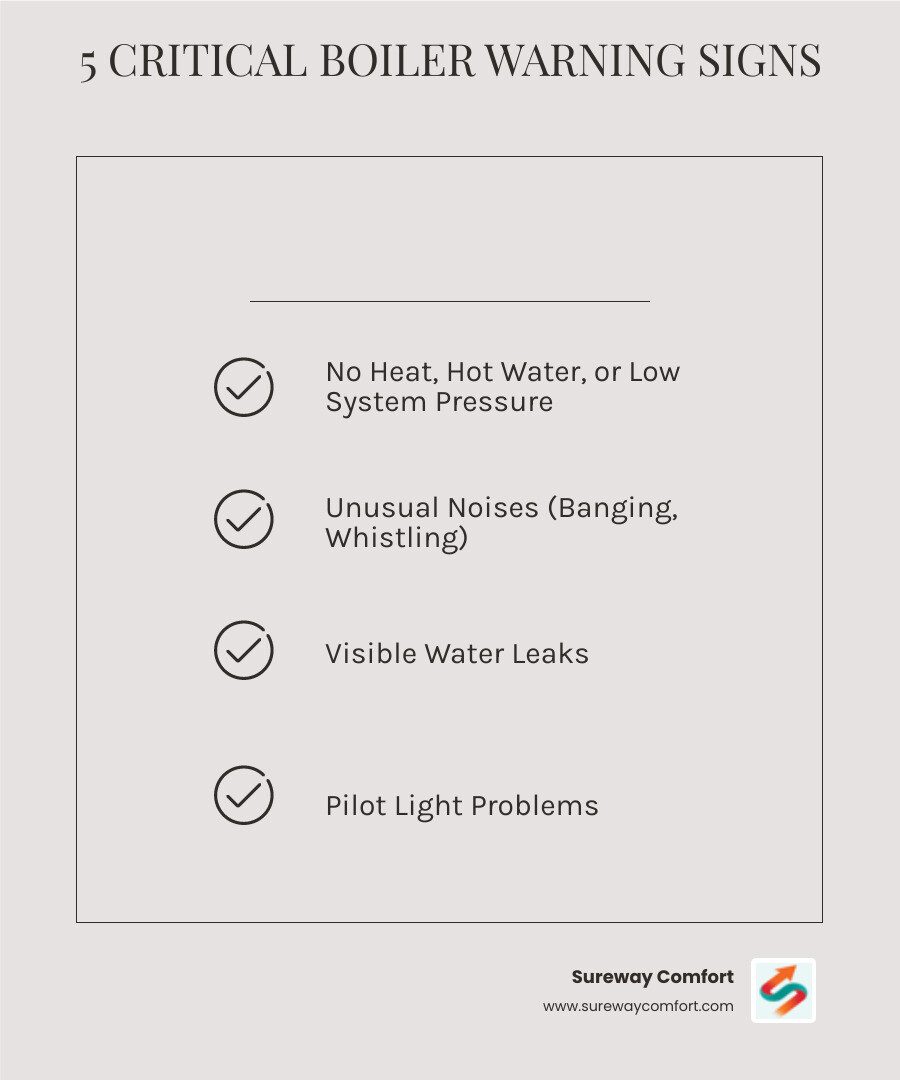
Imagine waking up on a crisp Mt. Lebanon morning, expecting the gentle warmth of your home, only to be met with an unwelcome chill. Your boiler, usually a silent workhorse, might be trying to tell you something. Recognizing the early warning signs of a boiler problem can often prevent a minor issue from escalating into a full-blown emergency boiler repair in Mt. Lebanon, PA. Here are the critical signs that indicate your boiler might be in distress:
• No Heat or No Hot Water: This is perhaps the most obvious and frustrating sign, especially during colder months. If your radiators are cold, or your shower only delivers icy blasts, your boiler isn't doing its job. This could stem from various issues, from a faulty thermostat to a complete system breakdown.
• Strange Noises: Boilers are generally quiet, so any unusual sounds should grab your attention.
— Banging (Kettling): This often sounds like a kettle boiling and typically indicates a buildup of mineral deposits (limescale) on the heat exchanger. This can restrict water flow and lead to overheating.
— Gurgling: This usually points to air trapped in the system or low water pressure, which can hinder proper circulation.
— Whistling: A high-pitched whistling sound can also signify air in the system or a pump struggling to move water.
• Leaking Water: Any visible water leaking from your boiler is a serious concern. Leaks can occur from various points, such as pressure relief valves, pump seals, or even cracks in the heat exchanger. Left unaddressed, leaks can cause significant property damage and indicate internal component failure.
• Pilot Light Problems: For older boiler models, the pilot light is crucial for ignition. If it frequently goes out, changes color (should be a strong blue flame), or is difficult to light, it signals an issue with the gas supply, thermocouple, or other ignition components. A yellow pilot light, in particular, could indicate incomplete combustion and potentially a carbon monoxide risk.
• Low System Pressure: Your boiler's pressure gauge (usually between 1–1.5 bar for residential systems) is an important indicator of its health. If the pressure consistently drops below the recommended range, it can prevent your boiler from operating efficiently or even cause it to shut down entirely. Low pressure can be due to a leak, a faulty expansion vessel, or other system issues.
• Unusual Odors: While boilers shouldn't have a strong smell, a metallic or burning odor could mean internal components are overheating. More critically, a smell of rotten eggs indicates a gas leak, which requires immediate and decisive action for your safety.
Ignoring these signs can lead to more extensive damage, higher repair costs, and, worst of all, a complete system failure when you need your heat the most. If you notice any of these symptoms, it's time to consider calling for professional emergency boiler repair in Mt. Lebanon, PA.
What to Do When Your Boiler Fails: A Step-by-Step Guide
When your boiler decides to call it quits, especially during the chilly Mt. Lebanon winter, it can feel overwhelming. But taking a calm, systematic approach can help ensure your safety and get your home warm again sooner.
Step 1: Prioritize Safety—Check for Gas or CO Leaks
Your safety is paramount. Before you do anything else, pause and assess for potential dangers.
• Gas Smell: If you detect a strong, distinct smell of rotten eggs, it's a clear indicator of a gas leak. This is an immediate emergency. Do NOT operate any electrical switches, use your phone indoors, or create any sparks. Evacuate your home immediately, leaving doors and windows open if possible as you exit. Once safely outside, call your gas company's emergency number and then contact us for professional assistance.
• Carbon Monoxide Symptoms: Carbon monoxide (CO) is an odorless, colorless gas produced by incomplete combustion. Symptoms of CO poisoning can include headache, dizziness, nausea, fatigue, and confusion. If you or anyone in your household experiences these symptoms, especially when near the boiler, get fresh air immediately. Evacuate the home and seek medical attention. Ensure you have working carbon monoxide detectors installed near sleeping areas and on every level of your home for early detection.
Step 2: Perform Basic Homeowner Troubleshooting
Once you've confirmed there are no immediate safety threats, you can try some basic troubleshooting steps. These can sometimes resolve minor issues without needing a service call, or at least help diagnose the problem for us.
• Check Thermostat Settings: It sounds simple, but ensure your thermostat is set to "heat" and the desired temperature is higher than the current room temperature. Also, check if it's running on batteries and if they need replacing.
• Inspect the Circuit Breaker: Head to your electrical panel and check the circuit breaker labeled for your boiler. If it's tripped, reset it. If it trips again immediately, there's an electrical fault that requires professional attention.
• Verify Boiler Pressure: Locate the pressure gauge on your boiler. For most residential systems, the pressure should be between 1 and 1.5 bar. If it's too low, you might be able to top it up using the filling loop (consult your boiler manual if unsure, or call us). If it's too high, there might be too much water in the system, or a faulty component.
• Bleed Radiators: If some of your radiators are cold at the top but warm at the bottom, it often means there's air trapped inside. You can bleed them using a radiator key to release the trapped air. This improves heat distribution.
• Check for Frozen Pipes: In very cold weather, the condensate pipe (a plastic pipe that carries waste water away from your boiler) can freeze. If it's blocked, your boiler might stop working. You might be able to gently thaw it with warm water (again, consult your manual or call us for guidance).
Step 3: Call for Professional Emergency Boiler Repair in Mt. Lebanon, PA
If you've gone through the safety checks and basic troubleshooting without success, or if you suspect a more serious issue, it's definitely time to call for professional emergency boiler repair in Mt. Lebanon, PA.
• When to Call a Professional: Any persistent issue, strange noises, leaks, or a complete lack of heat that you can't resolve with basic steps warrants a call to our experts. We offer 24/7 emergency service because we understand that heating emergencies don't stick to business hours.
• 24/7 Availability: Our team is ready to respond to your no-heat calls, especially during the brutal winter months. We prioritize these genuine emergencies to restore your comfort as quickly as possible.
• Experienced Technicians: Our technicians are experienced in diagnosing and repairing all types of boilers, including those in Mt. Lebanon's older homes with their unique heating systems. We bring a streamlined process and dedication to every repair.
• Information to Provide: When you call, be prepared to describe the problem in detail. Mention any sounds, smells, or visual cues you've noticed, and what troubleshooting steps you've already attempted. This helps our team prepare and potentially diagnose the issue more quickly upon arrival.
Common Causes of Boiler Breakdowns
Boilers are robust heating systems, but like any mechanical equipment, they're susceptible to breakdowns. Understanding the most common culprits behind a boiler failure can help you identify a problem quickly and even take preventative measures.
Here are the issues we frequently encounter when performing emergency boiler repair in Mt. Lebanon, PA:
• Low Water Pressure: This is one of the most frequent causes of boiler breakdowns. If the water pressure in your system drops too low, the boiler will often shut down as a safety measure to prevent damage. This can be due to a leak in the system, a faulty expansion vessel, or simply a need to top up the pressure via the filling loop.
• Thermostat Malfunctions: A faulty thermostat can lead to your boiler not firing up, cycling on and off too frequently (short cycling), or failing to maintain the desired temperature. Sometimes it's a simple battery replacement, other times it's a wiring issue or a faulty component within the thermostat itself.
• Airlocks in the System: Air trapped within your boiler or heating pipes can prevent hot water from circulating properly. This often results in cold spots in radiators or the entire system failing to heat up efficiently, leading to gurgling noises.
• Worn-Out Pumps or Valves: The circulator pump is vital for moving hot water throughout your heating system. If it fails or wears out, your home won't get heat. Similarly, malfunctioning zone valves (which control heat to different areas of your home) can cause uneven heating.
• Ignition System Failure: For boilers that use a pilot light or electronic ignition, issues with these components can prevent the boiler from firing up. This could be due to a faulty thermocouple, a blocked pilot jet, or a problem with the igniter or flame sensor.
• Frozen Condensate Pipe: In colder weather, the condensate pipe, which carries acidic wastewater from condensing boilers, can freeze. When this happens, it creates a blockage, and the boiler will often display an error code and shut down.
• Gas Supply Problems: A lack of gas supply to the boiler, either due to a shut-off valve, a problem with your gas meter, or even an issue with your utility provider, will naturally prevent your boiler from operating.
• Heat Exchanger Problems: The heat exchanger is where the water is heated. Over time, it can suffer from limescale buildup (leading to kettling noises) or even develop cracks, which can cause leaks and require significant repair or replacement.
• Electronic Control Failures: Modern boilers rely on complex electronic control boards. A malfunction in these controls can lead to a variety of operational issues, from incorrect temperature readings to complete system shutdown.
Many of these issues can be prevented or caught early with annual professional maintenance. This proactive approach helps us identify developing problems before they turn into urgent emergency boiler repair in Mt. Lebanon, PA.
When your boiler goes out, especially during a cold snap, getting it fixed quickly is your top priority. But beyond the immediate repair, you might face a significant decision: should you repair your existing boiler or invest in a new one? This choice is particularly relevant in Mt. Lebanon, given the prevalence of older homes.
Repair or Replace? Making the Right Decision
Deciding whether to repair or replace your boiler involves weighing several factors. We'll always provide an honest assessment to help you make the best long-term decision for your home and budget.
• Boiler Age — Favoring Repair: Under 10-12 years old — Favoring Replacement: Over 20-25 years old
• Maintenance History — Favoring Repair: Regularly maintained, good condition — Favoring Replacement: Poorly maintained, frequent issues
• System Efficiency — Favoring Repair: Still operating efficiently for its age — Favoring Replacement: Low efficiency (e.g., older models at 60-70%), leading to high energy bills
• Frequency of Repairs — Favoring Repair: Infrequent, minor repairs — Favoring Replacement: Repeated breakdowns, multiple major repairs in a short period
• Cost of Repair — Favoring Repair: Repair cost is less than 30-40% of the cost of a new boiler — Favoring Replacement: Repair cost is high, approaching or exceeding 50% of the cost of a new boiler
• Availability of Parts — Favoring Repair: Parts are readily available — Favoring Replacement: Parts are difficult to find or discontinued
• Safety Concerns — Favoring Repair: No immediate safety concerns (e.g., cracked heat exchanger, carbon monoxide risk) — Favoring Replacement: Significant safety concerns that are costly to mitigate
• Long-term Value — Favoring Repair: Boiler is expected to last several more years with the repair — Favoring Replacement: Boiler is nearing the end of its lifespan, and replacement offers better long-term value
For boilers under 10-12 years old that have been regularly maintained, repair often makes the most sense. However, for boilers over 20 years old needing major repairs, replacement typically represents better long-term value due to improved efficiency (modern high-efficiency condensing boilers can achieve 85-95% efficiency compared to older models at 60-70%) and reduced future repair costs. We'll provide a detailed quote and discuss these factors transparently.
Special Considerations for Older Homes in Mt. Lebanon
Mt. Lebanon is renowned for its beautiful, historic homes, many of which feature classic heating systems like cast iron radiators. While these systems offer a unique, comfortable radiant heat, they also present specific considerations when it comes to emergency boiler repair in Mt. Lebanon, PA or upgrades.
• Historic Home Architecture: We understand the charm and integrity of Mt. Lebanon's older homes. Our technicians are experienced in working with these unique properties, ensuring any repairs or upgrades respect the architectural character.
• Cast Iron Radiators: Many of these homes use robust cast iron radiators. While durable, integrating modern high-efficiency boilers with these older distribution systems requires specialized knowledge. We can guide you through options, whether it's preserving your existing radiators or transitioning to more contemporary boiler solutions.
• Retrofitting Modern Systems: Upgrading an older home's heating system involves blending modern efficiency with respect for the home's character. We specialize in retrofitting new high-efficiency condensing boilers that can work seamlessly with existing cast iron radiators, providing energy-smart upgrades while maintaining that classic Mt. Lebanon comfort.
• Energy-Smart Upgrades: Beyond repair, we can help you explore energy-smart upgrades and steer potential energy rebates. Our goal is to improve your home's comfort and efficiency without compromising its historical beauty.
How to Prevent Future Boiler Emergencies
Nobody wants to face an unexpected boiler breakdown, especially in the dead of winter. The good news is that many boiler emergencies are preventable. By taking proactive steps, Mt. Lebanon homeowners can significantly reduce the risk of future heating crises.
Annual Professional Maintenance
This is, without a doubt, the single most effective way to prevent boiler emergencies. Just like your car needs regular tune-ups, your boiler benefits immensely from an annual professional check-up.
• Improved Efficiency: During maintenance, we clean key components, ensuring your boiler operates at its peak efficiency. This can lead to noticeable savings on your energy bills, as a well-maintained boiler uses less fuel to heat your home.
• System Longevity: Regular servicing helps extend the lifespan of your boiler. By catching small problems early, we can address wear and tear before it leads to costly breakdowns or premature replacement.
• Safety Checks: A professional maintenance visit includes crucial safety inspections. We'll check for potential gas leaks, inspect the heat exchanger for cracks, test carbon monoxide levels, and verify that all safety controls are functioning correctly. This is vital for your family's well-being.
• Early Problem Detection: Our experienced technicians can identify developing issues—like low water pressure, worn-out parts, or minor leaks—before they escalate into a major emergency boiler repair in Mt. Lebanon, PA. Catching these problems early often means a simpler, less expensive fix.
Homeowner Tasks
While annual professional maintenance is essential, there are also a few simple tasks Mt. Lebanon homeowners can perform throughout the year to help keep their boiler in good shape:
• Checking Pressure: Regularly monitor your boiler's pressure gauge to ensure it stays within the recommended range (typically 1-1.5 bar). If it's consistently too low, it could indicate a leak that needs attention.
• Visual Inspections: Periodically take a look at your boiler. Are there any visible leaks? Any unusual discoloration? Is the pilot light (if applicable) a strong blue flame? Noticing these changes early can prompt a call to us before it becomes an emergency.
• Bleed Radiators: If you notice cold spots on your radiators, bleeding them to release trapped air can improve heating efficiency and reduce strain on your boiler.
By combining these simple homeowner checks with our comprehensive annual professional maintenance, you can enjoy greater peace of mind, a more reliable heating system, and significantly reduce the likelihood of needing an emergency boiler repair in Mt. Lebanon, PA.
Frequently Asked Questions About Emergency Boiler Repair in Mt. Lebanon, PA
We understand that when your boiler acts up, you have a lot of questions. Here are some of the most common inquiries we receive regarding emergency boiler repair in Mt. Lebanon, PA.
How quickly can I get help for a boiler emergency?
We prioritize heating emergencies, especially during the colder months in Mt. Lebanon. Our goal is to provide rapid response times, often reaching your home within a few hours of your call, and sometimes even faster, depending on current service demands. We offer 24/7 emergency service because we know that losing heat in winter is a genuine emergency. Our service vehicles are stocked with common parts, allowing us to complete many repairs on the initial visit.
Can my old boiler in my historic Mt. Lebanon home be repaired?
Absolutely. We have extensive experience working with the unique heating systems found in Mt. Lebanon's historic homes, including those with cast iron radiators. While older boilers might require specialized knowledge and parts, our technicians are trained to diagnose and repair them. We'll provide a professional assessment, discuss the feasibility and cost-effectiveness of repair versus replacement, and ensure any work preserves the integrity and charm of your historic property. Sometimes, a repair can effectively extend the life of your existing system, allowing you to continue enjoying its unique radiant heat.
What is included in a professional boiler maintenance visit?
A comprehensive boiler maintenance visit is designed to keep your system running safely and efficiently. During our multi-point inspection, we typically:
• Clean Key Components: We remove dirt and debris from burners, heat exchangers, and other vital parts to ensure efficient operation.
• Check Electrical Connections: We inspect all wiring and electrical components for wear and tear, ensuring safe and reliable function.
• Inspect the Heat Exchanger: We look for any signs of cracks, corrosion, or limescale buildup that could impact efficiency or safety.
• Test System Controls: We verify that your thermostat, pressure relief valve, and other safety controls are working accurately.
• Lubricate Moving Parts: We lubricate pumps and other moving components to reduce friction and extend their lifespan.
• Verify System Pressure: We check and adjust your boiler's water pressure to ensure it's within the optimal range.
• Examine the Flue and Ventilation: We ensure proper venting of combustion gases for safety.
• Provide a Detailed Report: After the service, we'll provide a report on your boiler's condition and recommend any necessary repairs or adjustments.
This annual check-up is crucial for preventing unexpected breakdowns and ensuring your boiler is ready to provide reliable heat all winter long.
Conclusion
Facing a boiler emergency in Mt. Lebanon can be a stressful experience, but knowing the signs, understanding the immediate steps to take, and having a trusted professional to call can make all the difference. From strange noises and leaks to a complete loss of heat, your boiler often provides clues that something is amiss. Prioritizing safety, attempting basic troubleshooting, and then promptly calling for professional emergency boiler repair in Mt. Lebanon, PA are your best courses of action.
While repairs are often the solution, sometimes a replacement makes more long-term sense, especially for older, inefficient units. And for our cherished historic homes in Mt. Lebanon, we approach every repair and upgrade with specialized knowledge and respect for your property's unique character.
The best defense against a boiler emergency is proactive maintenance. Regular professional servicing not only ensures your boiler operates safely and efficiently but also dramatically reduces the likelihood of unexpected breakdowns. Don't wait for a crisis to strike.
Contact us for expert boiler repair in Mt. Lebanon, PA to ensure your home stays warm and comfortable, no matter how cold it gets outside. We're here to provide the peace of mind you deserve.



.svg)
.avif)


