The Ultimate Guide to How Refrigerant Transition Affects Your AC Purchase
See how the refrigerant transition affects your next AC purchase: what R-454B and R-32 change, why retrofits do not work, and when to repair instead of replace.
Tips and Tricks for Navigating the Refrigerant Transition for Your Next AC Purchase
How the refrigerant transition affects your next AC purchase is simpler to understand than it might sound — and knowing a few insider tips and tricks before you buy can save you from a costly mistake.
Here are the key tips and tricks to keep in mind:
- Tip 1: Know the new refrigerants. As of January 1, 2025, all new residential AC equipment must use a refrigerant with a lower environmental impact than R-410A. The two most common replacements are R-454B and R-32.
- Tip 2: Don't rush to replace a working system. There is no law requiring you to swap out a functioning R-410A unit. You can continue to run and service it.
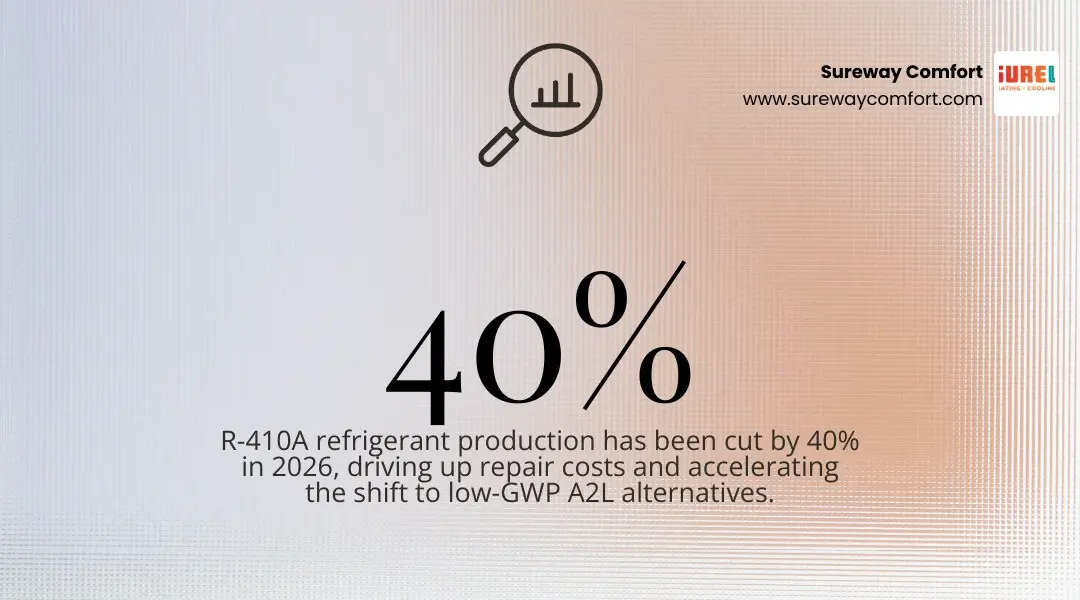
- Tip 3: Watch out for rising repair costs. R-410A production has been cut by 40% in 2026, which is pushing refrigerant prices up significantly.
- Tip 4: Avoid the retrofit trap. New A2L refrigerants are not compatible with older R-410A equipment — the pressures, lubricants, and safety components are completely different.
- Tip 5: Leverage the efficiency gains. A2L systems run roughly 10 to 15 percent more efficiently than the R-410A units they replace, which means lower monthly utility bills.
- Tip 6: Understand the new safety features. Modern A2L equipment includes automatic leak detection sensors and mitigation boards designed to keep your home safe.
If you are a homeowner in the Bridgeville, PA area trying to figure out whether to repair your current system or plan for a new one, these tips and tricks will help you make the most informed decision possible.
Understanding the 2025-2026 HVAC Refrigerant Shift
To understand why your next cooling system will look and run differently, we have to look at the federal regulations driving this change. The environmental transition is governed by the American Innovation and Manufacturing (AIM) Act of 2020. This federal law granted the Environmental Protection Agency (EPA) the authority to phase down the production and consumption of hydrofluorocarbons (HFCs) — the chemical compounds historically used as air conditioning refrigerants.
The primary metric used by the EPA to evaluate these substances is Global Warming Potential (GWP). Carbon dioxide has a baseline GWP of 1. By comparison, R-410A (the standard refrigerant used in almost all residential air conditioners for the past two decades) has a GWP of 2,088. This means releasing a single pound of R-410A into the atmosphere has the equivalent climate impact of burning over a thousand pounds of coal.
To address this, the EPA implemented a strict technology transition timeline:
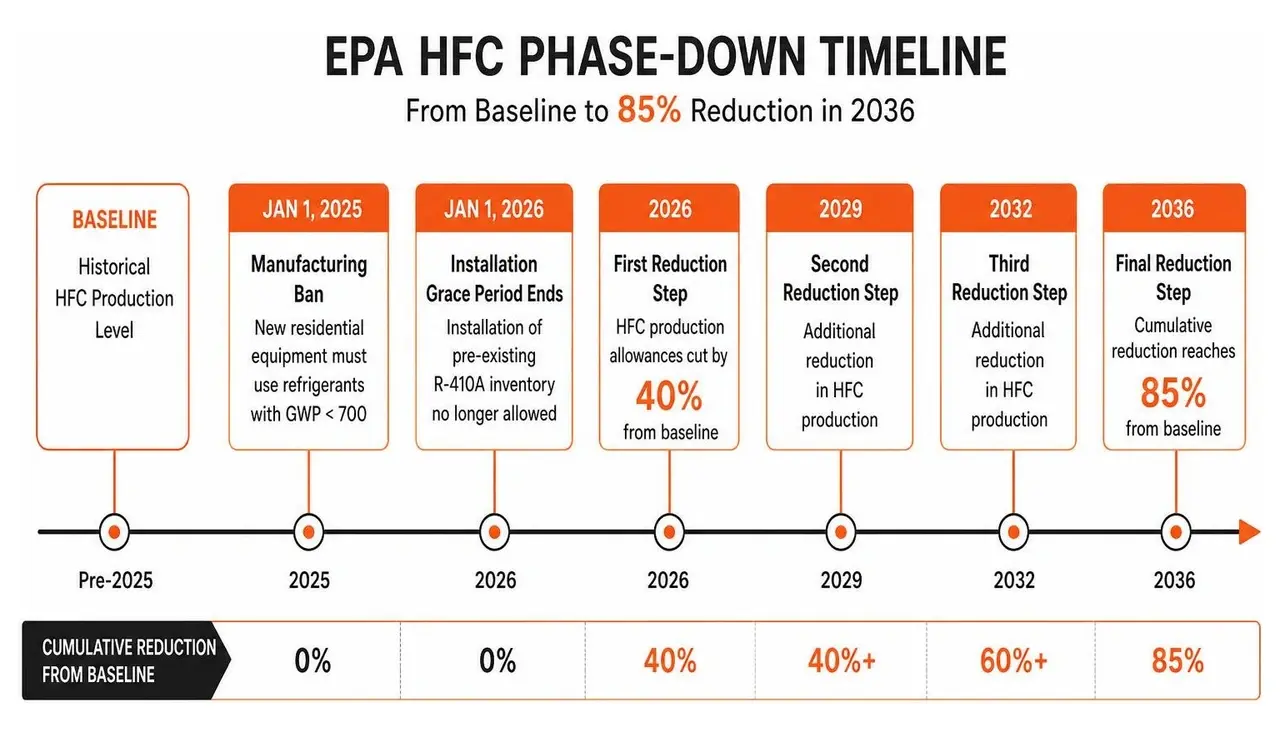
- The Manufacturing Ban: As of January 1, 2025, manufacturers were prohibited from producing new residential central air conditioners or heat pumps that utilize refrigerants with a GWP of 700 or greater.
- The Installation Grace Period: The EPA allowed a temporary grace period to install pre-existing R-410A equipment inventory. However, that grace period officially ended on January 1, 2026.
- The Production Phase-Down: We are currently in July 2026, which means R-410A production allowances have already been slashed by 40% compared to historical baselines. The EPA's schedule mandates a continuous step-down, culminating in an 85% total reduction in HFC production by 2036.
If you are currently evaluating your home comfort setup, you might be asking yourself: Should You Replace Your Aging AC? The answer depends heavily on how these production cuts are squeezing the supply of older refrigerants. As supply dwindles and demand remains high for older systems, the cost of servicing legacy units will continue to climb.
How the Refrigerant Transition Affects Your Next AC Purchase
If your current air conditioner is on its last legs, shopping for a new system in July 2026 means navigating a completely different market than you would have a few years ago. How the refrigerant transition affects your next AC purchase comes down to the technology under the hood of modern equipment.
The industry has standardized around a class of refrigerants known as A2L. The designation "A2L" comes from the safety classification system established by ASHRAE (the American Society of Heating, Refrigerating and Air-Conditioning Engineers):
- "A" indicates low toxicity (safe for residential indoor environments).
- "2L" indicates mild flammability, meaning the gas is difficult to ignite and has a low flame propagation speed.
The two primary A2L refrigerants replacing R-410A are R-454B and R-32.
When you purchase a new system, you must replace both the outdoor condenser and the indoor evaporator coil as a fully matched system. In the past, some homeowners tried to save money by replacing only the outdoor unit while keeping an older indoor coil. With the transition to A2L refrigerants, this is no longer physically or legally possible. Because A2L refrigerants operate under different pressures and require different synthetic polyolester (POE) lubricants, mixing components will destroy the compressor, void your manufacturer warranty, and violate local building codes.
To ensure your home remains comfortable and code-compliant, you will need to plan for a complete, Efficient AC Replacement that upgrades all connected components simultaneously.
Long-Term Benefits: How the Refrigerant Transition Affects Your Next AC Purchase
While a regulatory shift can feel overwhelming, the transition to A2L equipment brings major long-term advantages to your household. The thermodynamic properties of R-454B and R-32 are vastly superior to R-410A. They are much more efficient at transferring heat, which means your system doesn't have to work as hard to cool your home.
The physical benefits include:
- Superior Energy Efficiency: Systems designed around R-32 can achieve up to a 12% efficiency boost, while systems built for R-454B offer an 8% to 10% improvement. Overall, new A2L systems run 10% to 15% more efficiently than their R-410A predecessors.
- Lower Utility Bills: Because these systems require less electricity to move heat out of your home, you will notice immediate savings on your monthly cooling bills.
- Reduced Component Wear: Superior heat transfer reduces physical strain on the compressor. This helps prevent premature breakdowns and can extend the overall lifespan of your equipment.
- Shorter Atmospheric Lifetime: R-410A persists in the atmosphere for about 17 years if leaked. R-454B has an atmospheric lifetime of only 3 years, and R-32 lasts about 5 years, dramatically reducing their long-term environmental footprints.
Investing in a modern A2L system is the most practical path toward lowering your home's carbon footprint while locking in lower operating costs. When you weigh the math of repairing an older system versus upgrading, the utility savings of a new unit often tilt the scale. You can read more about how these operational savings offset upfront costs in our guide on AC Repair vs. New Unit: Long-Term Savings.
Inventory and Timing: How the Refrigerant Transition Affects Your Next AC Purchase
Because the EPA's installation grace period for R-410A equipment ended on January 1, 2026, distributors in Pennsylvania have largely depleted their remaining stock of legacy systems. Any contractor offering you a "deal" on a brand-new R-410A system in July 2026 is likely trying to sell non-compliant, obsolete inventory.
Proactive planning is crucial. If your air conditioner is more than 12 to 15 years old, waiting for a complete system failure in the middle of a humid July heatwave puts you in a difficult position. Emergency replacements limit your ability to research equipment, compare options, and secure financing. By planning your upgrade proactively, you can ensure your home's ductwork and electrical infrastructure are properly evaluated for the new A2L equipment.
Additionally, proper system sizing is critical with modern variable-speed A2L units. An oversized system will cycle on and off too quickly, failing to properly dehumidify your home during our sticky Pennsylvania summers. Before purchasing, it is highly recommended to consult our resource on What Size AC Unit is Right for Your Home? to ensure your new system is perfectly matched to your property's layout.
Safety and Efficiency: What to Expect from A2L Systems
Because A2L refrigerants carry a "mildly flammable" classification, manufacturers have engineered advanced safety protocols directly into the design of modern air conditioners and heat pumps. To put this classification into perspective, many everyday household items — including hairspray, rubbing alcohol, aerosol cooking sprays, and the natural gas piped into your kitchen — are significantly more flammable than R-454B or R-32. An A2L refrigerant requires a highly concentrated mixture in a confined space and a continuous, high-energy ignition source to catch fire. They are incredibly difficult to ignite, and if the ignition source is removed, the flame self-extinguishes.
To ensure absolute safety, new A2L systems feature integrated safety controls:
| Specification / Feature | Legacy R-410A | New R-454B | New R-32 |
|---|---|---|---|
| Global Warming Potential (GWP) | 2,088 | 466 (78% reduction) | 675 (68% reduction) |
| ASHRAE Safety Class | A1 (Non-flammable) | A2L (Mildly flammable) | A2L (Mildly flammable) |
| Atmospheric Lifetime | ~17 Years | ~3 Years | ~5 Years |
| Relative Efficiency Gain | Baseline | 8% to 10% Increase | 10% to 12% Increase |
| Leak Detection (RDS) | Not Required | Mandatory (Integrated Sensors) | Mandatory (Integrated Sensors) |
| Mitigation Controls | None | Mandatory (Blower Activation) | Mandatory (Blower Activation) |
Modern indoor fan coils now come equipped with highly sensitive Refrigerant Detection Systems (RDS) and specialized mitigation boards. If a sensor detects even a minor refrigerant leak within the indoor coil, the system automatically triggers a safety sequence:
- It immediately shuts down the outdoor compressor to stop the flow of refrigerant.
- It activates the indoor blower fan at 100% capacity.
- By continuously circulating air through your home's ductwork, the system safely dilutes the escaping gas well below any concentration level that could pose a safety hazard.
These smart safety features ensure that an A2L system is just as safe to operate in your home as any older appliance.
Navigating the Choice: Repairing R-410A vs. Upgrading to A2L
When your existing R-410A system experiences a breakdown, you face a tough choice: do you pay for a repair, or do you upgrade to a modern A2L system?
The decision-making process often comes down to the type of breakdown and the age of your equipment. If your system is less than 10 years old and has a simple electrical issue — like a failed capacitor or a bad contactor — repairing the unit is usually the most sensible choice.
However, if your older system has a refrigerant leak, the financial math changes dramatically. Because the federal government has cut R-410A production by 40% as of 2026, the wholesale cost of R-410A has surged over the last two years and is projected to keep climbing. Topping off a leaking system is no longer a viable long-term strategy; it is like putting air into a tire with a rusty nail stuck in it. You will find yourself paying for expensive, scarce refrigerant year after year without solving the underlying problem.
If you are facing a major component failure — such as a cracked evaporator coil or a seized compressor — on a system that is over 12 years old, investing in a repair is often an expensive gamble on obsolete technology. For a detailed breakdown of how to evaluate these scenarios, check out our Ultimate Repair or Replace AC Guide.
Frequently Asked Questions about the Refrigerant Transition
Can I retrofit my existing R-410A system to use R-454B or R-32?
No, you cannot retrofit an older system. R-454B and R-32 operate under different pressures and require specific synthetic POE lubricants that are incompatible with older R-410A compressors. Additionally, legacy systems lack the mandatory electronic mitigation boards, wiring, and integrated leak-detection sensors required by law for A2L refrigerants. Attempting to cross-charge or retrofit an older unit will ruin the equipment, void your warranty, and create serious safety hazards.
Is it still legal to repair my current AC using R-410A?
Yes, it is entirely legal to service, repair, and recharge your existing R-410A system. The EPA has not banned the use of R-410A, nor have they mandated that homeowners replace working units. However, because the production of R-410A is being phased down, the cost of the refrigerant gas will continue to rise as supply tightens.
What should I ask a contractor before buying a new system in 2026?
When shopping for a new air conditioner or heat pump in 2026, we recommend asking your contractor the following questions:
- Will you perform a full Manual J load calculation to ensure the new system is sized correctly for my home's layout?
- Does the written quote include a fully matched system, replacing both the outdoor condenser and the indoor evaporator coil?
- Will you pull all required local municipal permits for the installation?
- What specific manufacturer warranties and local utility rebates apply to this new A2L equipment?
- Do you offer flexible financing options to help manage the investment?
Conclusion
The 2026 refrigerant transition is a major milestone for home comfort, but it doesn't have to be a source of stress. By phasing out older gases and adopting highly efficient, safer A2L systems, homeowners can enjoy lower utility bills, reliable performance, and a cleaner environment.
At Sureway Comfort, we are proud to serve our neighbors throughout Bridgeville, McDonald, Mt Lebanon, Bethel Park, Canonsburg, Collier, South Fayette, Upper St. Clair, Carnegie, Green Tree, Scott Township, Brookline, and Oakdale. Our experienced team is dedicated to providing honest diagnostics, streamlined installations, responsive scheduling, and flexible financing options to keep your home comfortable in every season.
If you have questions about your current system's health or are ready to explore your options for a modern, energy-efficient cooling upgrade, we are here to help. Contact us today to schedule a personalized home comfort consultation on our Air Conditioning Services Page.
Need Service?
Family owned · once & done · phones answered 24/7 across the South Hills of Pittsburgh.
(412) 643-4118 Schedule ServiceMore Services
Ready to Do It Right With Sureway?
Request a quote, schedule HVAC service, or ask about HVAC and plumbing project financing across the South Hills of Pittsburgh.