

Are You Talking to a Real Dispatcher or Just an Answering Service?
How do you know how to verify your plumber is actually available for 24-hour furnace repair when you are shivering in the dark? Is the voice on the other end of the line actually in your zip code, or are they sitting in a call center three states away reading from a script? Waking up to a freezing house during an unexpected September early fall cold snap is stressful enough on its own. At Sureway Heating Cooling Plumbing, we have fielded countless frantic calls from Bridgeville residents who previously wasted hours on an out-of-state answering service that had absolutely no power to send a technician to their door.
You need to figure out within the first 60 seconds of that emergency phone call whether the person on the other end can dispatch a local professional immediately, or if they are simply taking a message for the next business day. When the temperature drops rapidly, you need reliable heating services and responsive 24-hour HVAC and plumbing services to protect your home. Unfortunately, many national directories and large-scale home service aggregators advertise "24/7 availability" when they really just mean "we answer the phone 24/7."
The person answering your call might be polite, professional, and empathetic, but if they cannot see a technician's GPS location or access the on-call schedule, they cannot help you tonight. Your goal is to cut through the pleasantries and establish exactly who you are talking to. By asking the right questions immediately, you can avoid wasting precious hours waiting for a call back that isn't coming until the sun comes up.
The 60-Second Phone Test: Questions to Ask for 24 Hour Furnace Repair
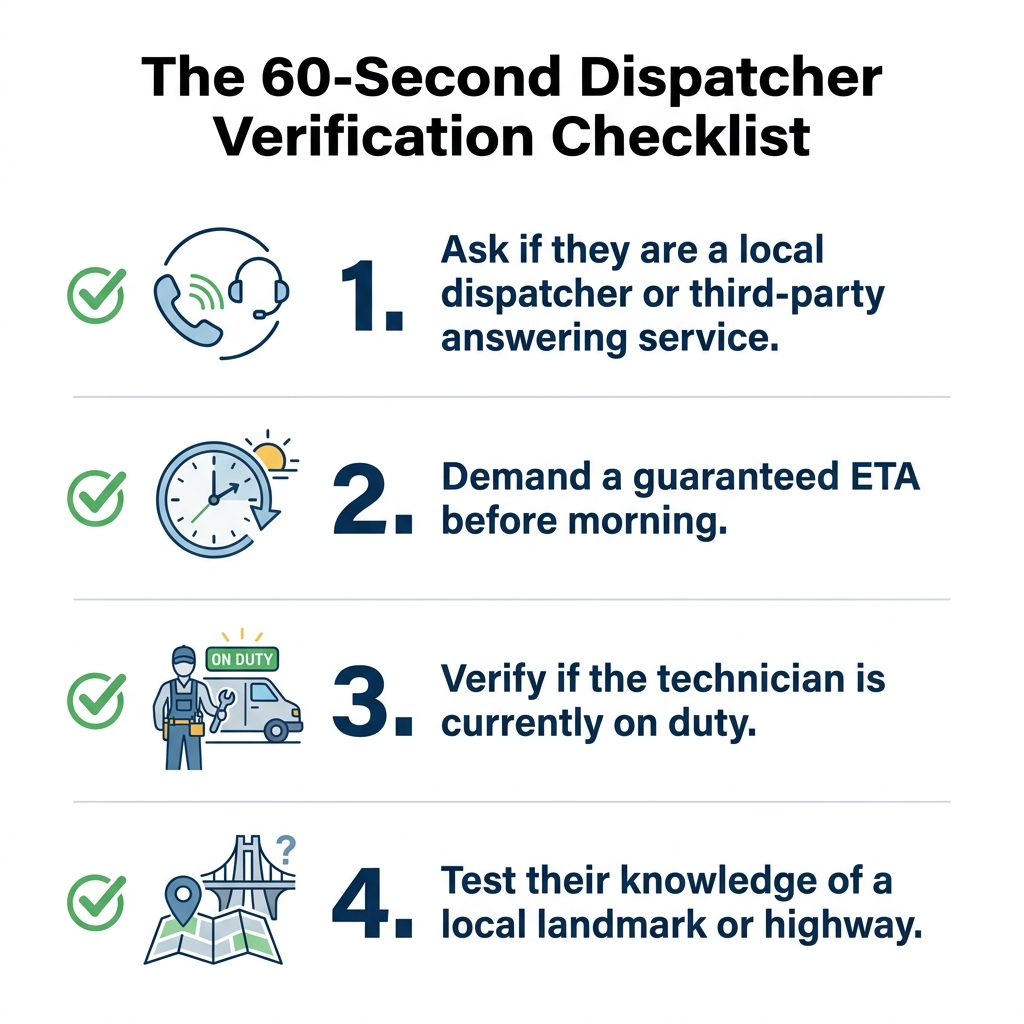
When you are searching for 24 hour furnace repair, you do not have time for vague answers. The moment a representative picks up the phone, you need to take control of the conversation. Do not wait for them to ask you for your name, address, and life story before you determine if they can actually help. Instead, use this quick, direct checklist to vet the dispatcher immediately.
• Ask directly about their location: "Are you a local dispatcher sitting in the local office, or are you a third-party answering service?" A real dispatcher will readily tell you their local city or neighborhood. An answering service will usually dodge the question or admit they are a national call center.
• Demand a specific timeline: "Can you guarantee a technician will arrive at my house before morning?" If they use the word "should" or "might," that means they do not have direct control over the technician's schedule.
• Verify the technician's status: "Is the technician currently awake and on duty, or will you have to page someone and hope they wake up?" Dedicated local companies have technicians scheduled for night shifts. Answering services just send automated pages to sleeping contractors.
• Test their local knowledge: Ask a quick question about a local landmark or highway. "Will your tech be taking Interstate 79 to get here?" If they are confused by basic local geography, you are definitely talking to an out-of-state call center.
Red Flag Answers to Watch Out For
Even if you ask the right questions, an experienced call center representative will try to keep you on the line. In our years of providing emergency services across Western Pennsylvania, our team has learned the exact phrases these third-party services use to stall you, which almost always indicate that no one is coming to fix your furnace tonight:
• "I can take a message for the morning team." This is the ultimate admission that they are an answering service. Hang up and call someone else.
• "I will page the technician, but I cannot guarantee they will answer." This means the company does not have a dedicated night-shift technician; they are just hoping an off-duty employee decides to pick up their phone.
• "We do not have access to their schedule right now." A real dispatcher always knows exactly where their technicians are and what they are doing. If the person on the phone cannot see the schedule, they cannot put you on it.
Spotting the Stalling Scripts of Third-Party Call Centers
Third-party call centers are highly trained in customer de-escalation. Their primary job is not to fix your heating system; their job is to calm you down, get your contact information, and convince you that waiting until regular business hours is perfectly fine. When a sudden September early fall cold snap hits, these call centers get flooded with panicked homeowners, and they rely on specific scripts to manage the volume.
At Sureway Heating Cooling Plumbing, we maintain a genuine local presence with dedicated on-call technicians who live and work in the same Bridgeville community you do. A pattern we see often during a sudden fall chill is panicked homeowners being given the runaround by national chains. We do not use out-of-network call centers to stall our customers. When you call a true local expert, the conversation is focused on solving the problem immediately, not delaying it. If you know the signs you need furnace repair now, you need a team that takes those signs seriously.
Here is how to tell the difference between a stalling script and a real dispatcher:
• Response to "My heat is out" — Answering Service (Stalling): "I'm so sorry to hear that. Let me get your name and number for the morning crew." — Real Local Dispatcher (Action): "Okay, I see a technician finishing a call nearby. Let's get your address."
• Arrival Time Estimates — Answering Service (Stalling): "Someone will reach out to you as soon as possible tomorrow." — Real Local Dispatcher (Action): "The technician is about 45 minutes away. I'll have them call you when they are en route."
• System Troubleshooting — Answering Service (Stalling): "I cannot provide technical advice. I just take messages." — Real Local Dispatcher (Action): "Before we send someone, let's verify your thermostat has fresh batteries and the breaker isn't tripped."
• Pricing and Fees — Answering Service (Stalling): "I don't have access to the emergency dispatch rates." — Real Local Dispatcher (Action): Clearly explains the after-hours dispatch process and what to expect upon arrival.
If the person you are speaking with falls into the "stalling" category, politely end the call. Your home is losing heat by the minute, and you cannot afford to wait for a company that is only pretending to be open.
Why Next-Day Service is Dangerous During a Bridgeville PA Cold Snap
Many homeowners underestimate how quickly a house loses heat when the furnace fails. Our technicians frequently see the aftermath of delayed service. You might think that throwing on an extra blanket is enough to get you through the night, but the danger extends far beyond personal discomfort. An unexpected September cold snap in Western Pennsylvania can rapidly drop indoor temperatures, making next-day service unacceptable and potentially dangerous for your home's infrastructure.
The physics of heat loss dictate that your home will equalize with the outside temperature much faster than you anticipate. If the temperature outside in Bridgeville PA drops into the low 30s or 20s, the inside of your home will follow suit within a matter of hours. Once the interior temperature of your home falls below 55 degrees Fahrenheit, the water sitting inside your exterior wall pipes is at severe risk of freezing.
The cascading effects of a frozen home:
When pipes freeze, the water inside expands, putting immense pressure on copper, PVC, and PEX lines. A single burst pipe can release hundreds of gallons of water into your walls, ceilings, and floors before you even realize what has happened. What started as a simple heating failure suddenly becomes a catastrophic water damage event.
Furthermore, early fall weather is notoriously unpredictable. Systems that have sat dormant all summer are suddenly forced to work at maximum capacity, catching un-serviced units off guard. Waiting for next-day business hours is an unacceptable risk. We always advise our customers that restoring heat is a race against the clock to protect your drywall, your plumbing, and your family's safety.
Can an Emergency Plumber Fix Your Furnace?
When searching for 24 hour furnace repair, you might be surprised to see plumbing companies appearing in your search results. This often leads to confusion—can an emergency plumber actually fix a broken heating system? The short answer is yes, provided they are part of a comprehensive, dual-trade local company that employs cross-trained experts.
While plumbing and HVAC are distinct trades, many reputable local companies operate dual divisions because the systems in your home are deeply interconnected. This is especially true if your home utilizes a boiler system, radiant floor heating, or a water-source heat pump. These systems require a professional who understands both complex piping mechanics and advanced heating technology.
Our team typically sees this pattern in older Bridgeville neighborhoods. During a recent early fall cold snap, we helped a local customer who faced a situation where they needed a new furnace, but their older home also presented severe, simultaneous plumbing issues. Our cross-trained team at Sureway Heating Cooling Plumbing arrived, assessed the entire structure, and provided thoughtful, creative solutions that resolved both the heating failure and the aging pipe challenges in one comprehensive visit. When you call for emergency plumbing or heating help, having a team that can handle multi-trade emergencies is a massive advantage.
When You Need Both Heating and Plumbing Expertise
Older homes often present complex, overlapping system challenges that a single-trade technician might struggle to resolve. If your boiler is leaking water across the basement floor while simultaneously failing to heat your radiators, you do not have time to call a plumber to fix the leak and then wait for an HVAC technician to fix the burner.
A true 24-hour company will have the resources, the inventory, and the technical expertise to address these multi-trade emergencies simultaneously. When you are on the phone vetting the dispatcher, confirming that their on-call team carries credentials for both emergency plumbing and heating is a critical part of the verification process.
What to Do While You Wait for a Local Technician to Arrive
Once you have successfully navigated the phone call, verified the dispatcher, and secured a guaranteed arrival time, the panic should begin to subside. However, your job is not entirely done. While you wait for the local technician to navigate the Bridgeville PA roads, there are several safe, proactive steps you can take to protect your home and help the repair process go smoothly.
The wait is usually short when you secure a real dispatch. When our local Sureway technicians are en route to your home, we always recommend a few basic preparations. In a typical late-night emergency call during a sudden fall chill, our technicians arrive swiftly after the initial dispatch, diagnose the issue, rebuild failing components on the spot, and fully restore the furnace. To help our team—or any true local technician—achieve similar results, follow these steps:
1. Lock down your home's heat: Keep all exterior doors and windows tightly closed. Close the doors to unused guest rooms or storage areas to concentrate the remaining heat in your primary living spaces. Do not continuously open the front door to check if the technician has arrived; wait for their phone call.
2. Clear the mechanical room: Technicians need space to work. Go to your basement or utility closet and clear away any boxes, storage bins, or laundry baskets that are sitting near the furnace. The technician needs immediate, unobstructed access to the cabinet the moment they walk in the door.
3. Check the simple fixes: While you should never attempt a DIY repair, you can check the absolute basics safely. Verify that the thermostat has fresh batteries and is set to "Heat." Check your main electrical panel to ensure the breaker dedicated to the furnace hasn't simply tripped.
4. Keep your hands out of the cabinet: Do not attempt to open the furnace cabinet, bypass safety switches, or reset flame roll-out sensors. Modern furnaces are highly complex machines dealing with combustible gas and high voltage. Tampering with the system is incredibly dangerous and can make the technician's diagnostic job much harder.
Frequently Asked Questions About Emergency Heating Responses
What counts as a furnace emergency?
A furnace emergency is any situation where your heating system fails during freezing weather, posing a risk to your health or your home's pipes. If you smell gas, see sparks, or notice smoke coming from the vents, that is an immediate emergency requiring you to evacuate and call for help. Sudden, loud grinding noises or a complete loss of heat when the outdoor temperature is dropping rapidly also qualify for immediate 24 hour furnace repair dispatch.
How long should it take for emergency HVAC to arrive?
A genuine local emergency HVAC technician should typically arrive at your home within one to three hours of your initial phone call, depending on road conditions and current call volume. If a dispatcher tells you it will take more than six hours, or if they push the appointment to the next morning, they are not providing true emergency service. Always demand a clear estimated time of arrival before ending the call.
How do I know if an emergency HVAC company is actually open?
You know a company is actually open if the person answering the phone can immediately tell you the status of their on-call technicians and provide a firm dispatch window. If the representative says they "only take messages after hours" or cannot access the scheduling system, the business office is closed. True 24/7 companies maintain active, awake dispatchers and technicians all night long.
Do plumbers fix furnaces in an emergency?
Yes, many professional plumbers are cross-trained in HVAC repair, particularly if they work for a comprehensive home services company. This is especially common with boiler systems, radiant heating, and water-source heat pumps, which require extensive knowledge of both water piping and heating mechanics. Always verify that the responding technician is licensed for the specific type of heating system in your home.
What to ask when calling for 24 hour furnace repair?
The most important thing to ask is whether you are speaking to a local dispatcher or a national answering service. Follow up by asking if the technician is currently on duty and awake, and demand a guaranteed arrival time before morning. These direct questions will immediately reveal if the company has the actual capability to send help to your home tonight.
Can a sudden fall cold snap cause pipes to freeze if the furnace is broken?
Yes, an unexpected early fall cold snap can absolutely cause pipes to freeze if your home loses its primary heat source. Because homes are not usually fully winterized in early fall, a rapid drop in outdoor temperatures can cause the interior of the home to plummet quickly. Once the indoor temperature falls below 55 degrees, exterior wall pipes become highly vulnerable to freezing and bursting.
Connect With a Genuine Local Expert Tonight
Learning how to verify your plumber is actually available for 24-hour furnace repair is the single most important step you can take when your heat fails in the middle of the night. There is an immense peace of mind that comes from reaching a real, local dispatcher who understands the urgency of your situation and has the authority to send help immediately. You do not have to settle for an answering service that leaves you shivering and guessing until morning.
The next time you face a sudden heating failure, use the 60-second verification checklist to take control of the phone call. Demand clear answers, verify their local presence, and ensure a technician is actually on duty. If your system is struggling to keep up with the cold, do not wait for a complete breakdown. Reach out to our genuine local experts at Sureway Heating Cooling Plumbing to schedule a comprehensive inspection, or request immediate emergency dispatch if your home is already losing heat.



.svg)
.avif)


