


The Mid-Afternoon Cooling Collapse
Summer is bearing down, and the July peak afternoon sun is absolutely relentless. At 9:00 AM, your house feels crisp, comfortable, and perfectly balanced. But by 3:00 PM, the environment shifts completely. You find yourself sweating in your own living room, staring at a thermostat that keeps climbing higher no matter how low you set the temperature. If you are searching online to figure out why your ac blows warm air only during the hottest part of the day, you are certainly not alone.
This mid-afternoon cooling collapse is one of the most frustrating experiences a homeowner can face. It triggers immediate panic. You wonder if your compressor has completely failed, if you have a massive refrigerant leak, or if you need to call for a costly emergency repair. The good news is that a system struggling specifically during peak afternoon hours is often dealing with a systemic capacity issue rather than a catastrophic mechanical failure. Understanding the physical forces at play can help you make the right decisions for your home.
Before the heat gets worse, establishing a baseline with professional air conditioning services and staying on top of routine HVAC maintenance is the best way to ensure your system survives the summer.
The 20-Degree Design Limit: How Hot is Too Hot?
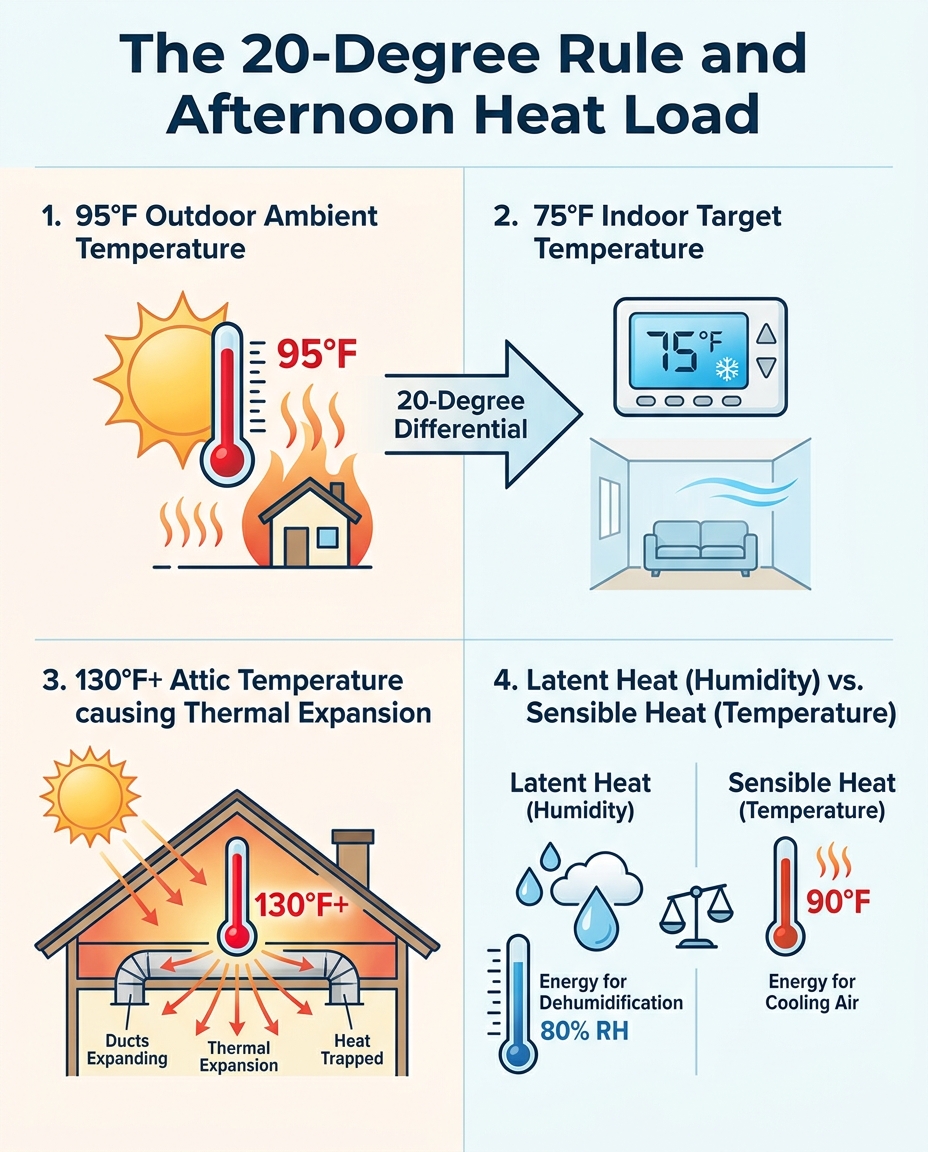
To understand why your system struggles in the late afternoon, we have to look at the foundational physics of residential air conditioning. Most homeowners believe that an air conditioner can cool a house to any temperature they choose, regardless of the weather outside. The reality is much different. According to standard design limits set by the Department of Energy and industry guidelines, standard residential cooling systems are designed to maintain a 20-degree temperature differential between the outdoor environment and the indoor air.
The Capacity Problem: When the July peak afternoon sun pushes the outside temperature to 95 degrees or higher, your air conditioner is working at its absolute maximum design capacity to keep your home at 75 degrees. If the temperature climbs to 100 degrees, the system will physically struggle to drop the indoor temperature below 80 degrees.
The Continuous Run Cause: Pushing beyond this 20-degree limit forces your compressor to run continuously. It never cycles off because it can never reach the ambitious 70-degree or 72-degree set point you have entered into the thermostat. The equipment is pulling as much heat out of the house as it physically can, but the heat is entering the home faster than the system can remove it.
The Airflow Solution: When you place your hand over the vent at 4:00 PM, the air coming out might feel less cold than it did in the morning. It isn't actually blowing "warm" air from a broken compressor. It just feels warmer because the system cannot overcome the extreme ambient heat load surrounding the house. A system struggling under a heavy peak load does not automatically mean the equipment is dead—it means it has reached its physical limit.
• 85°F — Maximum Expected Indoor Cooling Target: 65°F - 68°F — System Behavior: Normal cycling, easily meets thermostat setting.
• 90°F — Maximum Expected Indoor Cooling Target: 70°F - 72°F — System Behavior: Longer cycles, consistent cooling performance.
• 95°F — Maximum Expected Indoor Cooling Target: 75°F — System Behavior: Continuous running, reaching maximum design limit.
• 100°F+ — Maximum Expected Indoor Cooling Target: 80°F+ — System Behavior: Struggling to keep up, indoor temperatures will rise.

Thermal Expansion and the Hidden Ductwork Crisis
While the 20-degree rule explains the limitations of the condenser sitting outside, another major physical reaction is happening right above your head. The attic is one of the most hostile environments in a home during the summer. Even on a mildly hot day, the trapped air inside an unconditioned attic can easily exceed 130 degrees. This creates a severe hidden crisis for your ductwork.
The physics of thermal expansion dictate that materials expand when heated and contract when cooled. Your home's ductwork is largely made of sheet metal. As the attic temperature skyrockets in the afternoon, the metal ducts expand. When the sun goes down, they contract. Over years of this daily expansion and contraction cycle, the mastic sealant, tape, and mechanical joints holding your ductwork together begin to crack, peel, and break apart.
When these seals fail, the consequences for your indoor comfort are immediate. The system's blower motor creates negative pressure in the return ducts. If there is a crack in a return duct located in a 130-degree attic, the system will actively suck that scorching hot, dusty air directly into your air conditioner. The equipment then has to try and cool 130-degree air down to 55 degrees before blowing it into your living room—an impossible task.
Alternatively, supply duct leaks will pump the cold, conditioned air you are paying for straight into the attic before it ever reaches your living space. This is a primary reason why you might notice your ac blowing warm air specifically during the afternoon when the attic is at its absolute hottest. The equipment outside might be working perfectly, but the delivery system inside is completely compromised by thermal expansion.
Latent vs. Sensible Heat: The Humidity Factor
Temperature is only half of the cooling equation. To truly understand why an air conditioner loses ground in the late afternoon, you have to look at how moisture affects the refrigeration cycle. In the HVAC industry, we measure two distinct types of heat: sensible heat and latent heat.
Sensible heat is the actual temperature reading you see on your thermostat. It is the heat you can "sense" or feel. Latent heat, on the other hand, is the thermal energy hidden inside airborne moisture—otherwise known as humidity. An air conditioner does not just cool the air; it conditions it. To drop the sensible temperature of a room, the system's evaporator coil must first condense and remove the latent heat (moisture) from the air.
Bridgeville PA's humid summer climate means AC units are fighting a two-front war against both intense afternoon sun and heavy airborne moisture. When peak afternoon humidity rolls in, your condenser is forced to work overtime acting as a giant dehumidifier. The system expends a massive amount of its total energy capacity just trying to wring the water out of the air.
Until that latent heat is removed, the system severely limits its ability to drop the sensible room temperature. The air coming from the vents will feel clammy and less cool. This dual burden of high temperatures and thick humidity is exactly why systems that perform flawlessly in the dry morning air suddenly hit a brick wall when the muggy afternoon weather peaks.
Diagnosing the Symptoms: Capacity Limit or Mechanical Failure?
When the house is 82 degrees and the family is miserable, it is hard not to assume the worst. However, providing actionable diagnostic context can help you differentiate between a system that is simply struggling against a capacity limit and one that is actually broken.
Here is how you can evaluate the symptoms before making an emergency phone call:
• The Morning Test: Check the system's performance at 9:00 AM. If the air coming from the vents is ice cold and the house easily reaches your target temperature in the morning, the system still has its refrigerant charge and the compressor is functioning. The afternoon failure is likely a capacity limit, heat load issue, or ductwork problem.
• Short-Cycling: If the outdoor unit turns on for two minutes, shuts off abruptly, and turns back on five minutes later, this is a mechanical issue. It indicates the system is protecting itself from overheating or dealing with severe electrical faults.
• Strange Noises: A system struggling with heat load will sound like it normally does, just running longer. If you hear grinding, screeching, or loud buzzing, a motor or capacitor is likely failing under the strain.
• Frozen Evaporator Coils: If you see ice building up on the copper lines outside or the indoor coil, turn the system off immediately. This indicates a severe airflow restriction or a low refrigerant level, not just a hot day.
If the system goes completely dead, knowing what to check first if your AC won't turn on (like a tripped breaker or a clogged filter) can save you a lot of stress. Sometimes it is a total failure—one local homeowner reached out during the summer when they needed a new central air conditioning unit installed because their old system had completely failed. Our team worked to get the new unit installed in a timely manner, successfully restoring their home's comfort.
However, Sureway Heating Cooling Plumbing's expert technicians focus heavily on educating the homeowner and accurately diagnosing the root cause. We want to determine if you are dealing with a capacity issue or a true mechanical failure, rather than just pushing for a fast replacement when a targeted repair or duct sealing would solve the problem.
Strategic Solutions to Reduce Afternoon Heat Load
If your system passes the morning test but still loses the battle every afternoon, there are several strategic steps you can take to help the equipment survive the peak temperatures. These methods reduce the thermal load on the house, giving the air conditioner a fighting chance.
1. Pre-cooling the home: Think of your house as a thermal battery. Instead of waiting until 2:00 PM to lower the thermostat, set it a few degrees lower than normal in the early morning. This cools the furniture, walls, and flooring, building a reserve of cold air that takes much longer for the afternoon heat to penetrate.
2. Managing solar heat gain: The July peak afternoon sun radiating through glass acts like a magnifying glass for your living room. Close all blinds, shades, and thermal curtains on west-facing and south-facing windows before you leave for work in the morning. Stopping the radiant heat before it enters the room drastically reduces the sensible heat load.
3. Professional duct inspection and sealing: Have a licensed technician evaluate your attic ductwork. They can identify areas where thermal expansion has broken the seals, repair the mastic, and ensure the ducts have proper insulation to prevent the system from drawing in 130-degree attic air.
4. Condenser shading and clearance: The outdoor unit needs to breathe to release the heat it pulls from your home. Ensure there is at least two feet of clearance around the condenser. If possible, providing shade for the unit (without blocking the top fan exhaust) can help it operate more efficiently by keeping the metal casing out of direct, punishing sunlight.
When to Consider Supplemental Cooling Upgrades
In some homes, the architectural design permanently exceeds the central air conditioner's design limits. If you have a home with a large new addition, vaulted ceilings, or excessive west-facing windows, a standard central unit may never be able to overcome the afternoon heat load, no matter how well it is maintained.
This is where targeted upgrades make a massive difference. Ductless cooling solutions are an excellent way to provide targeted relief to problem rooms without the massive expense of ripping out and replacing the entire central duct system. By adding supplemental cooling to the hottest rooms in the house, you improve overall temperature consistency, lower utility bills, and reduce the heavy strain on the primary central unit.
Upgrading specific zones is almost always more cost-effective and comfortable than simply oversizing a new central unit. An oversized central unit will cool the house too quickly and shut off before it has a chance to remove the latent heat (humidity), leaving the house feeling like a cold, damp cave. For example, after our team spent time reviewing one customer's HVAC system and educating them on specific solutions, they had a new furnace and condenser installed in January. After experiencing both the harsh winter and the hot summer, they noted their new setup provided consistent temperatures, quiet operation, and noticeable savings on utility bills. Strategic upgrades like mini split systems can provide that exact kind of tailored relief.
Frequently Asked Questions About Afternoon AC Struggles
Why does my AC blow warm air in the afternoon?
This is often due to the system reaching its maximum 20-degree temperature differential. When it is 95 degrees outside, a standard AC will struggle to cool the house below 75 degrees. Additionally, this symptom can be caused by thermal expansion opening gaps in your attic ductwork, allowing scorching hot attic air to be sucked into the system and blown through your vents.
How hot is too hot for an air conditioner?
Most standard residential units are designed for peak efficiency up to 95 degrees ambient outdoor temperature. Beyond 95 degrees, the cooling capacity physically drops, and the system must run continuously to try and keep up. While the equipment won't immediately break at 100 degrees, it will lose its ability to maintain a cool indoor temperature.
Why is my AC running but not cooling the house?
High latent heat (humidity) forces the system to dehumidify the air before it can lower the sensible temperature. If the system is running constantly but the house remains warm, it is likely expending all its energy removing moisture. Furthermore, airflow restrictions from dirty filters or failing condenser coils can prevent proper heat transfer, keeping the house warm.
Does AC struggle in extreme heat?
Yes, extreme heat increases the pressure on the compressor and reduces the condenser's ability to release heat outdoors. This is a physical limitation of the refrigeration cycle, not necessarily a broken part. The hotter the air outside, the harder it is for the refrigerant to dump the heat it absorbed from inside your home.
Should I turn my AC off if it's blowing warm air?
If the air is genuinely warm (not just less cold than usual) and the unit has been running for hours without changing the indoor temperature, turn it off at the thermostat to prevent compressor damage. Let it rest, and call a professional to diagnose whether it is a refrigerant leak, a failed capacitor, or a severe airflow blockage.
Restoring Consistent Comfort Before the Next Heatwave
Dealing with a sweltering house at 3:00 PM is incredibly frustrating, but it is a highly solvable problem. Whether the solution involves sealing aging ductwork, managing solar heat gain with better shading, or performing targeted mechanical repairs, you do not have to settle for an uncomfortable home in Bridgeville PA.
The first step to restoring your comfort is getting a clear, non-alarmist diagnosis of exactly what your system is doing under peak load. Before the next major heatwave hits, schedule a thorough inspection to evaluate your equipment's capacity and your ductwork's integrity. Taking action now ensures your family stays cool and comfortable, no matter how high the afternoon temperatures climb.



.svg)
.avif)


