


Why Your AC System Fails During the Worst Heat Waves
At Sureway Heating Cooling Plumbing, we see firsthand how the peak summer cooling season pushes systems to their absolute limits, making the decision between repairing vs. replacing an AC compressor after a hard trip a sudden, high-stakes reality. When Bridgeville's outdoor temperatures soar in July and your air conditioner is running nearly nonstop to keep up, the mechanical and electrical components inside your condenser endure massive stress. A sudden loss of cooling when you need it most is stressful enough, but when the system completely refuses to reset, the situation escalates from a minor inconvenience to a major household emergency.
To navigate this effectively, you can explore our air conditioning resources for foundational knowledge on how these systems operate under pressure.
A "hard trip" occurs when your air conditioner attempts to start, but immediately overloads the electrical circuit, causing the breaker in your electrical panel to flip off instantly. This is not a simple glitch or a minor airflow issue. A breaker tripping immediately on startup is a severe warning sign that the compressor—the "heart" of your air conditioning system—is drawing an unsafe amount of electricity. Resolving this issue requires professional insight rather than guesswork, as the correct path forward depends entirely on whether the compressor is suffering from mechanical tightness or catastrophic electrical failure. Deciding how to proceed means carefully evaluating temporary electrical bypasses against long-term mechanical replacements.
Understanding the Mechanics of a 'Hard Trip'
To understand why your air conditioner is shutting down so aggressively, you have to look at the electrical demand required to start a heavy mechanical motor. When a compressor attempts to turn on, it requires a massive surge of power to overcome the inertia of the heavy internal components. This initial surge is measured in Locked Rotor Amps (LRA).
Under normal conditions, a healthy compressor might draw 10 to 15 amps while running, but it can draw 50 to 70 amps for a fraction of a second during startup. However, if the compressor is struggling to turn—either because the internal bearings are wearing out or the motor has seized entirely—that startup surge extends too long. The compressor begins pulling 5 to 7 times its normal running current for a sustained period. When your electrical panel detects this massive, sustained draw, the breaker trips immediately on startup to prevent the wires from overheating and catching fire.
The dangers of resetting the breaker:
• Electrical fire risks: A tripping breaker is a safety mechanism doing its job. Repeatedly forcing the breaker back on pushes dangerous amounts of current through compromised wires.
• Worsening the damage: If the compressor is only partially seized, forcing it to try and start repeatedly can permanently destroy the internal windings.
• Damage to other components: Excessive electrical surges can fry the capacitor, the contactor, and even the indoor air handler's control board.
Because a hard trip indicates a potentially dangerous electrical overload, our team strongly advises that you never attempt to bypass the safety mechanisms yourself. Instead, rely on professional AC replacement and repair services to safely measure the electrical draw and determine exactly why the motor is failing to turn.
The Reality of AC Compressor Repair Solutions
In our years of diagnosing cooling failures across Bridgeville, we find that homeowners often operate under a common misconception about what "repairing" a compressor actually entails. Unlike a car engine, an air conditioning compressor is a hermetically sealed unit. It is welded shut at the factory in a heavy steel casing. A technician cannot simply unbolt the casing, open the compressor, and replace a broken internal gear, piston, or valve.
Because internal mechanical repairs are impossible in the field, most "repairs" in this context are actually external electrical bypasses designed to force a struggling unit to start. If your system is experiencing a breaker tripping immediately on startup, our technicians are not going to rebuild the compressor; we are going to evaluate the electrical components attached to it. For a deep dive into how these external components are evaluated, understanding the process of diagnosing AC compressor failures is highly beneficial.
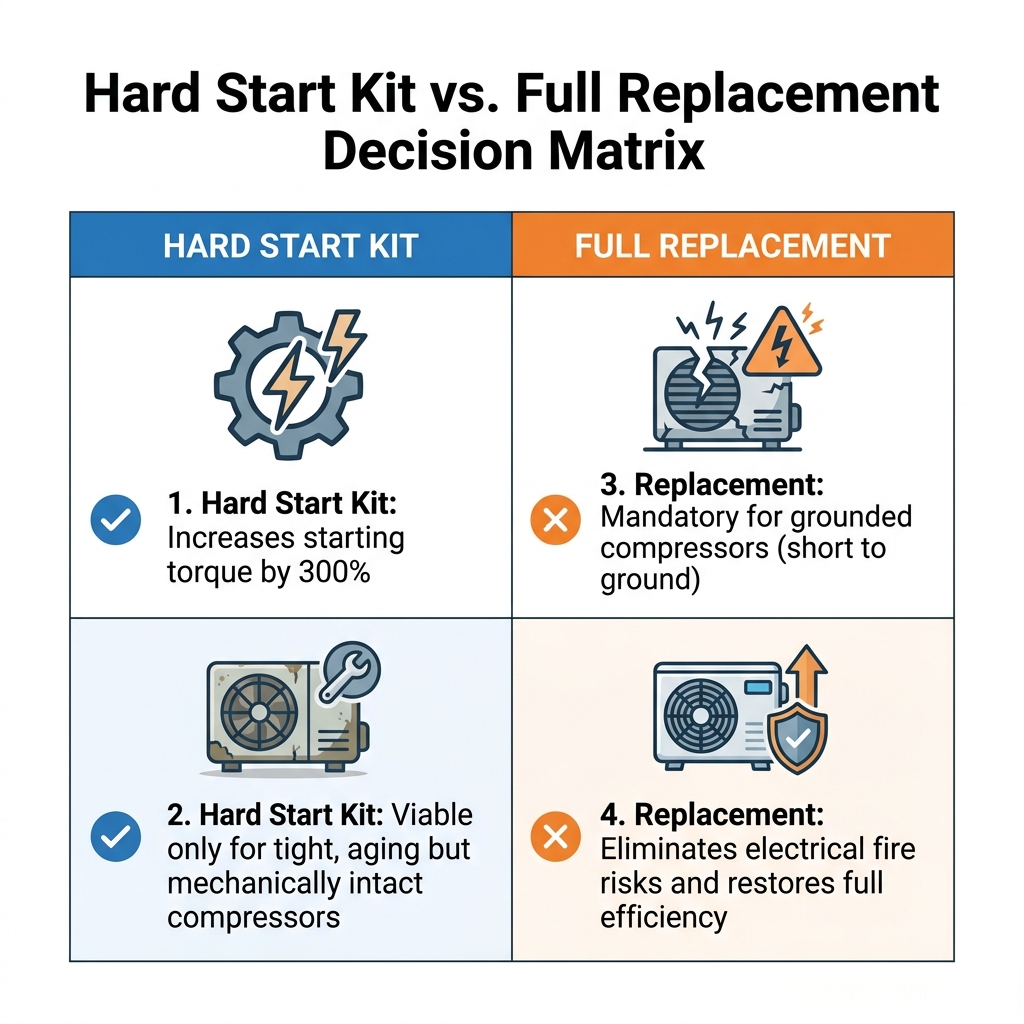
The most common electrical intervention is the installation of a hard start kit. A hard start kit is essentially a high-capacity start capacitor paired with a potential relay. When installed on the compressor's electrical circuit, this kit can increase the starting torque by up to 300%. It acts like a massive jolt of adrenaline, providing the extra rotational force needed to break a stuck compressor loose and get it spinning. However, deploying this high-voltage intervention requires highly accurate electrical diagnostics to ensure the compressor is mechanically sound enough to handle the surge without simply burning out the electrical terminals.
When a Hard Start Kit is a Viable Temporary Fix
While a hard start kit cannot rebuild a broken compressor, our technicians occasionally recommend it as an effective band-aid in specific situations where the unit is structurally intact but aging.
The Problem: Over years of operation, the internal mechanical components of a compressor can become "tight." The lubricating oil may break down, or minor wear and tear on the bearings can increase the physical resistance inside the shell. When the thermostat calls for cooling, the standard run capacitor simply cannot provide enough kick to overcome this increased mechanical resistance, resulting in a stalled motor and a spiked electrical draw.
The Cause: This tightness is a natural byproduct of age and heavy usage, particularly during the peak summer cooling season when the system cycles on and off dozens of times a day. Bridgeville's hot, humid July weather demands continuous AC runtime to manage heavy dehumidification loads, which significantly accelerates this internal wear and tear compared to systems operating in milder, drier climates.
The Solution: If our technician tests the electrical windings and confirms they are completely intact, a hard start kit can be installed to overcome the mechanical tightness. The 300% increase in starting torque forces the tight motor to turn over.
The Reality of Borrowed Time:
• It is not a permanent cure: A hard start kit does not reverse the mechanical wear inside the compressor. The bearings are still worn, and the motor is still tight.
• Lifespan is unpredictable: Depending on the severity of the wear, a hard start kit might buy you three more years of cooling, or it might only last three weeks.
• Continuous monitoring is required: Because the heavy summer heat in Bridgeville forces the system to run constantly, the "borrowed time" a hard start kit provides is often reduced. Homeowners must monitor the system closely for returning symptoms.
Grounded Compressors: Recognizing When Replacement is Mandatory
There is a massive difference between a compressor that is mechanically tight and one that has suffered a catastrophic electrical failure. When a compressor is "grounded," a hard start kit is completely useless, and replacement becomes mandatory.
A "short to ground" occurs when the protective insulation around the internal copper electrical windings breaks down or burns away. Once this insulation fails, the bare copper wire touches the internal steel casing of the compressor. Because the entire air conditioning condenser is made of metal and sits on the ground, the electricity immediately bypasses the motor and shoots straight into the metal chassis of the unit. This is a severe electrical hazard. When this happens, you will experience a breaker tripping immediately on startup every single time power is applied.
Our team at Sureway Heating Cooling Plumbing utilizes a highly transparent diagnostic approach, explaining exactly what our technicians look for so homeowners understand the "why" behind a replacement recommendation. During a recent summer service call, one local homeowner's air conditioner stopped working entirely. Our responding technician explained the diagnostic process step-by-step, taking the time to show the homeowner exactly what was happening inside the unit before fixing the system and restoring comfort.
Here is exactly how our technicians safely diagnose a grounded compressor:
1. Disconnecting all power: The technician pulls the outdoor disconnect switch and verifies with a meter that zero voltage is reaching the unit, ensuring absolute safety.
2. Isolating the compressor: The technician removes the electrical wire harness directly from the three terminals on the side of the compressor (Common, Start, and Run).
3. Testing for resistance: Using a specialized digital multimeter set to measure ohms, the technician places one probe on a compressor terminal and the other probe directly on the copper refrigerant line or the bare metal casing of the unit.
4. Reading the results: If the meter reads "O.L." (Open Line) or infinity, the insulation is intact. If the meter shows a numerical resistance value or beeps for continuity, it proves the electrical winding is touching the metal casing. The compressor is officially grounded.
You cannot put a hard start kit on a grounded compressor. Pushing more electricity into a short circuit will only result in blown fuses, melted wires, or electrical fires. In these cases, full replacement of the compressor or the entire condensing unit is the only safe and code-compliant option.
Decision Matrix: Hard Start Kit vs. Full Compressor Replacement
When you are facing a massive repair bill during the peak summer cooling season, making the right choice requires evaluating your long-term return on investment against immediate out-of-pocket costs. If your compressor is tight but not grounded, you have a choice to make.
• Upfront Investment — Installing a Hard Start Kit: Very low. A minor electrical part installation. — Full Compressor / System Replacement: High. Requires heavy labor, refrigerant recovery, and major parts.
• Long-Term Value — Installing a Hard Start Kit: Low. The underlying mechanical wear remains unfixed. — Full Compressor / System Replacement: High. Restores the system to factory-rated efficiency and performance.
• Reliability in Heat Waves — Installing a Hard Start Kit: Unpredictable. The compressor could still lock up permanently at any time. — Full Compressor / System Replacement: Guaranteed. A new unit will handle extreme temperatures reliably.
• Safety Considerations — Installing a Hard Start Kit: Safe if the windings are intact, but requires monitoring. — Full Compressor / System Replacement: Maximum safety. Eliminates all risks of aging electrical shorts.
Pros and Cons of Hard Start Kits
• Pro: Much lower immediate cost compared to a major mechanical repair.
• Pro: Can successfully extend the life of an aging but mechanically sound unit.
• Con: Highly unpredictable lifespan under heavy summer heat loads.
• Con: Does not fix the underlying wear and tear on the internal bearings.
Pros and Cons of Full Replacement
• Pro: Restores peak efficiency, lowering your monthly energy bills.
• Pro: Eliminates the safety risks of electrical shorts and failing motors.
• Con: Requires a significantly higher initial financial investment.
• Con: Requires scheduling a larger, multi-hour installation project.

Navigating the Financial Impact of an Unexpected Replacement
Finding out that your compressor is grounded and beyond the help of a hard start kit is always an unwelcome surprise. When our technician shows you the multimeter reading proving the short to ground, the immediate stress often shifts from the heat inside the house to the financial impact of the solution. However, investing in a new compressor—or choosing to upgrade the entire aging system—can yield significant long-term benefits that offset the initial shock.
Older units that are struggling to start are also struggling to run efficiently. A failing compressor draws excessive electricity not just on startup, but throughout its entire cycle. Furthermore, aging systems lose their ability to effectively remove humidity from the air. Modern air conditioning systems handle high dehumidification loads much better than failing, older units, allowing you to feel cooler at higher thermostat settings and significantly reducing your monthly energy usage during the peak summer cooling season.
When a local homeowner reached out to us last summer needing immediate assistance with their central air conditioning after a sudden, catastrophic failure, our team jumped into action. Our technician provided clear, objective options and installed a brand-new unit in a timely manner, completely resolving the home's cooling issues before the next heat wave hit. To help alleviate the immediate financial pressure of these unexpected mandatory replacements, Sureway Heating Cooling Plumbing offers flexible HVAC financing options. Manageable payment plans allow homeowners to bridge the gap and afford the safest, most reliable cooling solution without compromising their household budget.
Secure Your Home's Cooling Reliability Today
A breaker tripping immediately on startup is not a nuisance to be ignored; it is a serious warning sign that your air conditioner is experiencing a severe electrical or mechanical crisis. Whether the compressor is simply tight and requires the 300% starting torque boost of a hard start kit, or it is completely grounded and requires a mandatory replacement, knowing exactly what is wrong is the only way to move forward safely.
We recommend that you never spend money on temporary band-aids without thorough, professional electrical diagnostics from a trusted team. If your air conditioner is struggling to start, making strange noises, or continuously tripping the breaker, it is time to book a professional evaluation to restore your comfort safely. Once your system is repaired or replaced, keeping it in top shape moving forward through routine AC maintenance is the best way to prevent these sudden, high-stress failures in the future.
Frequently Asked Questions
Why does my AC compressor trip the breaker immediately?
Your AC compressor trips the breaker immediately because it is drawing an unsafe amount of electrical current on startup. This massive electrical draw, known as Locked Rotor Amps (LRA), occurs when the internal motor is either mechanically seized, extremely tight, or suffering from a catastrophic electrical short to ground. The breaker flips instantly as a safety mechanism to prevent the overloaded wires from overheating and starting an electrical fire.
Can an AC compressor be repaired?
An AC compressor cannot be mechanically repaired from the inside because it is a hermetically sealed, welded steel unit. Field technicians cannot open the casing to replace broken internal gears or valves. When the industry refers to "compressor repair," it almost always means installing external electrical components, like a hard start kit, to bypass starting issues and force a tight motor to turn over.
How long does a hard start kit last?
The lifespan of a hard start kit is highly unpredictable because it depends entirely on how badly the compressor's internal mechanics are worn. For a compressor that is only slightly tight, a hard start kit might buy you two to three more years of reliable cooling. However, if the internal bearings are severely damaged, the "borrowed time" might only last a few weeks before the motor locks up permanently.
Is it worth replacing an AC compressor on an older unit?
Replacing an AC compressor on an older unit is rarely worth the investment if the system is out of warranty and uses outdated refrigerant. The labor and parts cost to replace a compressor is exceptionally high, and placing a brand-new compressor into an aging system leaves you vulnerable to the failure of other old components, like the indoor coil or blower motor. In most cases involving units over 10 years old, putting that money toward a completely new, highly efficient system provides a much better return on investment.
What is the difference between a locked rotor and a grounded compressor?
A locked rotor means the compressor's internal motor is mechanically stuck or tight, preventing it from spinning, though the electrical wiring inside remains intact. A grounded compressor means the electrical insulation inside the motor has burned away, causing bare copper wire to touch the metal casing and create a dangerous short circuit. A locked rotor can sometimes be temporarily overcome with a hard start kit, whereas a grounded compressor is a severe hazard that requires mandatory replacement.
Can a bad capacitor cause the AC to trip the breaker?
Yes, a completely failed capacitor can occasionally cause the AC to trip the breaker, though it is less common than a compressor failure. The run capacitor provides the continuous electrical phase shift needed to keep the compressor spinning. If the capacitor fails, the compressor may stall, causing it to draw excessive Locked Rotor Amps until the breaker trips or the internal thermal overload switch shuts the system down.



.svg)
.avif)


