


The Unpredictable September Shift: Why Simply Turning on the Heat Isn't Enough
Your furnace is running, but the upstairs bedrooms still feel like an icebox while the downstairs living room is uncomfortably warm. When you encounter these frustrating cold spots, preparing your ductwork for the shift from cooling to heating is the critical missing step that most homeowners overlook. As the team at Sureway Heating Cooling Plumbing, we know from years of experience that the unpredictable September weather in Western Pennsylvania often demands a delicate balancing act—you might need cooling during a sunny afternoon and sudden heating when the sun goes down. Simply flipping the thermostat switch from "cool" to "heat" ignores the physical reality of how air moves through your home.
During the September and early fall transition, your ductwork remains physically configured for the summer months. The pathways that successfully pushed chilled air into your living spaces are not optimized for warmth. Taking the time to properly prep your ductwork and vents, rather than just ignoring poor airflow or cranking the thermostat higher, is the decision that separates a comfortable home from an inefficient one. Making these seasonal adjustments to your heating systems ensures that the warm air actually reaches the rooms where you need it most. By integrating this preparation into your routine HVAC maintenance, you can eliminate cold spots before the first freezing night of the season arrives.
The Physics of Airflow: Why Cooling and Heating Require Different Duct Strategies
The underlying problem: The ductwork settings that kept your home perfectly chilled throughout July will actively work against you in October. Many homeowners assume that ductwork is a static, one-size-fits-all delivery system. In reality, the air traveling through those metal pathways behaves entirely differently depending on its temperature. If you do not adjust your system for these physical changes, you will inevitably experience uneven temperatures and increased utility bills.
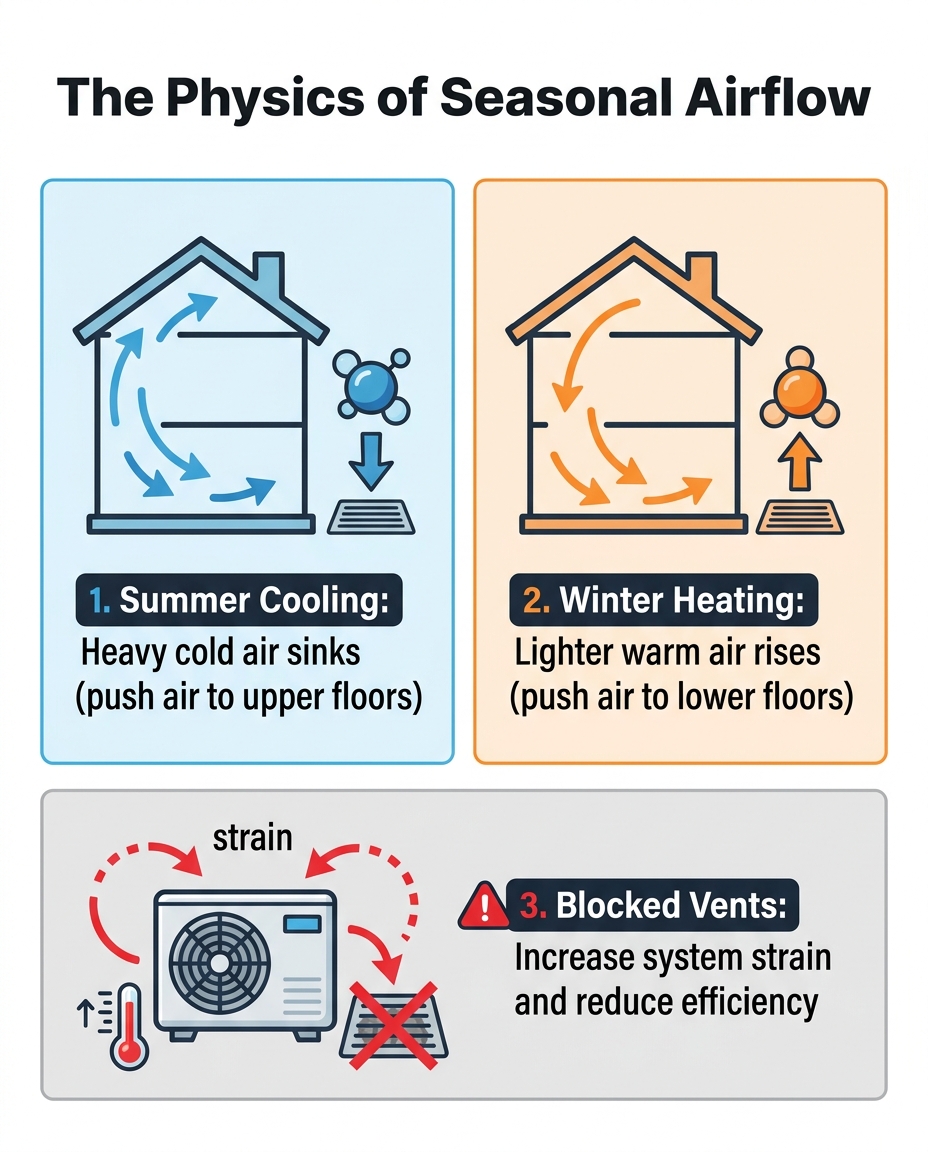
The root cause: It all comes down to basic thermodynamics. Heavy, cold air naturally sinks, while lighter, warm air naturally rises. During the summer, your air conditioning system must work hard to push heavy, dense cold air up to the second or third floors of your home. To achieve this, duct dampers are often adjusted to restrict airflow to the lower levels, forcing the maximum amount of chilled air upward. Once that cold air reaches the top floor, it naturally cascades down through the rest of the house. However, when winter arrives in the Bridgeville, PA area, the physics completely reverse. Your furnace produces lighter, warm air that desperately wants to rise. If your ductwork is still configured to force air upstairs, the second floor will become stiflingly hot, while the first floor and basement remain freezing cold.
The solution: Reconfiguring the airflow pathways allows your HVAC system to work with gravity and thermodynamics rather than fighting against them. By adjusting how air is distributed, you can force warm air to the lower levels, allowing it to naturally rise and heat the entire home evenly. Failing to make these adjustments forces your blower motor to work significantly harder, which reduces the overall efficiency of your equipment and shortens its lifespan.
How Thermodynamics Impact Your Comfort
Contrasting the behavior of conditioned air in the summer versus the fall reveals exactly why static ductwork leads to energy waste. When you leave your system in a single configuration year-round, you are essentially paying to heat the ceiling of your upper floors while your living spaces remain cold.
• Summer Cooling — Air Density: Heavy and dense — Natural Movement: Sinks to lower levels — Required Duct Strategy: Force maximum air to upper floors
• Winter Heating — Air Density: Light and buoyant — Natural Movement: Rises to upper levels — Required Duct Strategy: Direct maximum air to lower floors

Recognizing the Symptoms of Unbalanced Seasonal Airflow
Before you can fix an airflow issue, you need to know exactly what to look for. The symptoms of unbalanced ductwork often peak during the September and early fall transition, right before the system receives its seasonal tune-up. Because the weather is fluctuating, the HVAC system struggles to satisfy the thermostat, leading to a cascade of comfort issues throughout the house.
A pattern we see often during early fall tune-ups in the Bridgeville area is homeowners struggling with these exact symptoms. Recently, our technicians worked with a local family who had just invested in a new furnace and condenser installation. Despite the new equipment, they still needed our team to review their entire HVAC system to seek specific airflow solutions for their older home. The outcome of addressing the ductwork alongside the new equipment was a tremendous positive impact, providing consistent temperatures across every room and significantly saving on energy costs.
If your ductwork is still configured for summer cooling, you will likely notice several distinct warning signs:
• Freezing first floors: Because warm air naturally rises, and your summer duct settings are pushing air upstairs, the main living areas receive almost no heat.
• Stifling hot second floors: The bedrooms become uncomfortably warm because all the heated air is being forced upward, where it pools at the ceiling.
• Constant system cycling: The thermostat, usually located on the first floor, registers that the house is cold. It commands the furnace to keep running, overheating the upstairs while the downstairs remains chilly.
• Excessive blower noise: When air is forced through improperly configured pathways, the blower motor strains against the static pressure, resulting in a louder, more aggressive rushing sound from your vents.
A comprehensive review of your entire air distribution system can yield substantial savings and consistent temperatures year-round. Recognizing these symptoms early allows you to address the airflow imbalance before the deep winter freeze sets in.
Safe DIY Preparation: Clearing Vents and Registers for Winter
While mechanical adjustments inside the ductwork should be handled carefully, there are several safe, actionable DIY steps you can take to improve your home's airflow immediately. Before the heating season begins in the Bridgeville, PA area, a thorough walkthrough of your home is essential. Over the summer, furniture gets moved, new rugs are laid down, and the way you use your space changes. What worked for your air conditioning system in July might be blocking your heat in October.
Follow this room-by-room checklist to ensure your vents are prepared for the seasonal shift:
1. Locate every supply and return vent: Walk through every room, hallway, and bathroom. Identify where the conditioned air enters the room (supply) and where the stale air is pulled back to the system (return).
2. Move heavy furniture: Couches, beds, and bookshelves are notorious for blocking floor registers. Ensure there is at least 18 inches of clearance around every vent to allow air to circulate freely into the room.
3. Check window treatments: Heavy winter curtains that drape over floor registers will trap the heat against the window, preventing it from warming the living space.
4. Relocate winter rugs: Thick area rugs placed over floor vents completely smother the airflow, forcing the heated air backward into the ductwork.
5. Open all adjustable louvers: Ensure the little wheels or levers on your floor and ceiling registers are turned to the fully open position.
The Danger of Closed Vents
One of the most persistent myths in home heating is that closing vents in unused rooms saves energy. In reality, closing vents actively harms your HVAC system. Your furnace and blower motor are sized to push a specific volume of air through the ductwork. When you close registers in guest bedrooms or unused offices, you do not tell the furnace to produce less air. Instead, you trap that air inside the metal ducts, causing a massive spike in static pressure.
Modern ECM (electronically commutated motor) blowers are designed to maintain consistent airflow. When they sense the resistance caused by closed vents, they automatically ramp up their speed to push through the blockage. This burns a tremendous amount of electricity, increases the wear and tear on the motor, and often forces conditioned air to leak out of the duct seams into your attic or crawlspace. For the health of your system, we highly recommend keeping at least 80% of your home's vents fully open at all times.
The Role of HVAC Dampers in Directing Seasonal Airflow
To truly balance the airflow for the September and early fall transition, you must look beyond the vents in your floor and understand the role of HVAC dampers. A damper is a mechanical valve located inside the main ductwork itself, typically near the trunk line in your basement or utility room. While a floor register controls the air entering a specific room, a damper controls the volume of air traveling down an entire branch of ductwork.
Identifying your dampers: Accessible manual dampers usually look like small metal levers or wingnuts sitting on the outside of the round or rectangular metal ducts branching off from your furnace. The position of this lever tells you what the valve inside is doing.
• Parallel means open: When the lever is running parallel (in the same direction) as the ductwork, the internal valve is fully open, allowing maximum airflow.
• Perpendicular means closed: When the lever is turned across the ductwork, the valve is closed, restricting the air.
• Seasonal markings: In many well-maintained homes, previous technicians or homeowners may have used a permanent marker to label the damper positions for "Summer" and "Winter."
If your accessible dampers are clearly marked, turning them to the "Winter" position is a straightforward way to redirect the warm air toward the lower levels of your home. However, it is crucial to remember that adjusting dampers changes the static pressure of the entire system. While homeowners can safely check if their accessible dampers are labeled and turned correctly, complex balancing across multiple zones requires precise measurements and professional expertise.
Professional Duct Balancing vs. DIY Adjustments
There is a clear line between safe homeowner maintenance and the need for professional HVAC expertise. Clearing away rugs, opening floor registers, and checking clearly labeled dampers are excellent DIY tasks. However, achieving perfect whole-home balance without damaging your equipment requires specialized diagnostic tools and a deep understanding of fluid dynamics.
When our professionals balance a duct system in the Bridgeville, PA area, we do not just guess which dampers to turn. We use tools like anemometers to measure the exact velocity of the air leaving the registers, and manometers to measure the static pressure inside the ductwork. This ensures that restricting air to the upstairs doesn't cause a dangerous pressure buildup at the furnace heat exchanger.
Furthermore, our team's comprehensive expertise at Sureway Heating Cooling Plumbing across both heating and cooling systems ensures that these seasonal transitions happen seamlessly. Because we understand exactly how both systems interact with the same ductwork—something we evaluate daily in local homes—we can configure the dampers to prevent unnecessary strain on either unit. A professional assessment evaluates the entire system holistically, ensuring that changes made for the winter don't negatively impact the overall performance or longevity of the blower motor.
Professional maintenance also identifies hidden issues that DIY checks cannot catch. Duct leaks, disconnected joints in the crawlspace, or crushed flexible ducts can waste up to 30% of your heated air before it ever reaches your living space. Before you safely restart a dormant furnace for the season, a professional tune-up ensures that the ductwork is sealed, balanced, and ready to deliver the heat efficiently.
Frequently Asked Questions About Seasonal Ductwork Preparation
How do I adjust HVAC dampers for winter?
Adjusting HVAC dampers involves locating the metal levers on the ductwork near your furnace and turning them to direct airflow. For winter, you generally want to open the dampers leading to the lower floors and partially restrict the dampers leading to the upper floors. If your dampers are marked "Summer" and "Winter," simply align the lever with the winter marking. If you are unsure of the correct positions, a professional can measure the static pressure and mark them for you.
Should I close upstairs vents in the winter?
No, you should never fully close your upstairs vents during the winter. Closing floor or ceiling registers creates excessive static pressure inside the ductwork, which strains the blower motor and causes air leaks. Instead of closing the registers at the end of the line, the airflow should be balanced using the dampers located closer to the furnace.
Why are some rooms colder than others when the heat is on?
Cold rooms are typically caused by unbalanced airflow, blocked vents, or ductwork that is still configured for summer cooling. Because warm air naturally rises, the lower floors will often remain cold if the system is pushing the heated air toward the upper levels. Checking for furniture blocking the vents and ensuring the dampers are set for winter heating usually resolves these cold spots.
How do you balance HVAC airflow for heating?
Balancing airflow involves adjusting the dampers in the main ductwork to ensure an even distribution of warm air throughout the home. Professionals use specialized tools like anemometers to measure the air velocity at each register and adjust the dampers until every room receives the correct volume of air. This process ensures consistent temperatures without overloading the blower motor.
Can I adjust my duct dampers myself, or do I need a professional?
You can safely adjust dampers yourself if they are easily accessible and clearly labeled for seasonal changes. However, if the dampers are unmarked, difficult to reach, or if adjusting them causes your furnace to make unusual straining noises, you need a professional. A technician can properly balance the system and label the dampers for safe, easy transitions in the future.
When is the best time of year to balance my home's airflow?
The best time to balance your airflow is during the early fall transition, right before you need to rely on your furnace daily. Addressing the ductwork during this period prevents the sudden shock of cold spots on the first freezing night. It is highly recommended to have this balancing done alongside your routine pre-season heating maintenance.
Ensure a Smooth Transition to Reliable Winter Comfort
Preparing your ductwork before the impending freeze-thaw cycles of late autumn hit the Bridgeville, PA area is the smartest way to guarantee a comfortable home. The thermodynamics of heavy cold air and lighter warm air dictate that your system needs physical adjustments to perform efficiently. By taking the time to clear your vents, check your accessible dampers, and understand the physics of your home's airflow, you can eliminate cold spots and reduce the strain on your furnace.
You don't have to endure another season of freezing first floors and stifling bedrooms. Having clear, safe advice to ensure your vents are clear and your dampers are properly set provides incredible peace of mind. If you are unsure about your ductwork's configuration or want to ensure your system is perfectly balanced for the cold months ahead, reaching out to our team for comprehensive seasonal maintenance is the best way to secure reliable winter comfort.




.svg)
.avif)


