


The Late-Summer Shift: Why Your Home Suddenly Feels Sticky
As the late August back-to-school transition arrives, managing indoor humidity when transitioning away from constant AC use becomes a daily challenge, even as we welcome slightly cooler evenings and a break from peak heat. While outdoor temperatures are finally dropping, your indoor comfort might paradoxically be getting worse. You check your thermostat, and it reads a perfectly reasonable 72 degrees. Yet, the air inside your living room feels damp, heavy, and distinctly uncomfortable. At Sureway Heating Cooling Plumbing, our team frequently fields calls from Bridgeville homeowners frustrated by this clammy feeling, so you are definitely not alone.
This "clammy house" phenomenon forces a frustrating decision: do you lower the thermostat and freeze yourself out just to dry the air, or do you leave it alone and suffer through the stickiness? Before you resign yourself to a damp home, understanding how your air conditioning system handles moisture is the first step. Often, a few simple adjustments or scheduling professional HVAC maintenance can completely restore your comfort and get your home feeling crisp again.
The Disconnect Between Temperature and Comfort
When we talk about home comfort, we usually focus entirely on temperature. We set the dial to 70 or 72 degrees and expect the house to feel perfect. However, true indoor comfort is a delicate balance of both sensible heat (the temperature you can measure with a thermometer) and latent heat (the moisture suspended in the air). During the middle of summer, your cooling system manages both effortlessly. But as the seasons shift, that balance is easily broken.
In mild weather, the sensible heat drops, but the latent heat often remains high. Your body cools itself by evaporating sweat from your skin. When the air inside your home is already saturated with moisture, that evaporation process slows down drastically. This is why a 72-degree room at 65% humidity feels significantly warmer and far more uncomfortable than a 75-degree room at 45% humidity.
The Physics of Comfort: How Your AC Doubles as a Dehumidifier
To solve the clammy house problem, we first need to look at how your cooling system actually operates. Most homeowners do not realize that an air conditioner is fundamentally a dehumidifier that just happens to cool the air at the same time. In fact, early air conditioning technology was originally invented specifically to control humidity in printing plants, with the cooling effect viewed as a convenient byproduct.
The Condensation Process Explained
When your thermostat signals that the house is too warm, the blower motor pulls warm, humid indoor air through your return vents and forces it over the indoor evaporator coil. This coil is filled with extremely cold refrigerant. As the warm air makes contact with the freezing metal fins of the coil, a physical reaction occurs.
Think of a glass of ice water sitting on your patio on a hot afternoon. The moisture in the warm air condenses into water droplets on the cold surface of the glass. The exact same thing happens inside your HVAC system. The moisture from your indoor air condenses onto the evaporator coil, drips down into a drain pan, and is safely routed outside your home through a condensate drain line. The air that continues through your ductwork and out of your vents is now both cooler and significantly drier.
The Ideal Humidity Target
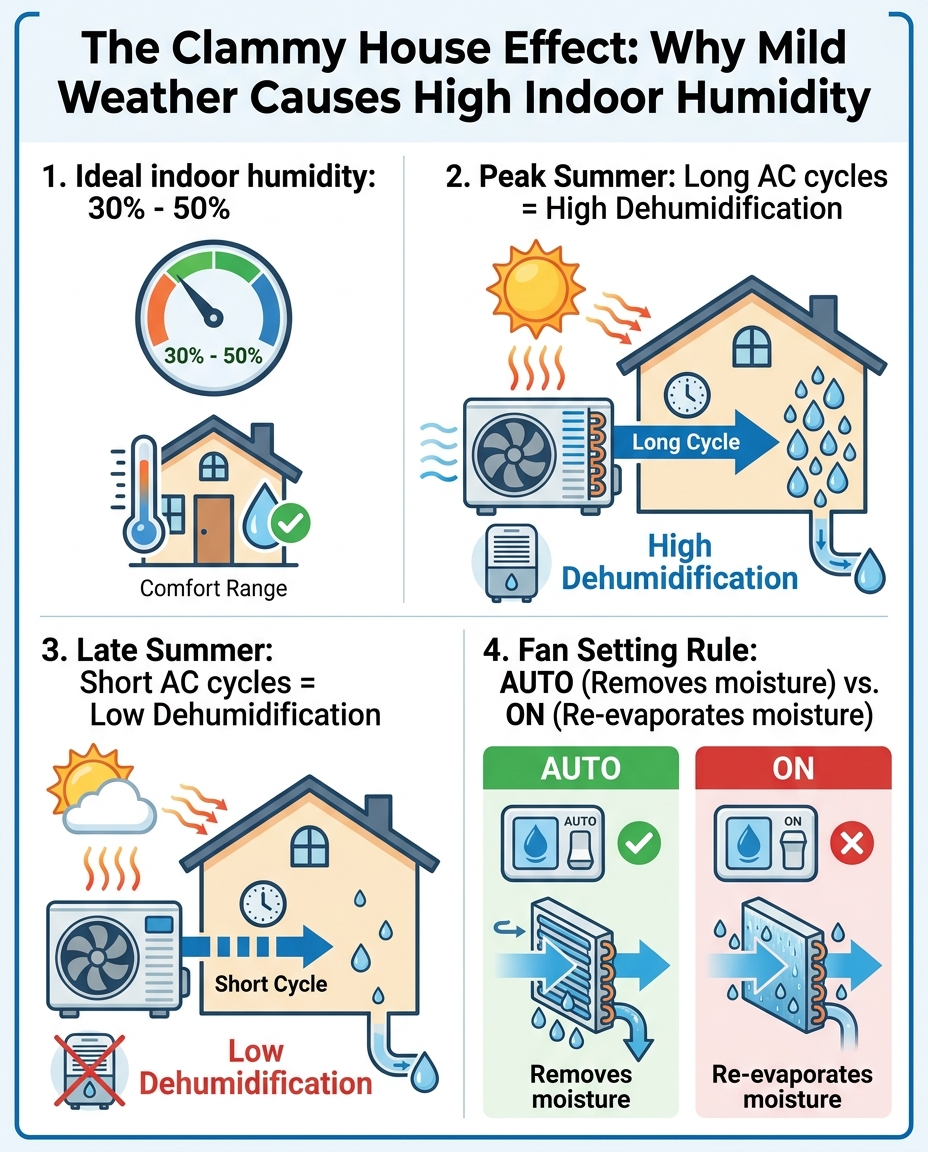
According to the American Society of Heating, Refrigerating and Air-Conditioning Engineers (ASHRAE), ideal indoor relative humidity should be kept between 30% and 50% for optimal comfort and health. When humidity climbs above 50%, you start to feel that sticky, heavy sensation. Furthermore, sustained high humidity can encourage musty odors and poor indoor air quality.
In Bridgeville PA and surrounding Western PA areas, lingering Appalachian moisture keeps outdoor humidity incredibly high even as the sun sets earlier in the late summer. Our technicians at Sureway Heating Cooling Plumbing often see homes struggling against this regional climate reality, which means a properly functioning dehumidification process is absolutely vital.
Short-Cycling: The Culprit Behind the Clammy House Phenomenon
If your air conditioner is designed to remove moisture, why does your house suddenly feel like a swamp in late August? The answer lies in the length of your system's run cycles. The moisture-removal process we just detailed requires time. Your system needs to run for extended, uninterrupted cycles to pull enough air over the cold coil to effectively wring out the humidity.
Peak Summer vs. Late Summer Operation
During a 95-degree heatwave in July, your home gains heat rapidly. To keep up with this massive cooling load, your air conditioner might run for 20 to 30 minutes at a time, several times an hour. Because the system is running constantly, it is continuously pulling moisture out of the air. The result is a cool, crisp, and dry interior.
Now, fast forward to the late-summer transition. The outdoor temperature dips into the mid-70s. The cooling load on your home drops drastically. When your thermostat calls for cooling, the system turns on, blasts cold air into the house, and satisfies the temperature setting in just five or ten minutes. The system shuts off before it has had a chance to extract any meaningful amount of moisture from the air.
The Mild Weather Dilemma
This rapid on-and-off operation is known as "short-cycling" due to mild weather. In our years of servicing HVAC systems across the Bridgeville area, we often see that even a perfectly functioning, well-maintained air conditioner will leave a house feeling sticky if the run cycle simply isn't long enough to dehumidify. The thermostat is blind to humidity; it only reads temperature. Once the room hits 72 degrees, the thermostat cuts the power to the condenser, leaving the heavy, damp air trapped inside your living space.

The Thermostat Mistake: Fan 'ON' vs. 'AUTO'
When the house feels stuffy and clammy, many homeowners make a logical but highly counterproductive decision: they walk over to the thermostat and switch the fan setting from "AUTO" to "ON." The thought process makes sense—moving air should help dry out the house and make it feel cooler. Unfortunately, in transitional weather, this is one of the worst things you can do for your indoor humidity.
The Physics of Re-Evaporation
Remember the condensation process we discussed earlier? When your cooling cycle ends, the indoor evaporator coil is left dripping wet with the moisture it just pulled out of your air. If the fan is set to "AUTO," the blower motor shuts off at the same time as the cooling cycle. This allows the water on the coil to slowly drip down into the pan and drain away outside.
If you have the fan set to "ON," the blower motor continues to run 24/7, even when the cooling cycle is finished. This continuous stream of warm indoor air blows directly over the soaking wet evaporator coil. Instead of draining away, that water is rapidly re-evaporated and blown right back through your ductwork into your living space. You are essentially paying your utility company to undo all the dehumidification your system just achieved, which can easily lead to excessive AC condensation issues and a damp home.
Comparing Your Fan Options
• AUTO (Recommended) — How It Operates: Blower only runs when the system is actively cooling. — Impact on Indoor Humidity: Allows moisture to drain off the coil between cycles, keeping humidity low.
• ON (Not Recommended) — How It Operates: Blower runs continuously, 24/7. — Impact on Indoor Humidity: Re-evaporates trapped moisture back into the home, spiking humidity.
The quick fix: Check your thermostat right now. If the fan switch is set to "ON," immediately switch it to "AUTO." This single adjustment can often reduce indoor humidity by 10% or more within a single day during mild transitional weather.
Actionable Strategies for Managing Indoor Humidity When Transitioning Away from Constant AC Use
Beyond fixing your thermostat fan setting, there are several practical steps you can take to mitigate the clammy feeling without overcooling your house. Managing indoor humidity when transitioning away from constant AC use requires a blend of smart system management and basic home habits.
1. Force a longer cooling cycle: During the most humid parts of the day—often late afternoon or early evening—lower your thermostat by just 1 or 2 degrees. While this makes the house slightly cooler, the primary goal is to force the system to run for a solid 15 to 20 minutes. This extended run time gives the evaporator coil the opportunity it needs to extract a significant amount of moisture from the air. Once the house feels crisp again, you can return the thermostat to your normal setting.
2. Utilize targeted exhaust fans: Your daily activities generate a massive amount of indoor moisture. Cooking, boiling water, and taking hot showers all release steam directly into your living space. During peak summer, your AC runs enough to clear this out. In late summer, it doesn't. Always run your bathroom exhaust fans during showers and leave them on for at least 20 minutes afterward to remove localized moisture at the source.
3. Keep windows closed during humid evenings: When the evening air feels cool, it is incredibly tempting to throw open the windows to let the house "air out." However, in regions with lingering late-summer moisture, that cool evening air often carries a very high dew point. Opening the windows invites heavy, moisture-laden air directly into your home. The temperature might be nice, but you will wake up to sticky floors and clammy sheets.
4. Ensure your condensate drain is clear: Your system cannot remove moisture if the water has nowhere to go. Over the course of a long cooling season, algae, dust, and debris can build up in the PVC condensate drain line attached to your indoor unit. If this line becomes sluggish, water sits in the drain pan, adding to the ambient humidity. While deep cleaning requires a professional, you can visually inspect the end of the line outside to ensure water is successfully dripping out when the system runs.
When Thermostat Tweaks Aren't Enough: Holistic IAQ Solutions
Sometimes, simple behavioral changes and thermostat adjustments aren't enough to combat severe transitional humidity. If you have set your fan to "AUTO," managed your indoor moisture sources, and your home still feels like a damp cave, it is time to look at permanent, professional solutions.
The Oversized Equipment Problem
One common reason homes struggle with humidity is oversized cooling equipment. If your air conditioner has a higher cooling capacity than your home actually requires, it will short-cycle constantly, even during hot weather. An oversized unit acts like a sledgehammer, dropping the temperature rapidly while doing absolutely nothing for the humidity. A comprehensive system evaluation can determine if your equipment is properly sized for your home's unique footprint.
Whole-Home Dehumidification
For homes that consistently battle clammy air during the spring and fall transitions, a whole-home dehumidifier is often the best investment. Unlike portable units that take up floor space and require constant emptying, a whole-home dehumidifier is integrated directly into your ductwork. It monitors the moisture levels in your home and operates entirely independently of your cooling cycle. This means you can keep your home perfectly crisp and dry on a mild 70-degree day without ever turning on the AC.
The Value of Professional Insight
Diagnosing comfort issues requires looking at the entire home as an interconnected system. One local customer reached out to us during a sticky summer stretch when their air conditioner simply stopped working. A technician arrived, performed the necessary work, cleaned up the workspace, and—most importantly—took the time to explain exactly what was happening with their system's airflow and moisture control before getting the unit fixed.
At Sureway Heating Cooling Plumbing, our approach goes beyond basic cooling. We provide holistic HVAC expertise that looks at the big picture to ensure comprehensive indoor air quality and transitional weather comfort. If your system is struggling to keep you comfortable, professional HVAC services can identify whether the issue is weather-related or a sign of an underlying system malfunction.
Frequently Asked Questions
Why is my house humid when the AC is on?
Your house remains humid when the AC is on because the system is likely short-cycling and not running long enough to extract moisture. An air conditioner needs extended, continuous run times to pull humid air over the cold evaporator coil and drain it outside. In mild weather, the system cools the house too quickly and shuts off before dehumidification can occur.
Does running the AC fan on increase humidity?
Yes, leaving your thermostat fan set to "ON" will actively increase your indoor humidity. When the cooling cycle ends, the indoor coil is left wet with condensation. A continuously running fan blows air over this wet coil, re-evaporating the moisture and pushing it right back into your living space.
At what temperature does an AC stop dehumidifying?
An AC doesn't stop dehumidifying at a specific temperature; rather, it stops dehumidifying whenever the thermostat setting is satisfied and the cooling cycle ends. When outdoor temperatures drop into the 70s, the system reaches its target temperature very quickly, significantly reducing the amount of time it spends actively removing moisture from the air.
Why does my house feel clammy in late summer?
Your house feels clammy in late summer because outdoor temperatures drop, but outdoor humidity levels often remain high. This mild weather reduces the cooling load on your home, causing your air conditioner to run for much shorter periods. Without long cooling cycles, the heavy moisture stays trapped inside your home.
Should I leave my AC fan on or auto for humidity control?
You should always leave your AC fan set to "AUTO" for the best humidity control. The "AUTO" setting ensures the blower motor only runs when the system is actively cooling the air. This allows the moisture collected on the indoor coil to safely drip down the drain instead of being blown back into the house.
Can an oversized air conditioner cause high indoor humidity?
Yes, an oversized air conditioner is a primary cause of chronic high indoor humidity. A unit that is too large for the square footage of the home will cool the space rapidly and shut off abruptly. Because it never runs for long, steady cycles, it fails to remove adequate moisture, leaving the home cold but damp.
Take Control of Your Transitional Comfort
You don't have to settle for a sticky, uncomfortable home just because the seasons are changing. By understanding how your system manages moisture and making smart thermostat adjustments, you can eliminate that clammy feeling. If you are still struggling to find the right balance, our team is here to provide the clear, non-technical explanations and effective solutions you need to restore your home's comfort.





.svg)
.avif)


