


Are Your HVAC Odors and Electrical Issues Normal or Dangerous?
Is that sudden burning smell coming from your vents a sign of an electrical emergency, or just a harmless quirk to note on your seasonal home maintenance checklist? As the peak July heat bears down on Bridgeville PA, your air conditioner is forced to work overtime. At Sureway Heating Cooling Plumbing, our team typically sees a sharp increase in service calls during these mid-summer heatwaves. Homeowners are running their cooling systems continuously to combat the heavy humidity, which often reveals hidden mechanical strain—particularly on the AC compressor—while introducing confusing odors from overworked electrical components or damp ductwork.
Knowing the difference between a normal summer cooling symptom and a dangerous mechanical failure is critical for protecting your home and your equipment. Ignoring a tripping breaker can lead to severe electrical hazards, while panicking over a harmless musty odor from summer condensation can result in an unnecessary service call. If you are dealing with alarming electrical symptoms or persistent odors, starting with authoritative diagnostics is the best path forward. Whether you need general guidance on Air Conditioning or are ready to schedule professional air conditioning services, understanding the root cause of these issues empowers you to make the right decision.
Why Does an AC Compressor Trip the Circuit Breaker?
Your circuit breaker acts as a crucial safety gatekeeper for your home's electrical panel. When an AC compressor begins to fail, it often demands significantly more electricity than the system is rated to handle. This excessive amperage draw triggers the thermal-magnetic mechanism inside the breaker, shutting off power to prevent the wires from overheating and potentially starting a fire.
During the peak summer heat in Bridgeville PA, your air conditioner is forced into longer, more frequent cooling cycles. This heavy workload exacerbates any underlying weaknesses in the compressor's motor windings or the electrical capacitors that support it. In our years of servicing local HVAC systems, we've found that a breaker trip is rarely a fluke; it is usually a direct symptom of a mechanical or electrical fault. A grounded compressor occurs when the internal electrical windings break down and touch the metal casing, creating a direct short. A weak run capacitor, on the other hand, fails to provide the necessary electrical momentum, forcing the compressor to pull dangerous amounts of amperage just to keep spinning.
The critical warning: Never repeatedly reset a breaker that continues to trip. Forcing electricity back into a failing component is a severe fire hazard and can completely destroy equipment that might otherwise be repairable. If you are wondering why your AC circuit breaker keeps tripping, the safest action is to leave the breaker off and call for a professional electrical diagnostic.
The Danger of the "Hard Start"
A "hard start" occurs when the AC compressor struggles to overcome the initial mechanical resistance required to pump refrigerant. As the motor strains to turn over, it pulls a massive surge of electricity—sometimes up to five times its normal running amperage. This sudden spike hits the electrical panel hard, often causing lights to dim temporarily or the breaker to trip immediately.
When a licensed professional from our team investigates a hard start, we do not just guess at the cause. We use a specialized multimeter to measure the exact inrush current (amperage draw) at the moment the system turns on. By comparing this reading to the manufacturer's maximum rating stamped on the unit, our technicians can pinpoint exactly where the electrical failure is occurring, whether it is a failing capacitor, a degraded contactor, or a compressor motor that is locking up.
Identifying Key Symptoms of AC Compressor Failure
Because the compressor is sealed inside a heavy steel shell, you cannot simply look at it to see if it is broken. Instead, you must rely on acoustic, thermal, and electrical symptoms to evaluate your cooling system's performance under heavy summer load. Diagnosing a bad compressor requires a systematic approach to rule out simpler issues first.
• Acoustic anomalies: Listen closely to the outdoor unit. A failing compressor often produces a loud grinding, clanking, or rattling noise, indicating internal mechanical wear. A distinct, loud humming or buzzing sound without the fan engaging usually points to an electrical lockup.
• Thermal warning signs: If your thermostat is set to cool but the vents are blowing warm or room-temperature air, the compressor is likely not circulating refrigerant. The outdoor unit itself may also feel excessively hot to the touch if the internal motor is overheating.
• Electrical interruptions: As discussed, a system that immediately trips the breaker upon startup or causes the lights to flicker severely is displaying classic signs of a compressor drawing locked-rotor amperage.
• Puddle formation: While condensation is normal, large pools of oil or strange fluids around the base of the outdoor unit can indicate a ruptured line or a cracked compressor shell leaking its internal lubricant.
We believe in transparent repair recommendations, which means explaining exactly what is happening inside the unit before suggesting a fix. Our technicians recently helped a local Bridgeville homeowner whose air conditioner suddenly stopped working during a July heatwave. Rather than just swapping parts blindly, our team explained everything that was happening mechanically, walked the homeowner through the diagnostic readings, and fixed the air conditioner efficiently. The goal is always to provide a definitive go/no-go diagnostic framework so you understand the exact health of your system.
The Impact of High Humidity on HVAC Components
The local climate heavily influences how HVAC systems perform and wear down over time. In Bridgeville PA, summer humidity levels frequently exceed 70%, creating a heavy, moisture-laden environment that forces your air conditioner to work double duty. An AC unit does not just cool the air; it must also act as a heavy-duty dehumidifier, extracting gallons of water from your indoor air daily. This constant moisture extraction adds significant thermodynamic strain to the compressor, forcing it to run longer cycles to achieve the desired comfort level.
This high humidity also heavily impacts your indoor air quality (IAQ). As the evaporator coil pulls moisture from the sticky summer air, the dark, damp environment inside your air handler becomes a prime breeding ground for mildew and biological growth. When dust and airborne particulates stick to this wet coil, it restricts airflow, further stressing the compressor and reducing cooling efficiency.
This climate-specific interaction between high summer humidity and constant cooling cycles is exactly why mid-summer odors—often referred to as "Dirty Sock Syndrome"—are so prevalent and noticeable in this region when the AC kicks on.
Proactive Monitoring During Peak Summer Load
Ensuring your air conditioner survives the intense July heat requires a proactive approach to your seasonal home maintenance checklist. Waiting until your system completely fails on a 90-degree day is a risky strategy. Performing basic, safe visual inspections of your cooling system helps prevent major mechanical failures when service schedules are fully booked.
Here is a safe, structured way to monitor your system's health while adhering strictly to safety boundaries:
1. Check the filter first: Verify that your current air filter is clean. A clogged filter restricts airflow, which can cause the evaporator coil to freeze solid and severely damage the compressor.
2. Clear the outdoor area: Ensure the space around your outdoor condenser unit is completely free of overgrown summer vegetation, tall grass, or debris. The unit needs at least two feet of clearance to properly exhaust heat.
3. Observe the cooling cycle: Listen to the system when it kicks on. You should hear a smooth hum from the compressor and the fan. Loud banging or screeching indicates a mechanical issue.
4. Monitor indoor humidity: Pay attention to how your home feels. If the air feels cool but "clammy" or sticky, your system may be short-cycling and failing to dehumidify the space properly.
5. Check the condensation line: Verify that water is actively dripping from the PVC drain line outside your home. If it isn't, the line may be clogged, which can trigger safety switches that shut the system down.
If your system fails to turn on, makes alarming noises, or trips a breaker during these basic checks, do not attempt to open the electrical panels or bypass safety switches. Internal troubleshooting requires a licensed professional. For a comprehensive review of your cooling system's health, scheduling professional HVAC maintenance ensures your equipment can handle the peak summer heat.
Normal Musty Odors vs. Dangerous Electrical Smells
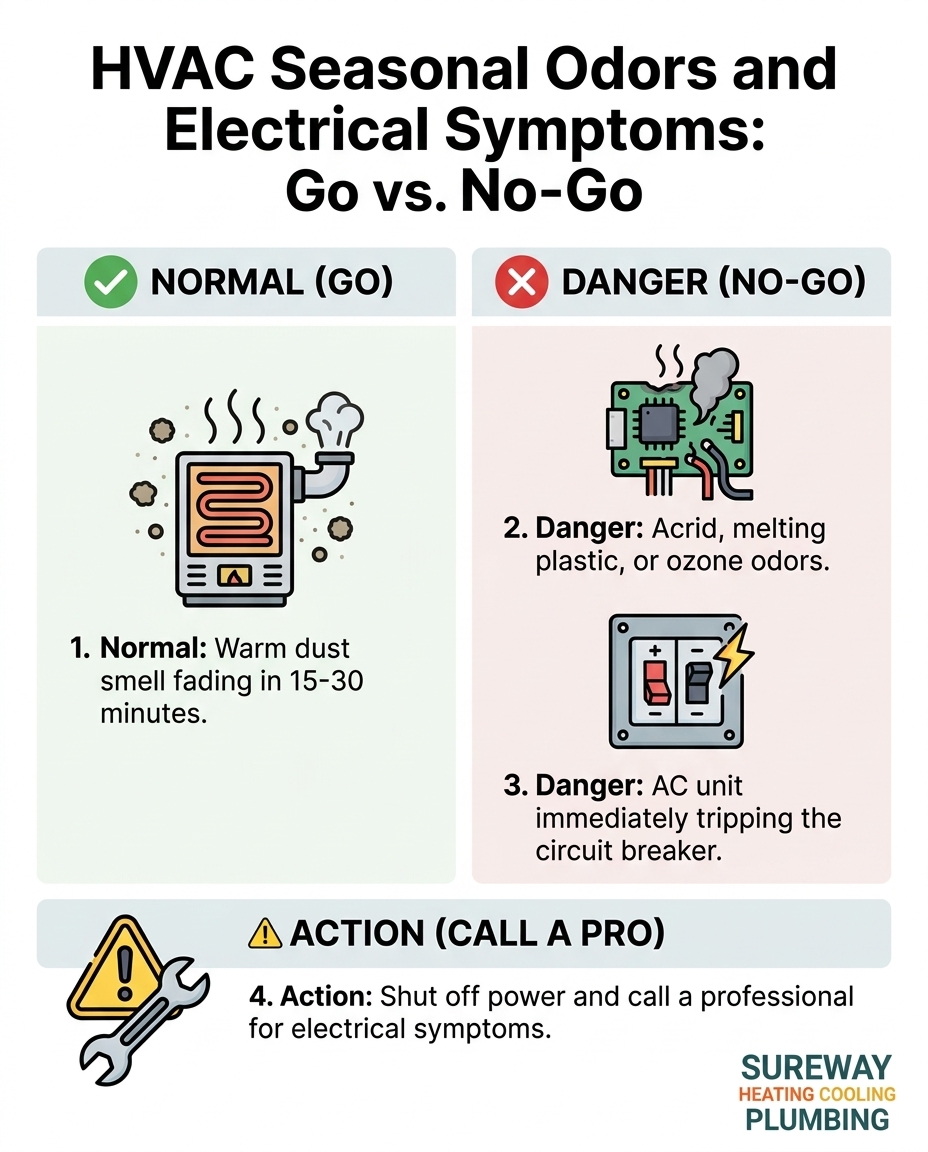
When running your AC heavily during peak summer, you might encounter strange smells. Providing a strict "go/no-go" decision matrix helps you determine whether an odor is a harmless IAQ issue or a genuine electrical hazard. Telling you when NOT to call for emergency service is just as important as telling you when it is a critical situation.
A normal musty smell (Dirty Sock Syndrome) happens because moisture sits on the evaporator coil between cooling cycles, allowing minor mildew to form. This creates a specific, predictable damp odor when the fan turns on. Conversely, an electrical short or a failing AC compressor motor produces a highly toxic, acrid odor that signals immediate danger.
• Type of Odor — Normal Musty Odor (No-Go): Smells damp, earthy, or like old gym socks. — Dangerous Electrical Failure (Go): Smells like melting plastic, burning rubber, fish, or pungent ozone.
• Duration of Odor — Normal Musty Odor (No-Go): Fades after the AC runs for a few minutes and condensation flushes away. — Dangerous Electrical Failure (Go): Persists continuously, grows stronger, or returns every time the system runs.
• Visual Signs — Normal Musty Odor (No-Go): None. The air remains clear. — Dangerous Electrical Failure (Go): Visible smoke, sparking, or scorch marks near the vents or equipment.
• Electrical Impact — Normal Musty Odor (No-Go): System runs smoothly without interrupting household power. — Dangerous Electrical Failure (Go): System immediately trips the circuit breaker or causes lights to flicker.
• Required Action — Normal Musty Odor (No-Go): Monitor the system. Consider an IAQ upgrade or coil cleaning during your next tune-up. Do not call for emergency service. — Dangerous Electrical Failure (Go): Shut off power at the breaker immediately. Call a professional for emergency service.
Making the Call: AC Compressor Repair vs. System Replacement
If professional diagnostics confirm that your AC compressor has definitively failed under the summer strain, you are faced with a significant bottom-line decision. The compressor is the "heart" of the air conditioning system. It is responsible for pumping the refrigerant through the coils, compressing the low-pressure gas into a high-pressure, high-temperature state so that heat can be released outside. Because of its central role and complex internal mechanics, replacing a compressor is a major mechanical event.
Several factors influence whether you should replace the broken compressor or upgrade the entire outdoor unit. The age of the unit is the primary consideration. If the system is over ten years old, the remaining components—such as the condenser coil and the fan motor—are also nearing the end of their usable lifespan. Putting a brand-new compressor into an aging, degraded system often leads to mismatched efficiency and further breakdowns down the road.
The type of refrigerant your system uses also plays a massive role in this decision. Older systems in Bridgeville PA that still rely on R-22 (Freon) are largely obsolete due to environmental phase-outs. Repairing a compressor on an R-22 system is rarely cost-effective because the refrigerant itself is incredibly scarce. Modern systems use R-410A or newer transition refrigerants, making repairs more viable on recent models.
Because major component replacements are significant investments, our team at Sureway Heating Cooling Plumbing maintains a neutral, objective tone when presenting these options, ensuring you have the data needed to make the right choice for your home. If a full system replacement makes the most long-term financial sense, exploring available financing options can help manage the investment comfortably while restoring your home's cooling power.
Frequently Asked Questions About AC Compressors and Summer Cooling
Why does my AC compressor keep tripping the breaker immediately?
An immediate breaker trip usually indicates a dead short to ground within the compressor casing. This happens when the internal electrical windings lose their insulation and touch the metal shell, causing a massive surge of uncontrolled electricity. The breaker trips instantly to prevent the wiring from overheating and causing a fire. You should never attempt to reset a breaker that trips immediately upon startup, as this forces dangerous voltage back into a compromised system and can cause catastrophic damage.
Is it normal for my AC to smell musty when it first turns on?
Yes, a brief musty or damp smell—often called "Dirty Sock Syndrome"—is common during humid summer months. This odor is caused by condensation and minor microbial growth on the indoor evaporator coil. However, it is vital to distinguish between the earthy smell of a damp coil and the acrid, toxic smell of an electrical fire. If the smell resembles melting plastic or ozone, shut the system down immediately.
How do I know if my AC compressor is bad?
A bad AC compressor typically presents a triad of failure: severe electrical trips, terrible mechanical noises, and a complete lack of cooling. You may hear loud grinding or a distinct buzzing sound coming from the outdoor unit while the fan fails to spin. Additionally, the system will blow warm air indoors because the compressor is no longer pumping refrigerant through the coils. A licensed technician uses a multimeter to test the electrical windings and confirm the failure without guesswork.
How long should a musty smell last when the AC cycles on?
The standard damp or musty odor should fade within a few minutes of continuous operation as the condensation flushes down the drain line and the air begins to circulate. If the smell persists for hours, dominates your entire home, or is accompanied by allergy symptoms, it may indicate a larger mold issue in the ductwork or a clogged condensate drain that requires professional cleaning and an IAQ assessment.
Can a dirty filter cause my AC compressor to fail?
Yes, a severely dirty air filter can absolutely lead to catastrophic compressor failure. When a clogged filter restricts airflow over the indoor evaporator coil, the coil drops below freezing temperatures and turns into a block of ice. This prevents the refrigerant from absorbing heat and boiling into a gas. As a result, liquid refrigerant travels backward through the suction line and hits the compressor—a condition known as "liquid slugging"—which destroys the internal valves and ruins the motor.
Get Expert Diagnostics for Your HVAC System Today
Addressing tripping circuit breakers, strange noises, and unusual odors immediately is the best way to protect your HVAC system from catastrophic damage. Whether you are dealing with an AC compressor struggling through the intense July heat in Bridgeville PA, or you need to ensure your cooling system is running at peak efficiency, professional insight is invaluable. Ignoring these warning signs only leads to more extensive, complicated repairs down the road.
You deserve a clear, technical explanation of your system's health and a definitive path forward. If your equipment is exhibiting any of the dangerous electrical symptoms outlined above, do not wait for the system to fail completely. Schedule a professional diagnostic with Sureway Heating Cooling Plumbing today to ensure your home remains safe, efficient, and comfortably cool all summer long.





.svg)
.avif)


