


The Immediate Panic of a Tripping AC Breaker
When your system suddenly shuts down in the sweltering heat, you might immediately wonder: does a tripping AC breaker always mean a bad compressor? A tripped circuit breaker does not automatically mean your entire cooling system is doomed, even though that is usually the first fear that comes to mind. Sitting in a hot house while your air conditioner refuses to stay running is incredibly stressful, especially when you suspect the most expensive component in the system has failed.
Before you panic, it is important to understand that a tripped breaker is actually a safety mechanism doing exactly what it was designed to do. The breaker is protecting your home's electrical panel from an overcurrent situation. Here at Sureway Heating Cooling Plumbing, we see this constantly by late summer. Components experience significant August end-of-season cooling wear, making minor electrical faults highly common. Most of these faults are far less severe than a dead compressor. For more insights into how your system operates, explore our air conditioning resources.
No, It Doesn't Always Mean Your Compressor is Dead
The short answer is no. A tripping AC breaker does not always mean a bad compressor. In our years of servicing air conditioners throughout Bridgeville PA, our team has found that most tripped breakers are caused by minor, highly repairable electrical faults. Air conditioners draw their absolute highest amperage during startup. If any component struggles during this initial surge, the system pulls more power than the circuit can handle, and the breaker trips to prevent an electrical fire.
When you understand that the system is simply protecting itself from an electrical overcurrent, it provides immediate psychological relief. You are likely dealing with a worn-out part rather than a catastrophic failure. If you are experiencing this issue, reaching out for professional air conditioning services is the safest way to pinpoint the exact fault.
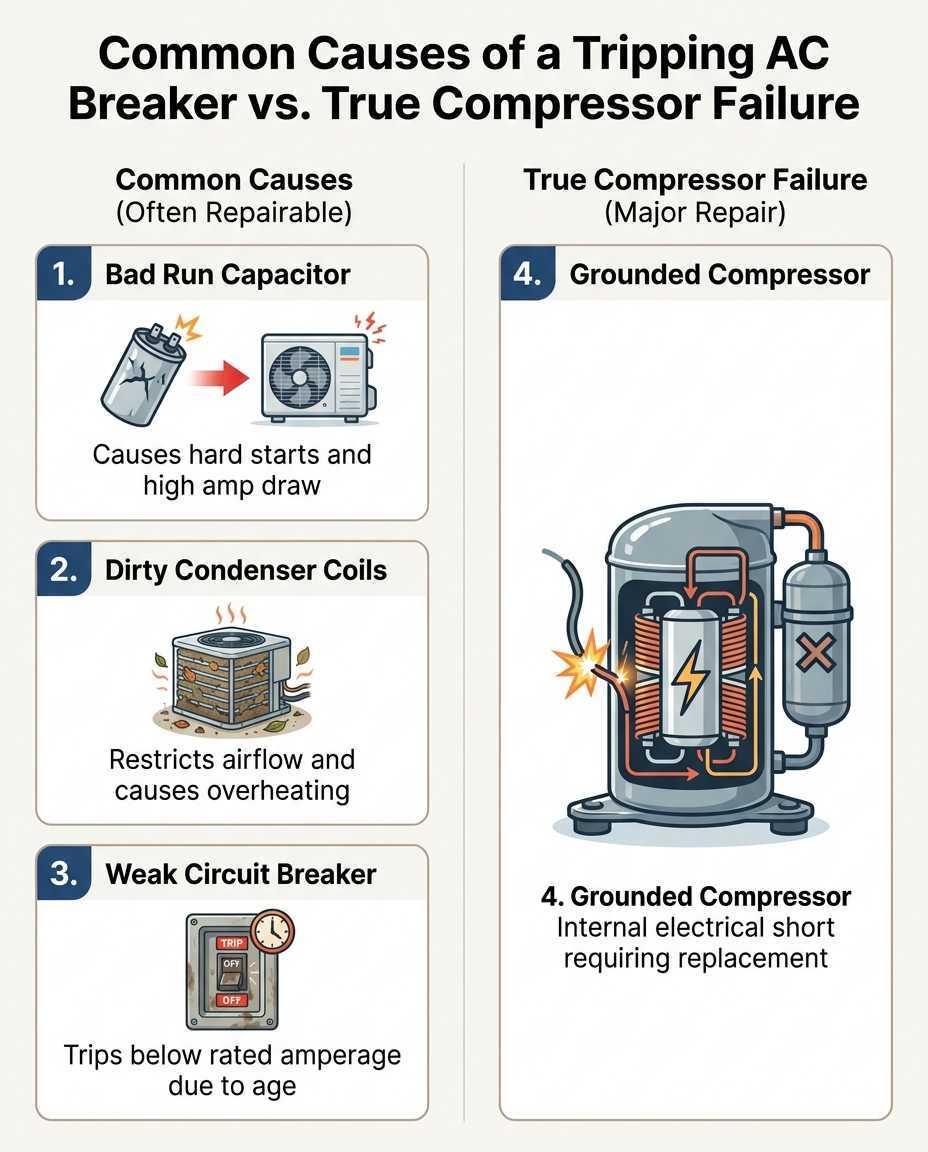
The most common culprits behind a tripping breaker include:
• Blown run capacitors: The component that gives the compressor the energy boost it needs to start.
• Dirty condenser coils: Restricted airflow forces the system to work harder and pull more electricity.
• Weak or aging breakers: The breaker itself may be failing and tripping at a lower amperage than it should.
• Loose wiring: Normal vibration can loosen electrical connections over time, causing a short circuit.
Common Electrical Faults That Mimic a Failing Compressor
Because multiple components work together to start your cooling system, a failure in one small part can easily mimic a massive compressor failure to the untrained eye. Bridgeville PA's humid subtropical summer climate forces air conditioners to run long, continuous cycles to dehumidify the air. Our technicians regularly see how this heavy, continuous electrical load naturally exposes weak components by late summer, leading to sudden breaker trips as families prep for the back-to-school transition. If you want to dive deeper into the mechanics of these shutoffs, you can read more about why your AC circuit breaker keeps tripping.
Bad Run Capacitors
The run capacitor acts like a battery jump-start for your compressor and fan motor. Because the compressor requires a massive surge of energy to begin pumping refrigerant, the capacitor stores electricity and delivers it on demand. When a capacitor becomes weak from August end-of-season cooling wear, it cannot deliver that necessary jolt. The compressor then struggles to start, pulling excessive amps directly from your electrical panel, which immediately forces the breaker to trip.
Weak or Aging Circuit Breakers
Circuit breakers do not last forever. They degrade over time from heat, continuous use, and previous trips. A breaker that is rated for 30 amps might weaken and begin tripping at just 15 or 20 amps. In this scenario, your air conditioner is operating perfectly fine and drawing a normal amount of current, but the faulty breaker is prematurely cutting the power.
Short Circuits and Loose Wiring
Your outdoor condenser unit vibrates every time it runs. Over months and years of operation, this constant vibration can loosen internal electrical connections. If a wire becomes loose and touches the metal casing of the unit, it creates an immediate short circuit. The breaker will trip instantly to prevent the casing from becoming electrified.
• Bad Capacitor — Typical Symptoms: Humming sound from unit, fan won't spin, immediate breaker trip on startup. — Severity Level: Minor (Quick Component Replacement)
• Weak Breaker — Typical Symptoms: Trips randomly even when the AC is not straining, breaker feels hot to the touch. — Severity Level: Minor (Electrical Panel Repair)
• Short Circuit — Typical Symptoms: Instant trip the second the thermostat calls for cooling, visible burnt wires. — Severity Level: Moderate (Wiring Repair Needed)
• Bad Compressor — Typical Symptoms: Loud grinding noises, system trips breaker instantly, unit vibrates violently. — Severity Level: Severe (Major Repair/Replacement)

How Dirty Condenser Coils Lead to Electrical Overloads
Mechanical maintenance issues frequently translate into electrical failures. The outdoor condenser unit is responsible for releasing the heat your system pulled from inside your home. To do this efficiently, the metal coils must be completely clean so air can flow freely through them. When our crews perform maintenance, we often find these coils choked with dirt, grass clippings, pollen, and debris, which severely restricts airflow.
The chain reaction of dirty coils:
1. The fan struggles to pull air through the clogged metal fins.
2. Heat becomes trapped inside the unit, causing the internal temperature to spike.
3. The compressor has to work twice as hard to pump refrigerant through the system.
4. This mechanical strain forces the compressor to draw excessive electrical current.
5. The circuit breaker detects the dangerous amperage spike and trips.
This specific scenario perfectly mimics a failing compressor. The unit runs hot, sounds loud, and shuts down the electrical circuit. However, the root cause is entirely preventable. Keeping up with routine HVAC maintenance ensures your coils remain clean, preventing this unnecessary electrical strain and protecting your system from premature August end-of-season cooling wear.
The Hidden Danger of Repeatedly Resetting Your Breaker
When the air conditioning goes out on a hot afternoon in Bridgeville PA, the immediate temptation is to march to the electrical panel and flip the breaker back on. If it trips again, some homeowners will try flipping it a third or fourth time, hoping the system will eventually catch and stay on. This is an incredibly dangerous habit that can turn a minor repair into a catastrophic failure.
A tripped breaker is a critical warning sign, not a nuisance to be bypassed. Every time you force power back into a circuit that has just tripped, you are sending a massive surge of electricity into a faulty component. If the issue is a weak capacitor, repeatedly trying to force the compressor to start without its required boost can permanently burn out the compressor motor. If the issue is a short circuit, repeatedly resetting the breaker can melt internal wiring or spark an electrical fire.
You should never attempt DIY electrical resets or internal testing. If a breaker trips more than once, leave it off. A professional must test the electrical draw using specialized tools to determine exactly where the overcurrent is occurring.
Professional Diagnostics: Finding the True Root Cause
Because so many different issues cause the exact same symptom—a tripped breaker—professional diagnostic testing is the only reliable way to distinguish between a minor electrical fault and a dead compressor. Our technicians do not guess based on symptoms; we measure the system's actual performance.
During a diagnostic visit, a professional will use a multimeter to test the electrical draw (amperage) of the compressor and fan motor. They will measure the microfarads of the run capacitor to see if it is holding a proper charge. They will also inspect the contactor for pitted metal and check the internal wiring for signs of scorching. By evaluating the entire system, they can isolate the exact component causing the overcurrent.
Our team at Sureway Heating Cooling Plumbing prioritizes accurate, honest diagnostics to protect homeowners from sales-first companies that might prematurely condemn a compressor just because a breaker tripped. For example, we recently helped one homeowner who reached out late in the summer when their air conditioner was not working properly and kept shutting down the circuit. Instead of jumping to the worst-case scenario, our technician explained everything that was happening with the electrical draw, identified a minor fault, and fixed the unit on the spot. The air conditioner was repaired and is now working well, saving the homeowner from an unnecessary replacement.
When It Actually Is a Grounded or Failing Compressor
While we have established that a tripped breaker is often a minor issue, there are times when our diagnostics confirm the compressor genuinely is the source of the electrical fault. The most common catastrophic failure is known as a "grounded compressor."
Inside the sealed compressor shell, there are tightly wound electrical coils. Over years of use in Bridgeville PA's demanding climate, the insulation around these windings can break down. If a bare wire snaps and touches the internal steel casing, the electrical current goes straight to the ground. This is a massive short circuit. If your compressor is grounded, the breaker trip is actually saving your home from a highly dangerous electrical event.
If professional testing confirms that the compressor windings are open or grounded, the compressor itself cannot be repaired; it must be replaced. Depending on the age of your system and the type of refrigerant it uses, you may need to decide between replacing the compressor or upgrading the entire outdoor unit. If you find yourself facing a major replacement decision, exploring flexible financing options can help make the necessary upgrades manageable without compromising your home's comfort.
Frequently Asked Questions About AC Electrical Issues
Why does my AC compressor keep tripping the breaker?
Your AC compressor keeps tripping the breaker because it is drawing too much electrical current. This overcurrent is often caused by a bad capacitor, dirty condenser coils, or a grounded internal motor. The breaker shuts off the power to prevent the wires from overheating and causing a fire.
Can a bad capacitor cause the breaker to trip?
Yes, a bad capacitor is one of the most common causes of a tripped breaker. The capacitor provides the massive jolt of electricity the compressor needs to start. Without this boost, the compressor strains, overdraws amperage from the electrical panel, and forces the breaker to trip.
How do I know if my AC compressor is bad?
You cannot know for sure without professional testing, but symptoms of a bad compressor include loud grinding noises, a failure to start, and immediate breaker trips the second the system turns on. Only a professional using a multimeter can confirm if the compressor has a grounded or open winding.
What should I do if my AC trips the breaker?
If your AC trips the breaker, leave the breaker in the off position and do not repeatedly attempt to reset it. Forcing power back into a faulty circuit can severely damage the equipment or cause an electrical fire. Schedule a professional electrical diagnostic to find the root cause safely.
Does a tripped breaker mean I need to replace my air conditioner?
No, a tripped breaker does not automatically mean you need a new air conditioner. In many cases, the issue is a minor component failure like a worn capacitor or a degraded circuit breaker that can be replaced quickly. A full system replacement is usually only necessary if the compressor itself has failed.
Why is my AC drawing too many amps on startup?
An AC draws too many amps on startup when it faces excessive mechanical or electrical resistance. This happens when the run capacitor is weak, the refrigerant pressures are unbalanced, or the compressor motor is seizing up due to age and August end-of-season cooling wear.
Get Honest Answers for Your AC Electrical Issues
Dealing with an air conditioner that refuses to stay running is frustrating, but remember: a tripped breaker is often a minor electrical component failure, not a death sentence for your AC. It is simply your electrical panel doing its job to protect your home from an overcurrent situation.
Because a weak capacitor, a dirty coil, and a grounded compressor all cause the exact same symptom, professional electrical draw testing is the only way to know for sure what is happening inside your system. Never force the breaker back on repeatedly. Instead, rely on our accurate, honest diagnostics to find the exact root cause safely. If you are tired of wondering, "does a tripping AC breaker always mean a bad compressor?", schedule a professional inspection with Sureway Heating Cooling Plumbing today to get the definitive answers you need to restore your home's comfort.



.svg)
.avif)


