



Escaping the Endless Winter Humidifier Hustle
When the temperature drops and your furnace kicks into high gear, evaluating whole-house humidifiers vs portable units for winter comfort quickly shifts from a casual thought to an urgent necessity. Cold, dry Western PA winters force heating systems to run continuously, which rapidly strips natural moisture from your indoor air. Before you know it, your home's relative humidity can plummet below 20%—making the air inside your living room drier than the Sahara Desert. You are left dealing with static shocks, scratchy throats, and the dreaded daily chore of constantly refilling multiple water tanks just to make it through the night. If you are tired of this endless cycle, it is time to look at permanent upgrades.
If you are ready to explore comprehensive indoor air quality solutions or need professional heating services, our team is here to help.
For many homeowners in Bridgeville PA, the winter routine involves dragging heavy jugs of water across the house, spilling half of it on the floor, and scrubbing mineral deposits out of plastic tanks. The central decision you face is whether to continue this exhausting daily routine or upgrade to an automated, integrated system. Proper humidification does more than just make the air feel warmer; it protects your respiratory health, preserves your home's interior, and allows you to actually enjoy the winter season without adding another chore to your daily list.
The Hidden Hassles and Limitations of Portable Humidifiers
Portable humidifiers seem like a quick fix when the air gets dry, but the long-term reality of relying on them during peak heating season is significantly more demanding than most people expect. The sheer time cost, maintenance burden, and uneven performance quickly turn a simple appliance into a part-time job.
The Daily Refilling Demands
The volume problem: When your furnace runs constantly to combat freezing temperatures, it dries out the air faster than a small tabletop unit can replace the moisture. A typical home requires several gallons of water added to the air daily to maintain comfortable humidity levels. Small reservoirs deplete in a matter of hours, meaning you are forced to refill them twice a day just to keep up. The physical hassle of transporting water to multiple units across different floors, navigating stairs with sloshing containers, becomes a frustrating daily demand.
The Three-Day Cleaning Rule
The hygiene requirement: Standing water is a breeding ground for biological growth. The Consumer Product Safety Commission (CPSC) explicitly warns that portable humidifiers must be cleaned every third day to prevent the growth of harmful bacteria and mold. This is not a casual recommendation; it is a strict health requirement.
• Descaling: You must regularly soak the components in vinegar to break down hard water mineral deposits.
• Scrubbing: Every tight corner of the plastic reservoir requires manual scrubbing to remove biofilm and pink slime.
• Filter changes: Wick filters in evaporative portables harden with minerals and require frequent, costly replacements.
If you neglect this hygiene routine, the unit can aerosolize bacteria and mold spores directly into the air you breathe, creating respiratory risks that defeat the purpose of using a humidifier in the first place. Furthermore, portable units only spot-treat isolated rooms. If you close the bedroom door to trap the moisture, your hallways, living room, and adjacent spaces remain completely vulnerable to the harsh, dry air.
Understanding the Mechanics of a Furnace-Mounted Bypass Humidifier
A furnace-mounted bypass humidifier operates on a completely different principle than a standalone room unit. Instead of relying on a stagnant pool of water and a small localized fan, these systems integrate directly into your home's central ductwork. This mechanical integration eliminates the daily chores associated with portable units and leverages the power of your existing HVAC equipment.
How Bypass Systems Utilize Existing Airflow
When your heating system turns on, the furnace blower circulates warm air throughout the house. A bypass humidifier connects between the warm air supply plenum and the cooler air return duct. A specialized humidistat monitors the moisture levels in your home. When the air is too dry, a solenoid valve opens, allowing a controlled trickle of water to flow directly from your home's plumbing over a specialized water panel (or evaporator pad).
As the warm air from the furnace passes through this saturated pad, it absorbs the moisture as a fine vapor. This freshly humidified air is then distributed evenly through your ductwork to every single room in the house. Because the system draws water directly from your plumbing and drains away any excess, there is absolutely no standing water and completely eliminates the need for manual refilling.
Taking a holistic approach to your home's climate control yields much better results than piecemeal fixes. For example, one homeowner recently reached out during the summer because they needed a new furnace and condenser installed. Instead of just swapping out boxes, the technician spent time reviewing their entire HVAC system and educating them on specific, integrated solutions. The outcome was a newly installed system that significantly reduced utility bills while providing consistently even temperatures and quiet operation. Adding a whole-house humidifier follows this exact same philosophy: you are treating the whole house as a single ecosystem rather than chasing symptoms room by room.
Sureway Heating Cooling Plumbing brings specialized expertise in seamlessly integrating whole-house humidifiers with existing heating systems for optimal performance. Proper furnace integration ensures that the humidifier operates perfectly in tandem with your blower motor, maximizing efficiency and protecting your equipment.
Comparing Whole-Home Consistency Against Spot Treatments
When you evaluate the environmental outcomes of both methods, the difference in square footage coverage is stark. Portable units create localized pockets of moisture surrounded by vast dry zones. A furnace-mounted bypass humidifier guarantees even humidity levels across every single room, eliminating the frustrating dry spots that plague homes in the winter.
Maintaining a consistent 30-50% relative humidity is not just about personal comfort; it is vital for protecting the structural integrity of your home. Dry air pulls moisture out of porous materials, which can cause expensive damage over time. Understanding how to approach managing indoor humidity correctly is essential for long-term home preservation.
• Air Distribution — Portable Spot Treatment: Confined to a single room; closing doors traps moisture while leaving the rest of the house dry. — Whole-Home Bypass System: Utilizes existing ductwork to push evenly humidified air into every room simultaneously.
• Interior Protection — Portable Spot Treatment: Inconsistent. Hardwood floors and trim in untreated rooms may still shrink, crack, or separate. — Whole-Home Bypass System: Consistent 30-50% humidity protects hardwood floors, wooden furniture, and musical instruments house-wide.
• Aesthetics — Portable Spot Treatment: Clutters floor space or nightstands; requires visible power cords running across the room. — Whole-Home Bypass System: Completely hidden out of sight in your basement or utility closet, attached directly to the furnace.
• Noise Level — Portable Spot Treatment: Localized fan noise and water gurgling sounds directly in your living space or bedroom. — Whole-Home Bypass System: Silent operation in the living areas; all mechanical action happens at the furnace location.
Maintenance Requirements: Portable vs. Whole-House Humidifiers
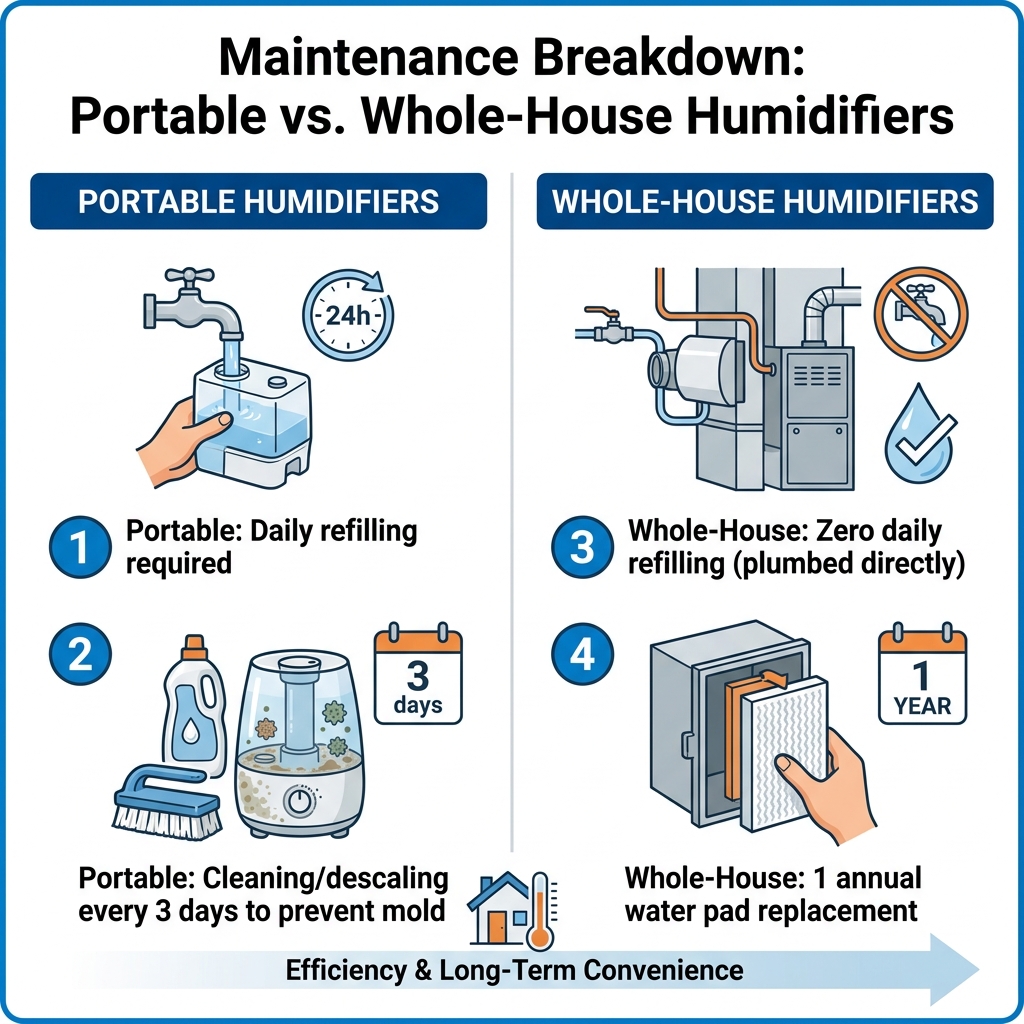
The most significant deciding factor for most homeowners is the long-term maintenance burden. When you break down the required chores, the time savings of an integrated system become incredibly clear.
• Portable Unit Daily Chores: You must unplug the unit, carry the tank to a sink, refill it with water, carry it back, and wipe up any spills. This happens 1-2 times every single day.
• Portable Unit Weekly Chores: Every three days, you must empty the reservoir, soak the base in white vinegar to dissolve mineral scale, scrub the tight corners to remove biofilm, rinse thoroughly, and replace expensive wick filters frequently.
• Whole-House Bypass Maintenance: Zero daily chores. Zero weekly chores. Because there is no standing water—excess water simply flows down the drain—the mold risk is inherently reduced. The only required maintenance is a single annual task: changing the water panel pad inside the unit, which takes about five minutes.

Why Early Fall is the Optimal Time for an IAQ Upgrade
Timing your installation correctly saves you from the reactive scramble that happens when the first major freeze hits. The September pre-heating season is the absolute best window to upgrade your indoor air quality systems. Waiting until your house is already freezing and bone-dry means you will be suffering while waiting for an installation appointment.
There is a distinct logistical advantage to installing a humidifier during a scheduled fall furnace tune-up. Your technician is already on-site to inspect your heating equipment, making it the perfect time to integrate new accessories. Here is how that proactive process generally works:
1. System Assessment: During your routine HVAC maintenance, the technician evaluates your ductwork layout to determine the optimal placement for the bypass unit.
2. Seamless Integration: The humidifier is mounted, the bypass duct is routed, and the water supply line is tapped into your home's existing plumbing.
3. Control Wiring: The humidistat is wired directly into your furnace control board so the two systems communicate perfectly.
4. Calibration and Testing: The system is tested before the heavy November heating usage begins, ensuring it is ready to perform flawlessly on the coldest days of the year.
By handling this in the early fall, you guarantee that your home is calibrated and ready. You bypass the winter rush and secure a comfortable, automated environment from day one of the heating season.
Frequently Asked Questions About Winter Humidification
Is a whole house humidifier worth it?
Yes, the time saved on daily maintenance and the comprehensive protection of home interiors typically outweigh the initial installation effort. For homeowners who dread carrying water jugs and scrubbing plastic tanks every week, an integrated system pays for itself in convenience alone. Furthermore, maintaining proper humidity protects expensive hardwood floors, trim, and furniture from cracking during the September pre-heating season and throughout the long winter.
Do portable humidifiers work as well as whole house?
Portable units are effective for single rooms but cannot match the even, whole-home distribution provided by a system integrated into your ductwork. A tabletop unit might keep your bedroom comfortable, but the moment you step into the hallway or living room, you are back in dry air. Whole-house systems ensure that every square foot of your home maintains a consistent, comfortable moisture level.
How much maintenance does a whole house humidifier need?
They generally require only an annual water panel pad replacement and a basic inspection, usually performed during a fall furnace tune-up. Because bypass systems draw water directly from your plumbing and drain away excess, there are no tanks to refill or scrub. You simply slide out the old mineral-crusted pad once a year and slide a fresh one in.
Can a whole house humidifier cause mold?
When professionally installed and maintained, bypass humidifiers pose minimal mold risk because they do not rely on stagnant reservoirs of standing water. The water flows over the evaporator pad while the furnace blower is running, and any excess immediately exits through a drain tube. As long as the annual pad replacement is performed and the humidistat is set correctly (between 30-50%), mold is highly unlikely.
Can I install a bypass humidifier myself?
Because installation involves modifying ductwork, connecting to the home's plumbing, and wiring into the furnace controls, it requires professional integration. Cutting into your supply and return plenums incorrectly can severely disrupt your HVAC system's airflow and efficiency. A licensed technician ensures the water lines are leak-free, the wiring is safe, and the unit operates in perfect sync with your blower motor.
Make Your Next Winter Effortlessly Comfortable
Ultimately, evaluating whole-house humidifiers vs portable units for winter comfort comes down to how much time you want to spend managing your home's air. Upgrading to a furnace-mounted bypass humidifier is about reclaiming your time, ditching the daily chores, and ensuring consistent comfort in every room. Take a moment to evaluate your current winter routine. If you are tired of the endless cycle of refilling and scrubbing, a permanent, integrated solution is the answer. Reach out to our team today to discuss your options and schedule an installation that will make your next winter effortlessly comfortable.



.svg)
.avif)


