

The Panic of a Silent Furnace on the First Chilly Night
When the early autumn air finally arrives, understanding how a failing thermostat can mimic major HVAC system breakdowns can save you from a moment of sheer panic. The scenario is incredibly common: you walk over to your wall control during that September first fall cold snap, switch the system over to heat, bump up the temperature, and wait for the familiar rumble of the furnace. Instead, you are met with absolute silence. As the house slowly gets colder, the sudden stress sets in. You immediately start calculating the cost of a catastrophic furnace failure, convinced that your heating equipment somehow broke down while sitting idle over the summer.
The reality is usually much less severe: In our experience serving Bridgeville families, the "major breakdown" you are experiencing is often nothing more than a simple control issue at the thermostat. The heavy machinery in your basement or utility closet might be in perfect working order, but it simply isn't receiving the instruction to turn on. This disconnect is exactly why our professional HVAC services team always starts with the simplest explanations before assuming the worst. By knowing what to look for, you can approach that first chilly evening with confidence rather than dread.
Why We Assume the Worst
Human nature makes us jump to conclusions when an expensive appliance fails to respond. Because the furnace is out of sight, we assume the silence means a burned-out motor, a cracked heat exchanger, or a completely dead system. However, modern heating equipment is highly dependent on its external controls. If the signal doesn't make it from the hallway to the basement, the furnace will remain in standby mode indefinitely, protecting itself but leaving you in the cold.
How the Thermostat Acts as the Brain of Your Heating System
To understand why a control failure looks exactly like a total system failure, you have to look at how your equipment communicates. Your furnace is a heavy-duty piece of machinery that runs on high voltage, but it does not make any decisions on its own. It relies entirely on the thermostat, which acts as the brain of the operation.
Thermostats operate on low-voltage signals—typically 24 volts. This low-voltage circuit runs from the control board inside your furnace, up through your walls, and into the back of your thermostat. When the temperature in your home drops below your set point, the thermostat closes a specific switch, sending that 24-volt signal back down to the furnace with a command to ignite.
The Impact of a Broken Communication Line
If there is any disruption in this low-voltage signal, the furnace never receives the instruction to turn on. You could have a brand-new, perfectly healthy furnace sitting in your home, but if the "brain" on the wall is malfunctioning, the system will sit completely dormant. The furnace doesn't know you are cold; it only knows whether it has received a 24V signal or not.
• Signal failure: A broken wire or dying battery stops the command from ever leaving the wall.
• Misguided commands: A faulty sensor might tell the furnace the house is already 75 degrees, preventing it from turning on.
• System lockout: Some smart thermostats will intentionally lock out the equipment if they detect a software error or a power fluctuation.
This simple disconnect is a primary reason our team at Sureway Heating Cooling Plumbing fields early fall "no heat" calls across Bridgeville PA area homes. Homeowners frequently schedule full heating system diagnostics expecting to replace a blower motor, only to find out that a small low-voltage issue was holding the entire system hostage.
Why the Early Fall Switchover Exposes Hidden Control Issues
You might wonder why these thermostat failures seem to surface all at once, right when you need your heat the most. The answer lies in the seasonal transition. For months, your thermostat has been sitting exclusively in cooling mode, managing your air conditioning systems without ever engaging the heating circuits.
Bridgeville PA experiences a distinct shift from hot, humid summers to freezing winters. This means your thermostat sits in one operational mode for an extended period. During those long summer months, our technicians regularly see how dust builds up behind the faceplate, slight wire corrosion develops on the heating terminals, and internal batteries slowly drain. Because you aren't using the heat, you have no idea these subtle degradations are happening.
The Stress of the First Test
Switching from cooling to heating for the first time during that September first fall cold snap tests those dormant connections. Suddenly, a circuit that hasn't carried a signal since March is asked to perform perfectly. If a wire has vibrated loose, or if a battery has just enough juice left to run the display but not enough to throw the internal relay switch, the system will fail to transition smoothly.
Normalizing the experience: If you find yourself staring at an unresponsive furnace on the first cold night of the year, know that you are not alone. This is a highly common, predictable pattern we see every autumn. The seasonal switchover is a high-stress moment for HVAC controls, and a failure at this exact moment is far more likely to be a dormant control issue than a sudden, catastrophic equipment failure.
Common Thermostat Glitches Disguised as Dead Furnaces
When a thermostat starts to fail, it rarely gives you a clear warning sign. Instead, it presents symptoms that look exactly like major mechanical breakdowns. Understanding these common glitches can help you avoid unnecessary panic, as our dispatchers frequently walk customers through these exact scenarios across Bridgeville PA area homes.
The Most Frequent Culprits
Dead or dying batteries: This is the single most common culprit. Many homeowners don't realize their thermostat even has batteries, assuming it draws all its power from the wall. When the batteries drop below a certain threshold, the screen may go blank, or worse, the screen might stay on but the unit lacks the power to send the ignition signal to the furnace.
Dropped connections and software glitches: Smart thermostats are incredible tools, but they are essentially small computers on your wall. They can lose Wi-Fi connectivity, get stuck in the middle of a firmware update, or suffer from software glitches that prevent them from communicating with the furnace. To the homeowner, this looks like a dead heating system.
Tripped breakers: Sometimes the issue is electrical, but localized. If a breaker trips, it cuts power to the system, causing the thermostat screen to go dark and the furnace to remain silent. If you are wondering does a tripping breaker always mean a bad compressor or a failed furnace motor, our team can assure you the answer is no—it can often be a simple electrical reset or a minor short in the low-voltage wiring.
Mismatched temperature readings: Dirt, dust, or even a draft from a hole in the drywall behind the thermostat can interfere with the internal temperature sensor. The thermostat might "think" the room is 72 degrees when it is actually 60 degrees. As a result, it never tells the furnace to turn on, leaving you freezing while the system thinks everything is perfectly fine.
Comparing Symptoms and Reality
• Blank screen, completely silent furnace — What You Might Fear: Burned-out furnace motor or dead control board — What It Actually Is (Thermostat Issue): Dead batteries or a tripped circuit breaker
• Screen is on, but heat won't kick on — What You Might Fear: Failed ignition sequence or cracked heat exchanger — What It Actually Is (Thermostat Issue): Weak batteries unable to throw the relay switch
• House is cold, but thermostat says it's warm — What You Might Fear: Major ductwork leak or failing blower — What It Actually Is (Thermostat Issue): Dust blocking the internal temperature sensor
• System runs for two minutes then shuts off — What You Might Fear: Overheating furnace (limit switch trip) — What It Actually Is (Thermostat Issue): Smart thermostat software glitch or lost connection
Safe Troubleshooting Steps to Try Before Calling a Professional
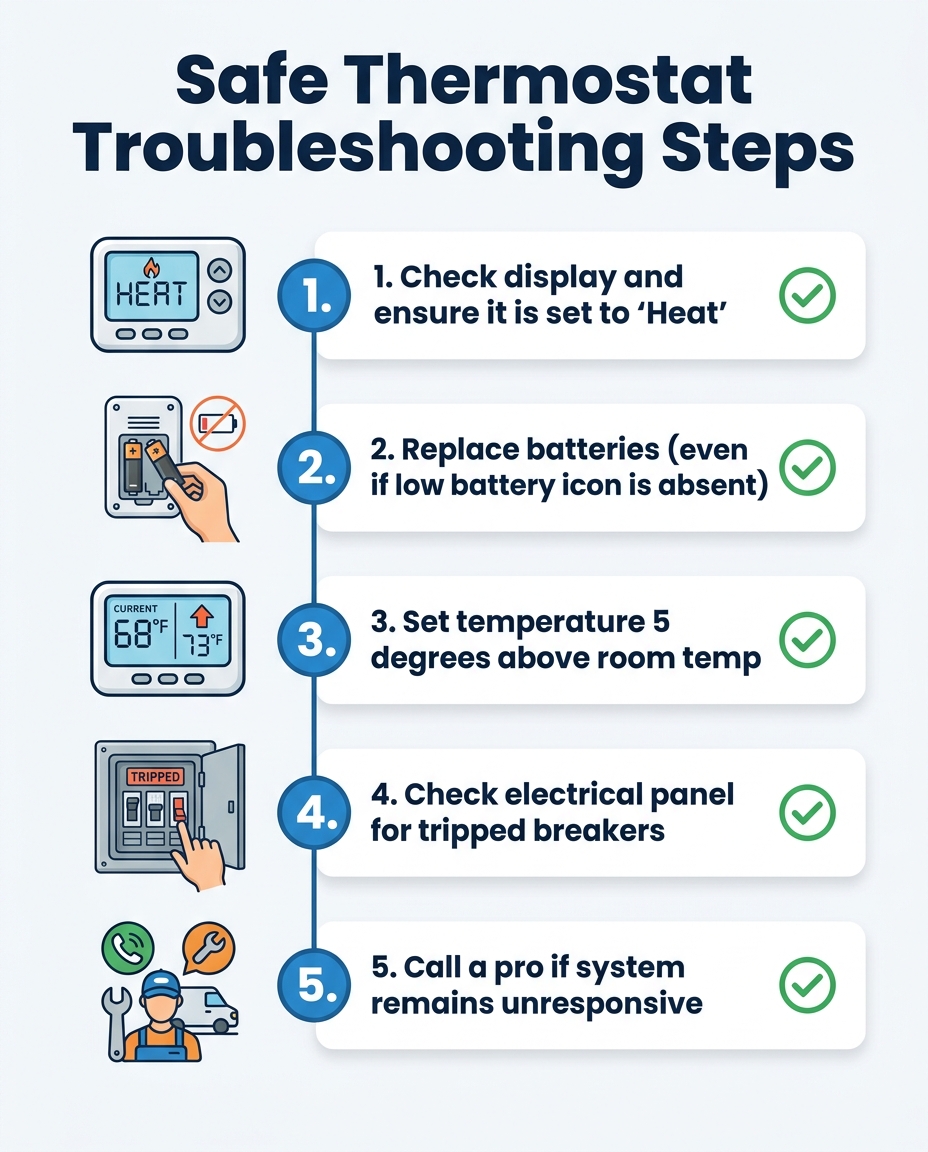
Before you resign yourself to a chilly night and a service call with our technicians, there are several safe, straightforward steps you can take to rule out the thermostat. However, it is critical to observe strict safety boundaries: never open the furnace cabinet, and never attempt to touch or test high-voltage wiring yourself. Stick strictly to the low-voltage controls on your wall.
1. Check the display and settings: Ensure the screen is active. Verify that the system is explicitly set to "Heat" and not accidentally left on "Cool" or "Off." Sometimes, a simple bump can change the setting.
2. Replace the batteries: Carefully pull the thermostat faceplate off the wall and swap out the old batteries with fresh, high-quality alkaline ones. Do this even if the low-battery icon isn't showing; a battery can have enough voltage to run an LCD screen but not enough to trigger a furnace relay during that September first fall cold snap.
3. Verify the temperature setting: Set the thermostat at least five degrees higher than the current room temperature. This creates a clear, undeniable demand for heat and forces the system to attempt an ignition cycle. Listen carefully for a click at the wall.
4. Check the electrical panel: Go to your home's main electrical panel and look for a tripped breaker. If the breaker labeled for your HVAC system is sitting in the middle position, flip it fully off, then firmly back on.
5. Clean the unit gently: If you have an older thermostat, you can use a soft brush or a gentle puff of canned air to clear away any dust that may have settled on the internal sensors over the summer.
If you have completed these steps and the furnace remains completely unresponsive, you have safely exhausted the DIY options and it is time to bring in an expert from our team.
The Value of Honest Diagnostics Over Immediate Replacements
There is a profound emotional relief in discovering that a major breakdown is just a simple control issue. When you are bracing for a massive expense and find out it just takes a pair of AA batteries, the weight lifts immediately. This is why working with a trustworthy technician is so vital for Bridgeville PA area homes.
A reputable professional will always rule out low-voltage and battery issues first. At Sureway Heating Cooling Plumbing, our commitment to precision diagnostics means finding the simplest, most honest fix first instead of jumping straight to a replacement recommendation. Unfortunately, a common industry problem involves technicians using a blank thermostat or a silent furnace as an excuse to push for unnecessary, expensive furnace replacements without checking the basic controls.
Education Over Aggressive Sales
One homeowner reached out to our team in January when their system failed, assuming they needed an entirely new setup immediately. While they ultimately did require a new furnace and condenser due to the system's age and condition, our technician spent significant time reviewing the entire setup and educating the customer on their options, including how federal tax credits may apply to qualifying high-efficiency installations. The outcome was a new system that maintains consistent temperatures and operates efficiently.
That exact same educational, patient approach applies to a thermostat diagnostic. A good technician will walk you through exactly why the system failed to communicate, show you the degraded wire or the faulty sensor, and explain your system's overall health during the diagnostic process. We firmly believe you should never feel pressured into a major purchase when a minor repair will restore your comfort safely.
When to Stop Troubleshooting and Call a Local Expert
While checking settings and changing batteries is perfectly safe, there is a hard boundary where DIY troubleshooting must end. If fresh batteries, basic setting checks, and a breaker reset do not bring your furnace back to life during that September first fall cold snap, the issue requires a professional.
Complex wiring issues, control board failures inside the furnace cabinet, or actual mechanical malfunctions require specialized diagnostic tools and a deep understanding of electrical safety. A Sureway technician can use a multimeter to trace the 24-volt signal from the thermostat down to the furnace, pinpointing exactly where the communication is breaking down.
The Role of Preventative Care
It is worth noting that routine HVAC maintenance can catch these dormant thermostat issues before they cause a chilly night. During a fall tune-up, our technicians actively test the heating cycle, calibrate the thermostat, check the low-voltage wiring for corrosion, and ensure the system transitions smoothly from cooling to heating. Scheduling a thorough evaluation not only resolves immediate glitches but ensures true peace of mind for the long winter ahead.
Restore Your Home's Comfort with Confidence
A silent furnace on a chilly evening doesn't automatically mean a depleted bank account. By understanding how the thermostat acts as the gatekeeper for your heating system, you can approach early fall heating failures with a calm, analytical mindset.
Remember to perform safe, basic checks like swapping batteries and verifying your settings, but never hesitate to rely on professional help when those steps fall short. For homeowners across Bridgeville PA area homes, taking the time to secure professional heating diagnostics from our trusted crew ensures that the problem is resolved safely, honestly, and correctly. Protect your comfort and your peace of mind by letting the experts at Sureway Heating Cooling Plumbing pinpoint the exact cause of your heating delay.
Frequently Asked Questions
How do I know if it's my thermostat or my furnace?
The easiest way to tell is by bypassing the thermostat's internal logic through a simple test. Set the temperature at least five degrees higher than the room temperature and listen for a click at the wall unit. If you hear a click but the furnace remains silent, the issue could be the wiring or the furnace itself; if the screen is blank or unresponsive, the thermostat is likely the culprit.
Can a bad thermostat cause a furnace not to kick on?
Yes, absolutely. The thermostat acts as the brain of the entire heating system. If it fails to send the low-voltage signal to the furnace's control board, the furnace will sit entirely dormant, even if it is in perfect mechanical condition.
What happens when a thermostat goes bad?
When a thermostat begins to fail, you may notice a blank display, a system that short-cycles (turns on and off rapidly), or indoor temperatures that do not match the setting on the screen. Ultimately, it loses the ability to communicate with the HVAC equipment, resulting in a total loss of heating or cooling.
Will a furnace run if the thermostat is broken?
No, a furnace will not run if the thermostat is completely broken and cannot send a signal. The furnace relies on the 24-volt command from the thermostat to initiate its ignition sequence and turn on the blower motor.
Why does my thermostat screen go blank when I switch to heat?
A blank screen when switching modes often points to depleted batteries that lack the power to throw the internal heating relay. It can also indicate a tripped circuit breaker, a blown fuse on the furnace control board, or a safety switch that has cut power to the thermostat to prevent system damage.
How often should I change my thermostat batteries before heating season?
It is best practice to change your thermostat batteries once a year, ideally right before the fall heating season begins. Swapping them out proactively prevents weak signals and sudden system unresponsiveness on the first cold night of the year.



.svg)
.avif)


