


The Late-Summer AC Emergency: When Your Breaker Trips Instantly
Figuring out exactly why your AC compressor trips the breaker immediately upon startup is a critical first step, especially as the August late-summer cooling season brings some of the most intense, unrelenting heat of the year to Bridgeville. You walk to your thermostat, hear a click, and then—nothing. You check your electrical panel and find a tripped breaker. You reset it, but the exact millisecond the system tries to kick on, the breaker snaps off again. Understanding this catastrophic fault protects your home from severe electrical hazards.
This specific symptom points to a severe electrical fault, not a minor glitch or a dirty filter. In our years of providing comprehensive HVAC services throughout the Bridgeville area, our team at Sureway Heating Cooling Plumbing has seen firsthand that when a breaker trips the exact second power is applied to the outdoor unit, your system is experiencing a catastrophic internal failure that requires immediate attention. Your safest course of action is to leave the breaker in the "off" position permanently to prioritize the safety of your home. By securing professional air conditioning repair, you ensure that our licensed experts can accurately diagnose the electrical fault without putting your property at risk.
Immediate vs. Delayed Trips: Why the Exact Timing Matters
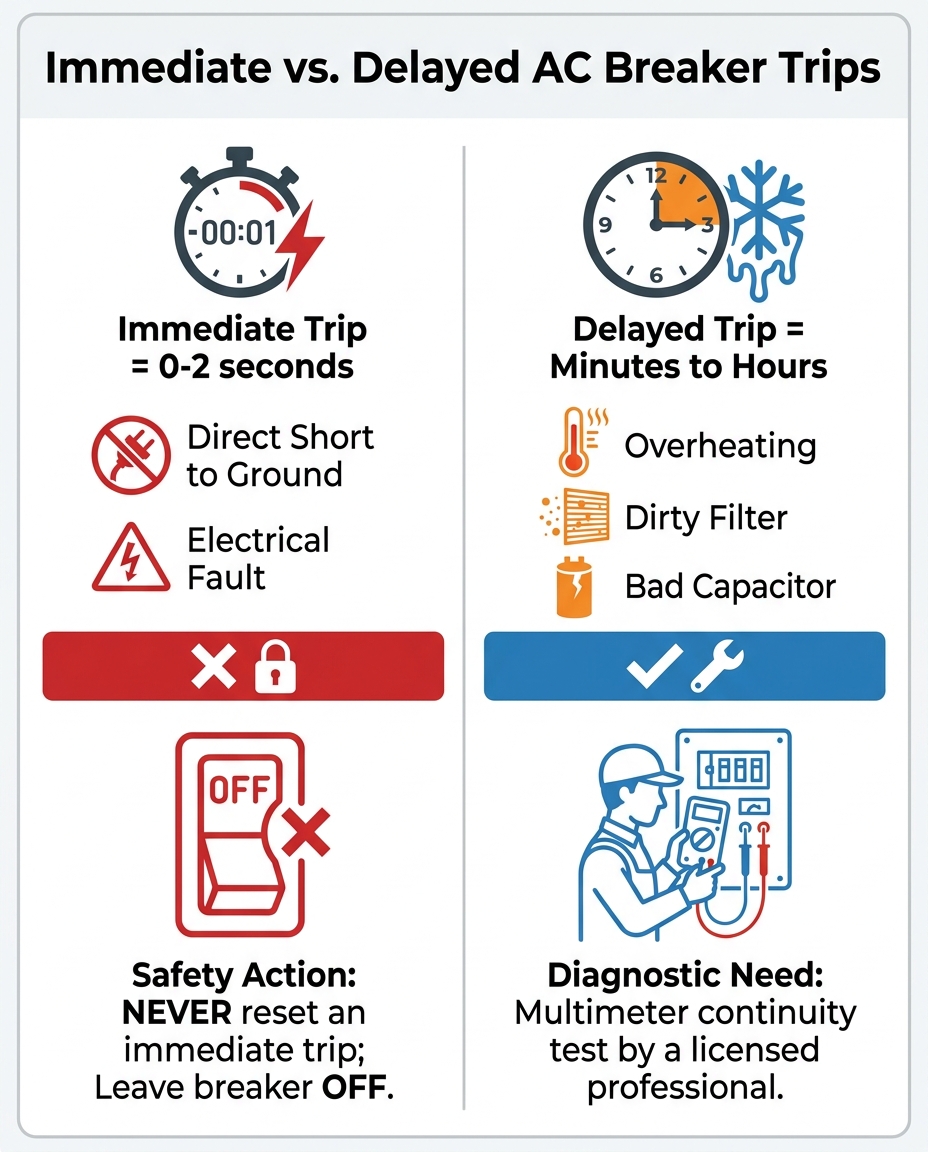
When an air conditioner causes a circuit breaker to trip, the exact timing of the event is the ultimate diagnostic clue for a technician. Homeowners often notice that their system loses power, but paying attention to precisely when the power cuts out can tell you whether you are dealing with a simple airflow restriction or a fatal equipment failure.
A delayed trip occurs minutes or even hours after the air conditioner begins running. In these cases, the system starts normally, blows cold air for a while, and then shuts down. Delayed trips almost always point to a system that is working too hard and gradually overheating. Common culprits include heavily soiled air filters, blocked return vents, or failing fan motors. As the system struggles to breathe or shed heat, it draws more and more electrical current until the breaker finally trips to prevent the wires from melting. While frustrating, delayed trips are often resolved with straightforward repairs or basic maintenance.
An immediate trip is an entirely different scenario. If the breaker snaps to the "off" position the exact instant the outdoor condenser attempts to turn on, you are dealing with a direct electrical fault. The system does not have time to overheat; instead, a massive surge of uncontrolled electricity is hitting the circuit instantly. Understanding this distinction is far more critical than just knowing why your AC circuit breaker keeps tripping in a general sense.
Immediate trips require a completely different diagnostic approach focused on the compressor's internal electrical integrity. Technicians do not look at air filters or ductwork for an instant trip; they look directly at the high-voltage electrical components.
• Immediate Trip — Timing of Failure: 0 to 2 seconds after startup — Typical Underlying Causes: Direct short to ground, severed high-voltage wires, fatal compressor failure — Severity Level: Severe (Electrical Hazard)
• Delayed Trip — Timing of Failure: Minutes to hours after startup — Typical Underlying Causes: Dirty air filters, restricted airflow, failing capacitors, overheating motors — Severity Level: Moderate (Mechanical Strain)

Understanding a "Short to Ground" Inside Your Compressor
To understand why your breaker trips instantly, you have to look inside the heart of your air conditioning system: the compressor. The compressor is a large motor housed inside a welded steel shell. It acts as the pump that moves refrigerant through your home, absorbing heat from the inside and releasing it outside.
Inside that welded steel shell sits a powerful electric motor made up of tightly wound copper wires, known as windings. Because the compressor is a hermetically sealed unit—meaning it is airtight and permanently welded shut—these internal electrical windings are constantly exposed to refrigerant gas and specialized lubricating oil. To keep the electricity flowing properly through the copper wire instead of jumping to the surrounding metal, the copper is coated in a thin layer of protective insulation.
Over years of operation, this protective insulation can degrade. Acid buildup in the refrigerant, extreme heat, or general mechanical wear can strip the coating off the copper wire. When a bare, uninsulated section of that high-voltage copper wire makes physical contact with the metal casing of the compressor, it creates what technicians call a short to ground.
The physics of the trip: Electricity always seeks the path of least resistance to the ground. Normally, the electrical current flows in a controlled loop through the motor windings to do the work of pumping refrigerant. But when the bare wire touches the grounded metal casing, the electricity bypasses the motor entirely. It dumps a massive, uncontrolled surge of electrical current directly into the metal shell of the unit.
Your electrical panel is designed to monitor this flow of current. When the circuit breaker detects this sudden, dangerous surge of electricity, it reacts instantly. Within milliseconds, the breaker snaps open, cutting the power supply to prevent the wires from melting and starting a fire. Because a short to ground is an internal mechanical failure inside a welded steel shell, there are absolutely no safe DIY electrical diagnostic steps a homeowner can perform. The unit is permanently compromised.
The Cumulative Toll of Summer Heat on Compressor Windings
Electrical failures inside a compressor rarely happen overnight. They are usually the result of long-term, cumulative wear, which is why these massive electrical faults tend to occur late in the cooling season. When you live in Bridgeville PA, the hot, humid summers demand a lot from your HVAC system. Your air conditioner does not just run for a few minutes a day; it endures long, strenuous cooling cycles to remove both heat and heavy moisture from your indoor air.
Months of continuous, heavy operation put immense strain on the internal electrical components of your outdoor unit. Every time the compressor cycles on, it generates internal heat. During peak summer heatwaves, the compressor barely gets a chance to cool down before it is called to run again. This prolonged thermal stress bakes the thin enamel insulation coating the copper motor windings inside the compressor. Over several years, and particularly toward the end of a grueling summer, that insulation becomes brittle and begins to flake away.
By late August, right around the back-to-school transition, the cumulative wear often reaches a tipping point. The insulation finally fails completely, the bare copper touches the metal casing, and the compressor shorts to ground, resulting in a sudden, instant breaker trip. One local homeowner reached out during a recent summer heatwave when they needed central air conditioning service and a new unit after their system suddenly failed. A technician initially arrived for plumbing issues, but was able to seamlessly transition to addressing the AC needs, ultimately installing a new unit in a timely manner to restore their home's comfort.
Keeping up with routine AC maintenance earlier in the year is one of the best ways to monitor this cumulative wear. During a thorough tune-up, technicians use specialized meters to measure the electrical draw of your compressor. If the compressor is pulling higher-than-normal amperage, it is often an early warning sign of electrical stress, allowing you to plan for a replacement before a total, unexpected failure leaves you without cooling.
Critical Safety Warning: Do Not Repeatedly Reset the Breaker
When an air conditioner suddenly stops working, the natural instinct for most homeowners is to go to the electrical panel and flip the breaker back on. If the breaker tripped because someone plugged too many appliances into a single outlet, resetting it once usually solves the problem. However, an air conditioner compressor is a massive appliance that draws a significant amount of high-voltage power. If the breaker trips the exact millisecond the AC tries to turn on, you must stop immediately.
A circuit breaker is a critical safety device. It is not a suggestion or a nuisance switch; it is actively protecting your home from a severe hazard. When it trips instantly, it is telling you that there is a direct, uncontrolled electrical short on the line.
Repeatedly forcing the breaker back into the "on" position is incredibly dangerous for several reasons:
• Melting Wires: Every time you force power into a shorted compressor, a massive surge of electricity travels through the wires in your walls. This repeated surging generates intense heat that can melt the protective insulation off your home's wiring.
• Fire Hazards: According to standard National Fire Protection Association (NFPA) electrical safety guidelines, forcing power through a known electrical fault is a primary cause of electrical fires. If the wire insulation melts, the wires inside your walls can spark and ignite surrounding building materials.
• Collateral Equipment Damage: Forcing power through a shorted compressor can send electrical spikes back through the system, potentially frying your thermostat, the indoor furnace control board, or other connected HVAC components.
If your AC trips the breaker immediately upon startup, leave the breaker in the "OFF" position permanently. Do not try to reset it a second or third time to see if it will "catch." Leave it alone, ensure your family is safe, and wait for a licensed professional to arrive.
What to Tell Your HVAC Dispatcher When You Call
When you are facing an emergency AC failure, clear communication with the HVAC dispatcher is essential. Giving the dispatcher precise, accurate details ensures that the technician arrives at your home fully prepared, with the right diagnostic tools and safety equipment ready to go.
If your system is experiencing an instant trip, do not just tell the dispatcher, "My AC isn't working." Instead, use this exact phrasing: "My AC tripped the breaker the exact second it tried to turn on, and I have left the breaker off."
This specific script immediately alerts the dispatch team to a potential high-voltage short to ground, rather than a routine airflow issue or a frozen coil. It tells them that the technician will need to perform advanced multimeter diagnostics on the outdoor unit before attempting to restore any power to the system.
Sureway Heating Cooling Plumbing provides exact, reliable diagnostics so homeowners know definitively if they are dealing with a simple fix or a fatal short, preventing wasted money on parts-swapping guesswork. When our technicians arrive, they will isolate the outdoor unit and use a specialized electrical meter to test the resistance of the compressor windings. This exact diagnostic process eliminates assumptions. It definitively proves whether the compressor has suffered a fatal internal short or if there is a fixable electrical issue elsewhere in the system.
Next Steps: Electrical Repair or Full AC Replacement?
Once the technician completes their multimeter testing, they will present you with a clear diagnosis of why the breaker is tripping instantly. Depending on where the electrical fault is located, you will generally face one of two outcomes.
Outcome 1: A Straightforward Electrical Repair.
In some lucky cases, the short to ground is not inside the compressor itself. Sometimes, the high-voltage wires leading from the electrical disconnect box to the condenser unit become frayed by weed whackers, chewed by rodents, or degraded by the sun. If a bare exterior wire is touching the metal cabinet, it will cause an immediate trip. If this is the case, the technician can often repair or replace the damaged wiring, safely restoring power and getting your system back online without major component replacement.
Outcome 2: A Fatal Compressor Short.
If the multimeter confirms that the short to ground is located inside the hermetically sealed compressor, the compressor is fatal and cannot be repaired. Because the unit is welded shut, there is no way to open it, rewind the copper wire, and seal it back up. In this scenario, you face a major decision: replace just the compressor, or upgrade the entire aging condenser unit.
Replacing a compressor is a highly labor-intensive process that involves recovering the old refrigerant, brazing in a new compressor, pulling a deep vacuum, and recharging the system. If your air conditioner is older, uses outdated refrigerant, or is no longer under the manufacturer's warranty, investing in a brand-new outdoor unit is often the more reliable, cost-effective choice in the long run. One local customer faced a similar situation during the summer when their air conditioner stopped working correctly; a technician arrived, performed the necessary work, cleaned up the area, and clearly explained everything, resulting in a successfully fixed system that restored their comfort.
If you find yourself facing a fatal compressor short on an older system, exploring financing options for AC replacement is a practical next step. Additionally, federal tax credits and local utility rebates may apply to qualifying high-efficiency heat pump or AC installations, helping to offset the upgrade. We always advise readers to verify current programs with their utility provider or a tax professional. This allows you to upgrade to a more efficient, reliable system without bearing the entire burden of an unexpected emergency replacement all at once.
Frequently Asked Questions About AC Breaker Trips
Why does my AC trip the breaker as soon as it turns on?
An immediate trip usually points to a direct short to ground within the system. This happens when internal electrical wiring breaks its protective insulation and touches the metal casing of the unit, causing a massive power surge. The circuit breaker detects this dangerous surge and trips instantly to prevent electrical fires and protect your home's wiring.
Is it safe to turn the AC breaker back on after it trips?
No, it is highly unsafe to reset a breaker that has tripped immediately upon startup. A breaker is a safety device, and an instant trip means it is actively blocking a severe electrical fault. Repeatedly flipping it back on can melt wires inside your walls, destroy the breaker panel, or start a dangerous electrical fire. Always leave it in the off position and call a licensed professional.
Can a bad capacitor cause the breaker to trip immediately?
While a bad capacitor can cause hard starting and eventual breaker trips, it rarely causes an instant trip the exact millisecond power is applied. Capacitor issues usually result in a loud humming or buzzing noise from the outdoor unit, followed by a delayed trip a few seconds or minutes later as the motor overheats. Instant trips are overwhelmingly due to direct shorts to ground or severed high-voltage wires.
How does a technician test for a shorted compressor?
Professionals use a specialized electrical multimeter to measure the electrical resistance (measured in ohms) between the compressor's electrical terminals and the copper refrigerant lines. If the meter shows continuity to ground—meaning electricity is flowing to the metal casing—the compressor is definitively shorted and must be replaced. This exact diagnostic process eliminates all guesswork.
Will a dirty air filter cause an immediate breaker trip?
No, a dirty air filter will not cause an immediate breaker trip upon startup. A severely clogged filter restricts airflow, which can cause the indoor evaporator coil to freeze and the blower motor to overwork, eventually tripping the breaker due to overheating. However, this is a delayed trip that happens after the system has been running for a while. Instant trips are purely electrical faults.
Get Expert Diagnostics for Your AC Electrical Fault
Dealing with an air conditioner that trips the breaker the exact moment it turns on is a serious, high-stress situation, especially during the peak heat of late summer. An immediate breaker trip is a severe symptom that requires professional intervention; it is your home's electrical system working exactly as designed to protect you from a catastrophic short to ground.
Having a clear explanation of the mechanics behind the failure gives you the confidence to handle the situation safely. By leaving the breaker off and knowing the exact words to tell your dispatcher, you set the stage for a fast, accurate resolution. If your system is refusing to run and instantly snapping the breaker, do not risk your safety by forcing it back on. Schedule an inspection with a local expert today to safely diagnose the electrical fault and restore your home's comfort.



.svg)
.avif)


