


The Hidden Vulnerabilities in Local Radiant Heating Systems
If you live in a historic property, you might be wondering exactly why McDonald PA homes often require specialized boiler maintenance before the winter chill sets in. At Sureway Heating Cooling Plumbing, our technicians have spent years servicing vintage heating systems across the Bridgeville and McDonald areas, and we've seen firsthand what happens behind those heavy metal casings. Your older boiler is working hard to keep your house comfortable, but unseen problems are likely developing. Over decades of use, water-based radiant systems accumulate hidden scale buildup and develop undetected pressure irregularities that can compromise their performance.
Addressing these vulnerabilities early is a critical decision point for homeowners. You can either proactively service the unit now, or wait until a freezing night forces an emergency repair. Taking care of your heating systems before the temperature drops ensures your equipment runs safely and efficiently all season long.
Older radiant heat systems operate differently than modern forced-air furnaces. Instead of blowing warm air through ducts, they circulate heated water or steam through a network of pipes and radiators. Because water is constantly heated, cooled, and recirculated, the internal components are subjected to unique chemical and physical stresses. In our daily field work, we consistently find that these stresses create hidden vulnerabilities that a standard visual inspection will completely miss.
Common hidden issues in aging radiant systems:
• Mineral scaling: Hard water deposits coat the inside of the heat exchanger, acting as an unwanted insulator.
• Micro-leaks: Tiny breaches in older pipe joints allow air to enter the closed-loop system, causing circulation blockages.
• Corroded expansion tanks: Waterlogged expansion tanks fail to absorb pressure changes, leading to dangerous pressure spikes.
• Sludge buildup: Rust and sediment settle at the bottom of the boiler, blocking water flow and reducing heat output.
When you live in one of the McDonald PA older residential homes, your heating infrastructure requires a trained eye. A basic filter change and burner check won't address the complex hydronic issues that develop inside these vintage units.
Understanding the Unique Profile of Historic Local Architecture
The architectural history of our area is rich and enduring. Many homes were built during an era when cast-iron boilers and heavy radiant radiators were the gold standard for residential heating. These systems were built to last, and many original radiators are still actively warming rooms today. However, the internal plumbing that supports them has endured decades of hard water cycling, thermal expansion, and continuous use.
Maintaining these vintage setups requires specific expertise, especially across McDonald and surrounding service areas. Retrofitting a historic structure with modern ductwork is often incredibly invasive, requiring contractors to cut through original plaster, hardwood floors, and structural beams. Because replacing the entire system is usually impractical, preserving the existing radiant infrastructure becomes the best path forward.
Our team at Sureway Heating Cooling Plumbing sees the unique challenges of historic home infrastructure every fall season. Just recently, a homeowner with a turn-of-the-century property reached out to us regarding complex hydronic issues tied to their aging system. We tackled these historic home challenges thoroughly and responsively, resolving the plumbing issues effectively without damaging the property's original character. In our experience, this level of care is mandatory when working with vintage local architecture.
The Legacy of Cast-Iron and Radiant Heat
Cast-iron radiators are famous for their incredible durability and their ability to hold heat long after the boiler stops firing. But that durability can create a false sense of security. While the radiators themselves might outlast the house, the boiler heating the water is still subject to modern efficiency standards and mechanical wear.
Because these setups rely on water rather than air, the maintenance requirements are vastly different from a standard heat pump or furnace. Aging infrastructure demands specialized care. Your technician must understand how to balance the entire network, ensuring that the radiator in the farthest upstairs bedroom gets the same flow of hot water as the one right next to the boiler.
The Mechanics of Scale Buildup in Older Boilers
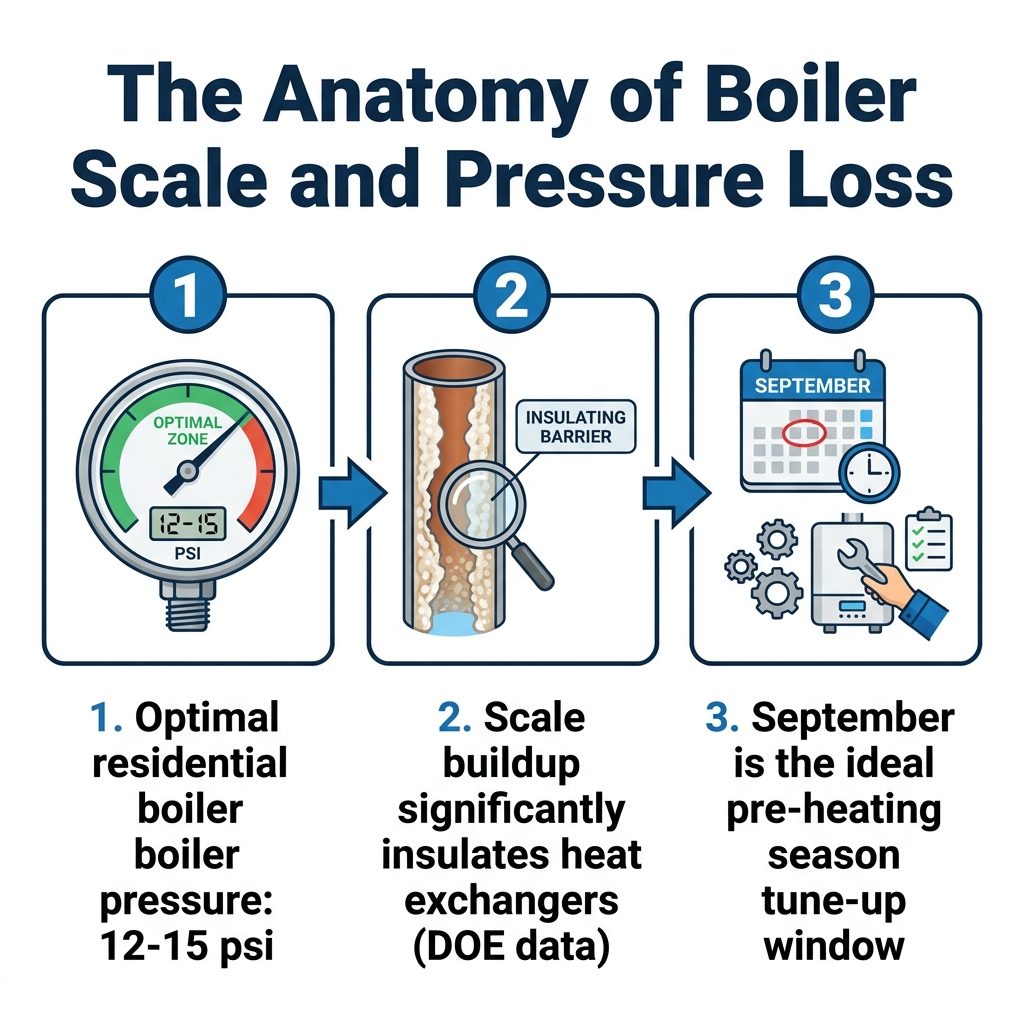
One of the most persistent threats to your boiler's longevity is mineral scaling. When hard water is heated, the calcium and magnesium dissolved in the water begin to precipitate out. These minerals leave the water and cling directly to the metal surfaces of the heat exchanger. Over years of operation, this creates a thick, rock-like layer of scale inside the unit.
According to data from the U.S. Department of Energy (DOE), scale buildup acts as a powerful insulator. Instead of the burner's heat transferring directly into the water, the heat must first push through the mineral layer. This drastically reduces the efficiency of your system. The boiler has to burn more fuel and run for longer cycles just to reach your thermostat's set temperature.
We prioritize educating our customers on these hidden mechanics. Recently, a local customer called our team regarding some general service issues with their boiler. Our technician promptly arrived, identified severe scaling, and took the time to explain exactly how this buildup was straining their system. By understanding exactly how scale affects the equipment, the customer received highly informative and effective service that addressed the root cause, not just the symptoms.
Why Mineral Deposits Are a Silent Threat
The chemical process of scaling happens entirely out of sight. You will not hear a sudden loud noise or see an obvious leak when scale begins to form. Instead, the damage is cumulative and silent. As the scale thickens, the metal heat exchanger absorbs more thermal stress because the heat cannot escape into the water fast enough. This uneven heating causes the metal to warp, crack, and eventually fail.
• Light Scaling — System Impact: Minor efficiency drop (1-3%) — Noticeable Symptoms: Slightly longer heating cycles
• Moderate Scaling — System Impact: Noticeable efficiency loss (5-10%) — Noticeable Symptoms: Higher energy bills, uneven room heating
• Severe Scaling — System Impact: Major efficiency loss, thermal stress — Noticeable Symptoms: Banging noises (kettling), system overheating
For McDonald PA older residential homes, treating this scale is not a DIY project. It requires professional descaling solutions that break down the minerals without corroding the vital metal components of the boiler itself.

Why Pressure Calibration is Critical Before Freezing Temperatures Arrive
Beyond scale buildup, your boiler's internal pressure dictates how well it functions. For optimal and safe operation, a standard residential boiler must maintain a pressure between 12 and 15 psi. If the pressure strays outside this narrow window, the entire heating cycle breaks down.
When the pressure drops too low, the system loses the ability to push water up to the second or third floor of your home. You will notice that the downstairs radiators are boiling hot while the upstairs radiators remain ice cold. Conversely, if the pressure spikes too high, the system becomes dangerous. The built-in safety relief valve will discharge scalding water onto your basement floor to prevent the boiler vessel from rupturing.
Western Pennsylvania experiences harsh, freezing winters, making proactive pressure checks in early fall critical to prevent catastrophic mid-winter pipe freezing. If your boiler loses pressure and shuts down during a January cold snap, the stagnant water inside your radiant pipes can freeze solid, splitting the cast iron and causing devastating water damage.
Never attempt to manually adjust your boiler's pressure-reducing valve or expansion tank on your own. Calibrating these vessels requires specific gauges and a deep understanding of hydronic physics. Always rely on a licensed professional to adjust your system during the September pre-heating season.
The Dangers of Mid-Winter Pressure Loss
When a boiler loses pressure during peak winter demand, the consequences escalate quickly. Without proper circulation, the heat distribution to your upper floors stops completely. This leaves bedrooms freezing and forces space heaters to run continuously.
More importantly, stagnant water in perimeter pipes—especially those running along poorly insulated exterior walls—is highly susceptible to freezing. A pressure failure is not just a comfort issue; it is a structural risk to your home. Calibrating the pressure in the fall ensures your system has the hydraulic force needed to keep water moving on the coldest nights of the year.
The Risks of Delaying Pre-Season Boiler Descaling
Ignoring specialized maintenance until the system is under heavy winter load is a gamble that rarely pays off. Running a heavily scaled boiler during peak winter demand forces the equipment to work twice as hard. The burner runs longer, the circulator pumps run continuously, and the heat exchanger bakes under trapped thermal energy. This accelerates component wear and dramatically shortens the lifespan of the unit.
There is a massive difference between a controlled, proactive service visit in the early fall and an emergency repair in the dead of winter. During the September pre-heating season, technicians have the time to carefully drain the system, apply descaling agents, flush the lines, and recalibrate the pressure. If you wait until the system fails in January, you are dealing with a cold house, frozen pipes, and emergency service timelines.
Most homeowners don't realize that standard heating tune-ups often overlook deep descaling. A generic HVAC check might inspect the gas valve and change a filter, but it takes specialized hydronic knowledge to properly clean the water side of the equipment. Understanding how our technicians perform comprehensive boiler service is key to knowing what your older system actually needs to survive the winter.
Why Boiler Systems Demand Dual-Trade Expertise
Boilers are unique because they sit at the exact intersection of water mechanics and combustion technology. They are half plumbing system and half HVAC system. Because of this, standard single-trade contractors often lack the holistic knowledge required to service them properly. An HVAC-only technician might understand the gas burner but struggle with the water pressure, while a standard plumber might understand the pipes but lack the training to tune the electronic heating controls.
Proper maintenance requires a technician who understands piping, water filtration, expansion tanks, and complex heating controls simultaneously. If the water quality is poor, the heating elements will fail. If the heating elements are misaligned, the water won't circulate. The two sides of the system are entirely dependent on one another.
As a comprehensive HVAC and plumbing provider serving the Bridgeville and McDonald communities, Sureway Heating Cooling Plumbing is uniquely equipped to handle these complex boiler systems, offering expert knowledge of both trades. We do not have to guess how the hydronic side impacts the combustion side because our teams are cross-trained in both disciplines. This dual-trade expertise is exactly what McDonald PA older residential homes need to keep their vintage systems running safely.
Bridging the Gap Between Water Mechanics and Heating
Water quality plays a massive role in heating longevity. If your home has hard water, the plumbing side of the boiler will suffer from scale, which immediately impacts the HVAC side's ability to generate heat. Comprehensive diagnostics require a multi-disciplinary approach.
We evaluate your residential plumbing systems alongside your heating elements to ensure the water feeding into your boiler is clean, properly pressurized, and free of highly corrosive minerals. This holistic approach prevents premature breakdowns and keeps your energy consumption as low as possible.
Securing Your Home's Warmth for the Upcoming Winter
There is immense peace of mind that comes from knowing your specialized local system has been properly descaled, flushed, and calibrated by a professional. You do not have to spend the winter worrying about kettling noises in the basement or cold radiators in the upstairs bedrooms.
Take action during the September pre-heating season before the fall window closes. By scheduling your specialized boiler maintenance now, you ensure that your historic home remains consistently warm, safe, and efficient, no matter how harsh the Western Pennsylvania winter gets.
Frequently Asked Questions
Why do older boilers need to be descaled?
Older boilers need to be descaled because hard water minerals precipitate out during the heating process and cling to the metal heat exchangers. Over time, this creates a thick layer of scale that acts as an insulator, blocking heat transfer. Descaling removes this buildup, restoring the system's efficiency and preventing the metal components from overheating and cracking.
How do I know if my boiler has pressure issues?
You will usually notice pressure issues when the heat distribution becomes uneven across your home. If your upstairs radiators remain cold while the downstairs units are hot, the pressure is likely too low to push the water upward. Additionally, if you see water pooling around the boiler from the pressure relief valve, the system pressure has spiked too high and requires immediate professional calibration.
Who is qualified to service a residential boiler?
Servicing a residential boiler requires a licensed professional with dual-trade expertise in both HVAC and plumbing. Because boilers rely on complex combustion controls (HVAC) and closed-loop water circulation (plumbing), a standard single-trade technician may miss critical issues. Always hire a specialized hydronic heating expert to handle descaling, pressure calibration, and safety checks.
What happens if you don't descale a boiler?
If you skip descaling, the mineral buildup will continue to thicken, forcing the boiler to burn significantly more fuel to heat the water. This leads to higher energy bills, longer heating cycles, and severe thermal stress on the heat exchanger. Eventually, the trapped heat will cause the metal to warp or crack, resulting in a catastrophic system failure and expensive replacement.
Why is my boiler losing pressure?
A boiler typically loses pressure due to micro-leaks in the aging pipe joints, a failing pressure-reducing valve, or a compromised expansion tank. Even a pinhole leak in a radiator valve can allow enough water to escape over time to drop the system pressure below the required 12 psi. A professional technician must perform a thorough diagnostic to locate the leak and restore the proper hydraulic balance.
What is the difference between HVAC and plumbing boiler service?
HVAC boiler service typically focuses on the combustion side, including the gas valve, burners, electronic controls, and exhaust venting. Plumbing boiler service focuses on the hydronic side, including water pressure, pipe integrity, expansion tanks, and circulation pumps. Proper boiler maintenance requires both disciplines working together to ensure the water is safely heated and effectively distributed.
How often should an older boiler be serviced in Western PA?
An older boiler in Western PA should be professionally serviced at least once a year, ideally during the early fall before the first freeze. Annual service ensures that scale is removed, pressure is calibrated, and safety controls are tested before the system is placed under heavy winter load. Proactive annual maintenance is the most effective way to prevent mid-winter breakdowns in historic homes.




.svg)
.avif)


