


Pro Tips: Why Long Dryer Duct Runs Are a Bigger Problem Than Most Homeowners Realize
How dryer vent boosters solve long duct run problems comes down to one simple trick: when your dryer's exhaust duct runs too far, airflow weakens, and everything suffers — from drying times to home safety.
Here are the essential tips for managing long duct runs:
• Standard dryers are built to push air through roughly 25 feet of straight duct
• Every 90-degree elbow adds the equivalent of 5 extra feet of resistance
• Once you exceed that limit, moist air and lint back up inside the duct
• A dryer vent booster fan is an inline fan installed in the duct that restores lost airflow velocity
• With a booster, vent runs of 60 to 100 feet or more become manageable
• The result: faster drying, less lint buildup, lower energy use, and reduced fire risk
Most homeowners don't think much about what happens behind the wall after the dryer kicks on. But when a duct snakes through a ceiling, bends around framing, or climbs two floors before reaching the outside, the dryer is fighting serious resistance with every cycle. Clothes stay damp. The dryer runs hot. And lint — one of the leading causes of home fires — quietly accumulates where you can't see it. According to the U.S. Fire Administration, approximately 2,900 home dryer fires occur every year, with failure to clean the vent as the leading cause. Long, restricted ducts make that risk worse.
A dryer vent booster fan fixes the underlying airflow problem, not just the symptoms.
The Secret to Better Airflow: How Dryer Vent Boosters Solve Long Duct Run Problems
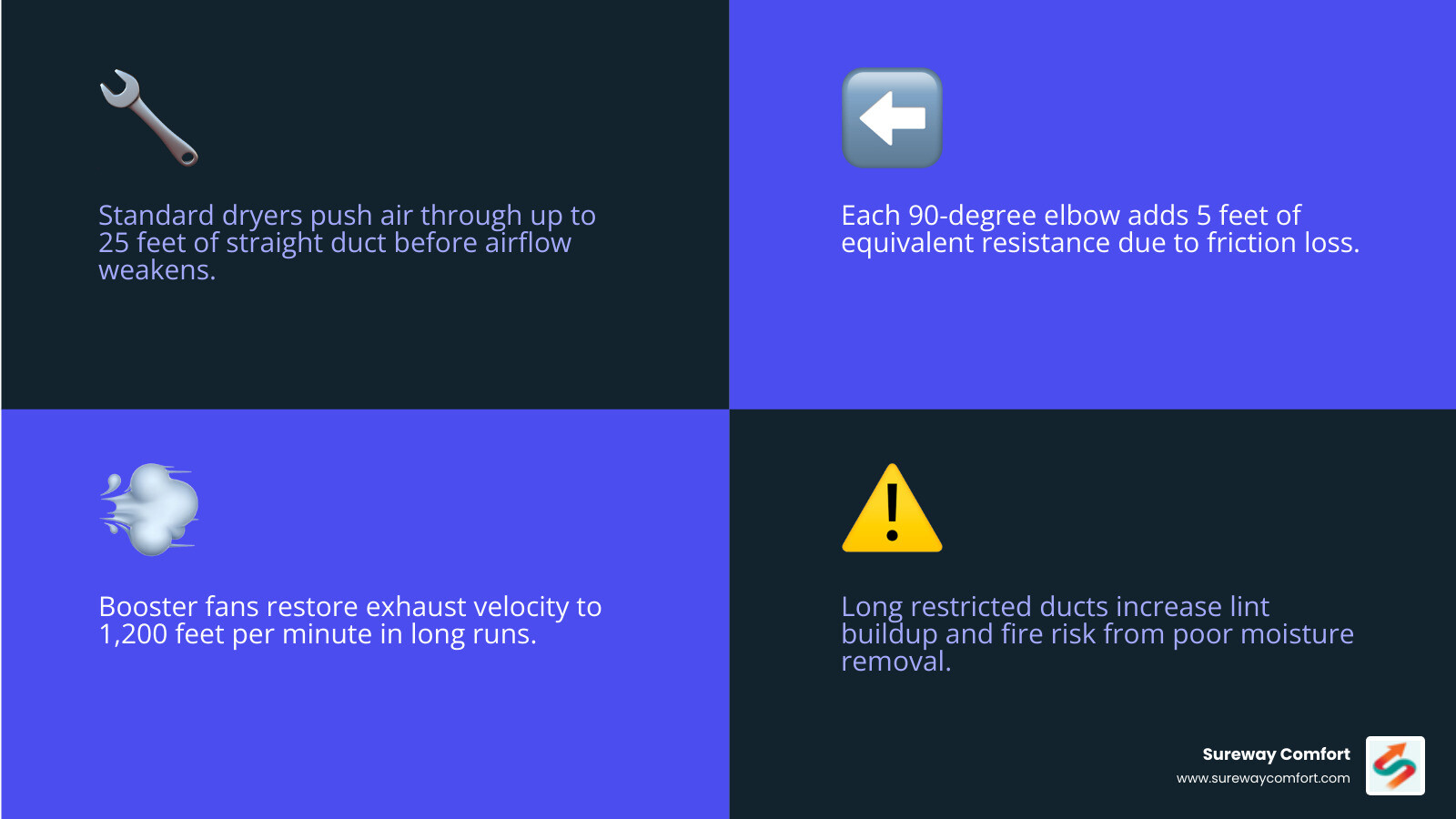
To understand why a booster fan is such a game-changer, we first have to look at the physics of your laundry room. Every dryer has an internal blower, but it isn't an industrial-strength machine. It’s designed to push hot, moist air through a relatively short distance—usually about 25 feet of straight, smooth metal duct.
When your ductwork exceeds this length, it encounters airflow resistance. Think of it like trying to breathe through a very long straw; the longer the straw, the harder you have to work. This creates back pressure, which forces the dryer’s internal fan to work against a wall of air. Friction loss occurs as the air rubs against the sides of the duct, slowing it down further.
This is exactly how dryer vent boosters solve long duct run problems. By installing an inline fan midway through the run, you create a "relay race" for your exhaust. The dryer pushes the air the first half of the way, and the booster fan picks it up and pulls it the rest of the way to the exit.
Pro Tip: Maintaining airflow velocity
The goal of any venting system is to maintain an exhaust speed of at least 1,200 Feet Per Minute (FPM). Why 1,200? Because that is the "magic number" required to keep lint airborne. If the velocity drops below this, lint becomes too heavy for the air to carry and settles at the bottom of the duct.
Booster fans ensure that even with heavy loads or vertical runs—where the dryer has to fight gravity to push air upward—the velocity remains high enough to move moisture and lint completely out of the house. Without this assist, moisture condenses inside the cool duct, creating a sticky trap that catches lint and eventually leads to a total blockage.
Why homeowners ask how dryer vent boosters solve long duct run problems in multi-story layouts
In many modern homes in Bridgeville and Mt. Lebanon, laundry rooms have moved from the basement to the second floor or even the attic. While this is convenient for carrying baskets, it often results in complex duct routing. Vents might travel through floor joists, make several 90-degree turns, and exit through a roof jack.
Since every 90-degree elbow carries a "penalty" of 5 equivalent feet, a duct that is physically 15 feet long but has three elbows actually performs like a 30-foot duct. This exceeds the standard capacity of most dryers. We often see this in local Category/Dryer Vent assessments where homeowners are frustrated that their "new" home takes two hours to dry a single load of towels.
5 Tips to Spot If Your Home Needs an Airflow Boost
How do you know if your duct is too long or restricted? Your dryer is usually trying to tell you, but you have to know what to listen (and look) for. Use these diagnostic tips to check your system:
• Long Drying Cycles: If a standard load of jeans takes two or three cycles to dry, your dryer isn't broken—it’s suffocating.
• Excessive Humidity: If your laundry room feels like a sauna or you see "sweat" on the walls behind the dryer, the moist air isn't escaping properly.
• Hot Dryer Exterior: When air can't escape, the heat stays trapped in the drum. If the top of your dryer is hot to the touch, it’s a sign of a dangerous heat buildup.
• Musty Smells: Damp lint sitting in a long duct will eventually start to smell like a wet basement.
• Lint Bypass: If you find lint all over the floor behind your dryer or inside the cabinet, the back pressure is so high that the air is forcing its way out of the machine's internal seals.
Identifying restricted airflow in long ducts
Modern "smart" dryers are often equipped with sensors that display error codes like "D80," "D90," or "D95." These codes specifically indicate that the duct is 80%, 90%, or 95% blocked. However, even without a digital screen, you can check for condensation buildup in the terminal hood outside. If you feel only a faint, lukewarm breeze at the exterior vent while the dryer is running, your airflow is severely restricted.
Pro Tips for Selecting a Reliable Booster Fan System
Not all fans are created equal. You cannot simply go to a hardware store and buy a standard "duct fan" used for heating and cooling. Dryer exhaust is hot, wet, and full of flammable lint. A standard fan will quickly clog or, worse, become a fire hazard itself.
When we look for a reliable system, we prioritize the following features:
• UL 705 Listing: This is the gold standard for safety. It ensures the fan is specifically tested for dryer exhaust applications.
• DEDPV Standards: DEDPV stands for Dryer Exhaust Duct Power Ventilator. These units are engineered to handle high temperatures and have specialized impellers that resist lint buildup.
• Pressure Sensors: High-quality boosters feature an internal pressure switch. When the dryer starts, it creates a small amount of air pressure that the sensor detects, automatically kicking the booster fan into gear.
• Indicator Panels: Many systems include a small light panel for your laundry room wall. It glows when the fan is working correctly and flashes if there is a blockage or fan failure.
Safety certifications and code compliance
Building codes, specifically IRC Section M1502.6, have strict requirements for long vent runs. In many jurisdictions around Upper St. Clair and Bethel Park, if a vent exceeds 35 feet, a listed booster fan is legally required.
Reliable boosters also feature a fire shutoff. If the air temperature inside the duct exceeds a safe limit (usually around 165°F to 190°F), the fan will automatically shut down to prevent fanning the flames of a potential lint fire. Proper installation also involves using metal housing rather than plastic, as metal can withstand much higher heat. You can learn more about these safety standards in our guide on Dryer Vent Cleaning And Maintenance.
Maintenance Tricks for Extended Vent Systems
Adding a booster fan makes your system more powerful, but it doesn't make it maintenance-free. In fact, because the fan is an extra component in the line, it needs its own set of checks. Use these maintenance tricks to keep your system in top shape.
We recommend installing a secondary lint trap between the dryer and the booster fan. This acts as a second line of defense, catching the fine lint that escapes the dryer's internal screen before it can reach the fan blades. This keeps the booster running efficiently for years.
Maintenance Checklist for Booster Systems:
1. Clean the Secondary Trap: Check this every few loads, just like your main lint screen.
2. Inspect Fan Blades: Once a year, the fan should be opened and the impeller (blades) wiped clean of any "fuzz" that has stuck to them.
3. Check the Seals: Ensure all joints are sealed with UL-listed foil tape, never plastic duct tape, which dries out and peels off.
4. Rigid Metal Only: Ensure your entire long run is made of smooth, rigid metal ducting. Flexible foil or plastic "accordion" vents are fire hazards and create massive airflow resistance.
• Effort — Booster Fan System: Moderate (Install in duct) — Rerouting the Duct: High (Cutting walls/roof) — Ventless (Heat Pump) Dryer: High (Buying new appliance)
• Airflow — Booster Fan System: Significantly Increased — Rerouting the Duct: Improved — Ventless (Heat Pump) Dryer: N/A (Closed loop)
• Cost — Booster Fan System: Mid-range — Rerouting the Duct: Varies (Can be high) — Ventless (Heat Pump) Dryer: High (Appliance cost)
• Drying Speed — Booster Fan System: Fastest — Rerouting the Duct: Fast — Ventless (Heat Pump) Dryer: Slower
• Best For — Booster Fan System: Multi-story homes — Rerouting the Duct: Accessible walls — Ventless (Heat Pump) Dryer: Condos/Apartments
Preventing lint ignition in long runs
The statistics are sobering: lint ignition is responsible for approximately 16,000 home fires annually in the U.S. In a long duct, the risk is higher because the lint has more surface area to cling to. When a booster fan is working correctly, it keeps that lint moving so it doesn't have a chance to settle and become tinder.
However, professional cleaning is still vital. A booster fan can push air through a long duct, but it cannot push out a three-inch-thick "lint snake" that has already solidified. We recommend a full professional cleaning of the duct and the fan unit at least once a year for heavy-use households.
Expert Tips: Frequently Asked Questions About Dryer Boosters
How long can a dryer vent run with a booster fan?
While a standard dryer is limited to about 25–35 equivalent feet, a high-quality booster fan can extend that significantly. Most manufacturer specifications allow for runs of 60 to 100 feet, and some high-performance DEDPV systems can support up to 125 feet of equivalent length. Always check the specific rating of the fan model being installed to ensure it matches your home's layout.
Do I still need to clean my vents if I have a booster?
Absolutely. Think of the booster fan like a turbocharger on a car engine; it makes the system perform better, but you still need to change the oil. Lint can accumulate on the fan's impeller blades, which can eventually cause the fan to vibrate, become noisy, or lose its effectiveness. Annual maintenance ensures the system stays safe and quiet.
Can I install a dryer vent booster fan myself?
While some homeowners with advanced DIY skills might feel comfortable, we generally recommend professional installation. A booster fan requires both electrical wiring and precision ductwork. It must be calibrated to the correct pressure sensitivity and sealed perfectly to prevent leaking moist air into your attic or wall cavities. Furthermore, ensuring the installation meets local Bridgeville building codes is essential for home insurance and resale value.
Conclusion: Final Tips for a Safer Home
At Sureway Comfort, we’ve seen how a simple airflow fix can save a homeowner’s sanity. No one wants to spend their entire Saturday waiting for three loads of laundry to dry, and no one should have to worry about the hidden fire risk lurking in their walls.
Whether you’re in McDonald, Canonsburg, or Upper St. Clair, our team of Bridgeville HVAC experts is here to help. We provide reliable diagnostics to determine if your venting issues are caused by a simple clog or a duct run that’s just too long for your dryer to handle. With responsive scheduling and a commitment to home safety, we can help you find the right solution.
If your laundry is taking forever, don't blame the dryer—check the vent. A Dryer Vent Booster Fan System With Lint Trap might be exactly what you need to get your chores back on track and your home back to peak safety. Give us a call today, and let’s get that air moving again!





.svg)
.avif)


