
Tank vs Tankless: The Ultimate Guide
Thinking about switching from tank to tankless? Learn the real benefits, the gas line and venting upgrades to plan for, how to size a unit, and what yearly maintenance involves.
Switching From a Tank to a Tankless Water Heater: What to Know and Pro Tips
Switching from tank to tankless is one of the biggest water heater decisions a homeowner can make — and there's more to it than just swapping one unit for another. Here are the top tips for what the conversion actually involves:
Quick Overview: Pro Tips for Your Switch
| Factor | What to Expect |
|---|---|
| How it works | Tankless heats water on demand instead of storing it |
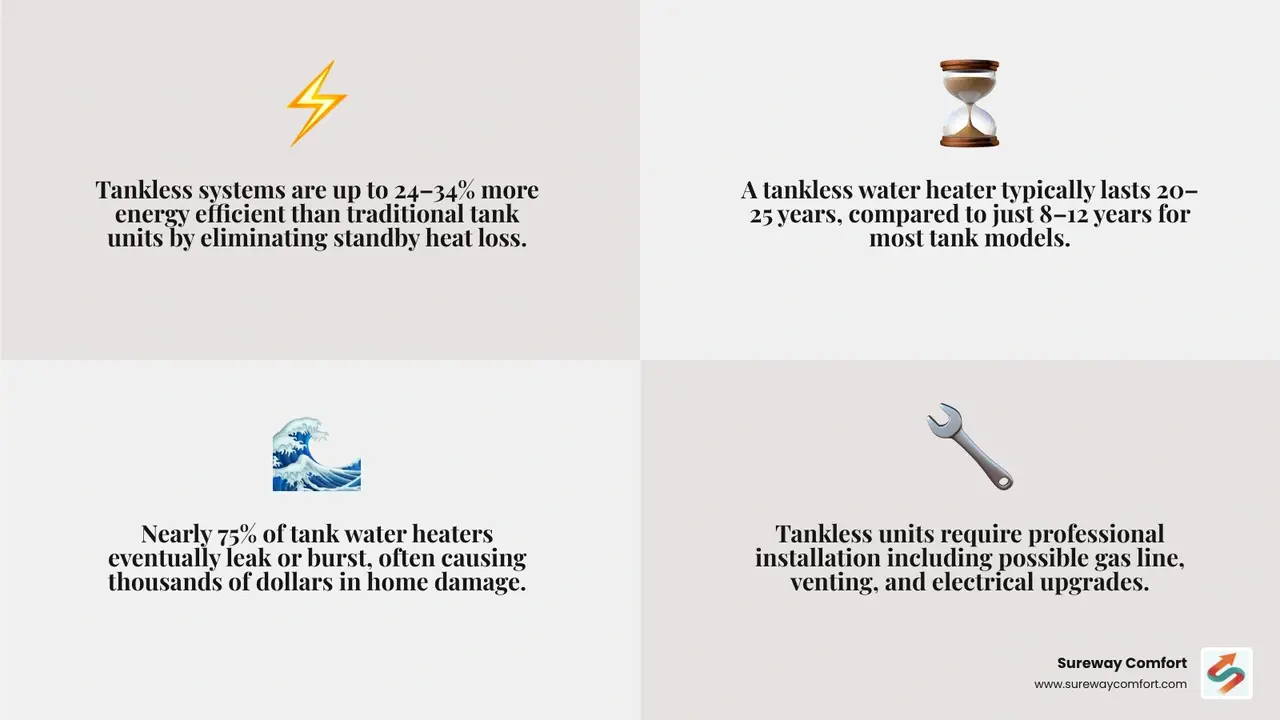
| Energy efficiency | Up to 24–34% more efficient for average-use homes |
| Lifespan | Tankless lasts 20–25 years vs. 8–12 years for tank units |
| Infrastructure | May need gas line, venting, or electrical upgrades |
| Sizing | Must be sized by peak flow rate (GPM), not tank gallons |
| Installation | Requires a licensed professional and local permits |
| Maintenance | Annual descaling required, especially in hard water areas |
| Initial Setup | Requires more planning than a tank replacement, but long-term efficiency is higher |
If your current tank is aging, you're running out of hot water during busy mornings, or you're planning a home renovation, this guide is for you. A tank water heater quietly does its job — until it doesn't. Nearly 75% of traditional tank heaters eventually burst or leak, spilling up to 80 gallons of water and causing significant property damage. That kind of failure is rarely convenient, and it's almost always unexpected.
Tankless systems solve several of those problems at once. They heat water only when you need it, take up a fraction of the space, and can last more than twice as long as a conventional tank. But the switch isn't plug-and-play. Your gas line, venting setup, and electrical supply may all need attention before a tankless unit can even be installed properly.
This guide walks you through everything — the real benefits, the honest tradeoffs, what infrastructure upgrades to plan for, how to size the right unit, and what ongoing maintenance looks like — so you can make a confident, informed decision.
Pro Tips: Comparing Tank and Tankless Performance
When we talk about switching from tank to tankless what to know, the first step is understanding the mechanical "why" behind the change. Traditional tank water heaters work like a large kettle that never stops boiling. They store 40 to 80 gallons of water and keep it at a set temperature 24/7. This leads to "standby heat loss," where energy is wasted keeping water hot even while you're asleep or at work.
Tankless units, often called "on-demand" heaters, skip the storage entirely. When you turn on a hot water tap, a flow sensor activates a high-powered heat exchanger. Water travels through a series of coils, getting blasted with heat instantly before reaching your shower.
| Feature | Storage Tank Water Heater | Tankless Water Heater |
|---|---|---|
| Operation | Constant heating of stored water | Heats only when water flows |
| Energy Factor | Typically .60 to .70 UEF | Up to .94 to .96 UEF |
| Heat Input | ~30,000 to 50,000 BTU/H | ~150,000 to 199,000 BTU/H |
| Lifespan | 8–12 years | 20–25 years |
| Space | Large footprint (24"+ diameter) | Compact, wall-mounted |
For a detailed breakdown of these mechanics, check out our Tankless vs Tank Water Heater Comparison.
In terms of efficiency, tankless units are the clear winners. They are roughly 24-34% more energy-efficient for homes using 41 gallons or less of hot water daily. Even in high-demand households, they typically offer 8-14% better efficiency. This efficiency is measured by the Uniform Energy Factor (UEF). While newer tank models might reach a .70 UEF, high-end tankless water heaters can achieve ratings as high as .96, meaning 96% of the energy used goes directly into heating your water.
Switching From Tank to Tankless: Tips for Maximizing Benefits
The upgrade to a tankless system isn't just about being "green"; it's about peace of mind. One of the most overlooked benefits is the reduced risk of a catastrophic flood. Since a tankless unit doesn't store a massive reservoir of water, you don't have to worry about a "burst tank" scenario that can dump 50 gallons of rusty water into your basement. Given that nearly 75% of tanks eventually leak, this is a major safety upgrade.
Beyond safety, there is the long-term value. The extended 20-25 year lifespan means you may go through two or three traditional tanks in the time it takes for one tankless unit to retire. You can learn more about the value in our guide to Tankless Water Heater Cost vs Value Long-Term. A robust Tankless Water Heater Warranty also helps protect your system for decades.
Switching from tank to tankless: tips for endless hot water
We've all been there: the third person in the shower gets the "Arctic surprise" because the tank ran out. With a tankless system, that simply doesn't happen. As long as you have gas and water, you have hot water. It provides a continuous flow, meaning the last person to shower gets the same temperature as the first.
However, "endless" doesn't mean "infinite simultaneous use." While the hot water won't run out, the unit has a maximum flow rate. If you try to run three showers, the dishwasher, and the washing machine at once, the unit might struggle to keep up with the "peak demand," resulting in a drop in water pressure or temperature.
Switching from tank to tankless: tips for space savings
Traditional tanks are bulky. They take up valuable square footage in your garage, basement, or utility closet. A tankless unit is roughly the size of a carry-on suitcase and mounts directly to the wall. This allows you to reclaim that floor space for storage or even a stackable washer/dryer. When deciding on a switch, consider New Tankless Water Heater Best Locations to maximize your home's layout.
Technical Requirements and Sizing for Your Home
This is the most critical part of switching from tank to tankless what to know. You cannot simply "swap" the units. Because a tankless heater must flash-heat water instantly, it requires a massive burst of energy.
- Gas Line Upgrades: A standard tank uses about 30,000 to 50,000 BTUs per hour. A whole-house tankless unit needs between 150,000 and 199,000 BTUs. This often means your existing 1/2-inch gas line must be upgraded to a 3/4-inch or 1-inch line to provide enough fuel.
- Venting: You cannot use your old masonry chimney or metal flue. Modern tankless units, especially high-efficiency condensing models, produce cooler, acidic exhaust. This requires specialized PVC or stainless steel venting. For more details, see our Tankless Water Heater Venting Guide.
- Electrical: Even gas units need electricity to power the ignition, control board, and sensors. You'll need a standard 120V outlet nearby.
- Sizing: We size tankless units based on Gallons Per Minute (GPM) and "Temperature Rise." In our region, groundwater in the winter can be quite cold (around 45°F). To get that water to a comfortable 120°F, the unit must be powerful enough to handle that 75-degree rise at your peak flow rate.
Because of these complexities, professional installation is non-negotiable. We handle everything from gas line upsizing to securing local permits, ensuring your system is code-compliant. If you're in the area, our team specializes in Tankless Water Heater Bridgeville PA installations and can help you determine exactly what your home needs.
Maintenance and Longevity: Keeping Your System Efficient
"Tankless" does not mean "maintenance-free." In fact, because these units use high-heat exchangers, they are sensitive to mineral buildup. If you have hard water, calcium and magnesium can "bake" onto the heat exchanger, reducing efficiency and eventually causing the unit to overheat or fail.
- Annual Descaling: We recommend a professional flush once a year. This involves circulating a food-grade descaling solution (like white vinegar) through the unit to dissolve mineral deposits.
- Filter Cleaning: Most units have a small screen filter to catch debris from the water line. This should be checked and cleaned regularly.
- Valve Kits: To make maintenance easier, we install service valves. You can find out how these work in our Tankless Water Heater Valve Complete Guide.
Proper care ensures your system reaches that 20+ year lifespan. If you ever run into issues, such as an error code on your display, our Tankless Water Heater Repair Bethel Park Tips can help you troubleshoot before calling in the pros.
Frequently Asked Questions
Are tankless water heaters better for large families?
Yes, they are often the best choice for large families because they offer an endless supply of hot water. As long as the unit is sized correctly for the "Peak GPM" (ensuring it can handle two showers at once, for example), you'll never have to worry about the last person in line getting a cold shower.
Do I need to upgrade my electrical panel for a gas tankless unit?
Usually, no. A gas tankless unit only needs a standard 120V outlet for its electronic components. However, if you are considering an electric tankless unit, you will almost certainly need a major panel upgrade, often requiring 150-200 amps of dedicated capacity, which can be quite involved.
How often should I service my tankless water heater?
For most homes, an annual professional flushing and inspection is the gold standard. If you have extremely hard water, you might need to service the unit every 6 to 9 months, or consider a water softener to protect the heat exchanger.
Conclusion
Switching to a tankless water heater is a smart move for homeowners looking for long-term comfort, energy savings, and a bit of extra space. While the initial setup requires careful planning regarding gas lines and venting, the payoff is two decades of reliable, endless hot water.
At Sureway Comfort, we're your neighbors in Bridgeville and the surrounding communities. We understand the local climate and the specific infrastructure of homes in our area. Our experienced technicians provide a streamlined process, from the initial sizing assessment to the final safety inspection. We also offer maintenance plans to make your upgrade as smooth as possible.
Ready to ditch the tank and experience the luxury of on-demand hot water? Whether you need a new installation or expert repair, we're here to help. Explore our full range of Sureway Comfort Water Heaters services and give us a call today!
Need Service?
Family owned · once & done · 24/7 emergency service across the South Hills of Pittsburgh.
(412) 643-4118 Schedule ServiceMore Services
Ready to Do It Right With Sureway?
Request a quote, schedule HVAC service, or ask about HVAC and plumbing project financing across the South Hills of Pittsburgh.