
AC Tune-Up Checklist: What Your Technician Should Check
Discover the complete AC tune up checklist of what your technician should check to keep your Bridgeville home cool and efficient all summer.
What Every Bridgeville Homeowner Should Know Before Summer Hits
The ac tune up checklist what your technician should check covers far more ground than a quick filter swap and a glance at your outdoor unit. If your system hasn't been professionally serviced in the past year, there's a good chance small problems are quietly building into expensive ones. Knowing these professional tips and tricks can help you keep your system running flawlessly.
Here's a quick look at what a thorough AC tune-up should include:
- Thermostat calibration - verify accurate temperature readings and proper cycling
- Motor capacitors - test for proper function (the #1 cause of summer AC failures)
- Contactor inspection - check for pitting or burned contacts
- Electrical connections - tighten and measure voltage and amperage draw
- Evaporator coil - inspect for dirt, mold, or debris buildup
- Condenser coil - clean and check for damage
- Refrigerant levels - measure precisely with digital gauges and check for leaks
- Blower motor and fan blade - inspect for balance, dirt, and proper amperage
- Condensate drain line - clear clogs that can cause water damage
- Temperature split - confirm a 15–20°F difference between supply and return air
- Safety controls and overflow switch - test all shutoff and safety devices
- Ductwork - visual inspection for leaks or disconnected sections
- Air filter condition - assess and replace if needed
- Outdoor unit platform - confirm the pad is level and undamaged
- Disconnect box and wiring - check for rodent damage, corrosion, or loose connections
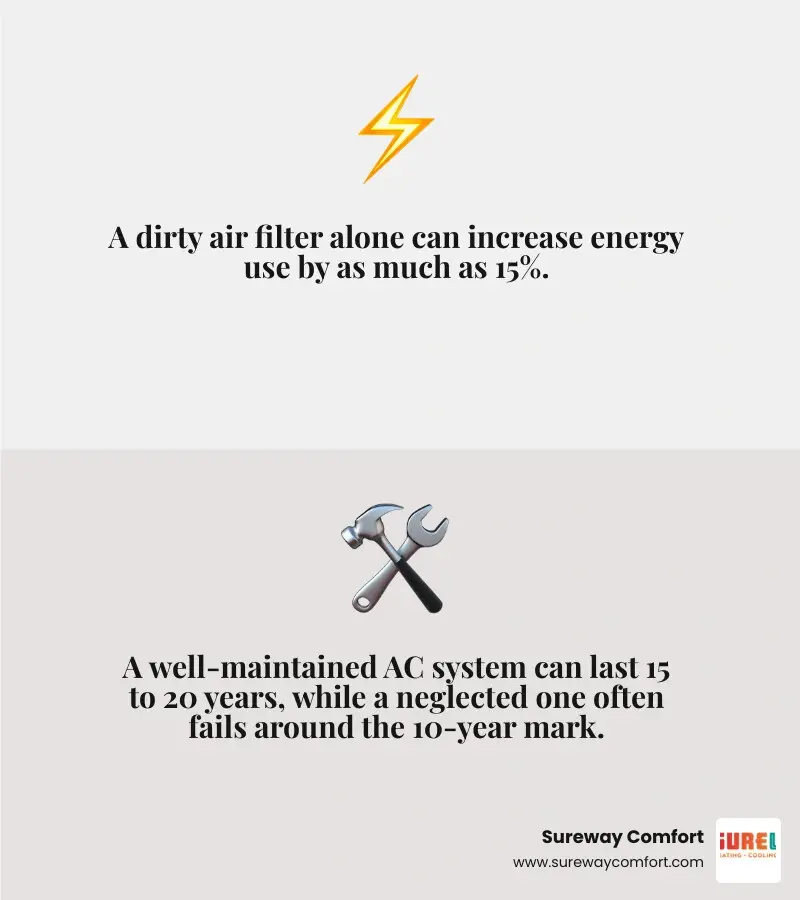
A well-maintained AC system can last 15 to 20 years. A neglected one often fails around the 10-year mark — and a dirty air filter alone can push your energy use up by as much as 15%. Regular professional maintenance helps you avoid both outcomes.
At Sureway Comfort, our technicians serve Bridgeville and the surrounding area with thorough, honest inspections — so you know exactly what's been checked and why it matters before summer arrives.
Why Pre-Season AC Maintenance is Essential for Bridgeville Homeowners
Living in Western Pennsylvania means experiencing the full spectrum of the seasons. By the time July 2026 rolls around, our local humidity and high temperatures will put your cooling system through a grueling daily workout. Preparing your air conditioner before the sweltering weather hits is the smartest way to keep your home comfortable and your energy bills manageable.
When you schedule pre-season maintenance, you directly address several critical performance factors:
- Lower Monthly Utility Bills: A system choked with dust, dirt, and worn-out parts has to work twice as hard to cool your home. Routine maintenance restores your system's efficiency, saving you up to 15% on your monthly energy consumption.
- Extended System Lifespan: An air conditioner is a major investment. Regular care can extend its useful life by 5 to 7 years, deferring the need for a costly replacement.
- Fewer Emergency Breakdowns: Most AC failures occur during the hottest weeks of the summer when the system is under maximum stress. Catching a weak capacitor or a tiny refrigerant leak in the spring prevents a miserable, hot weekend waiting for emergency repairs.
- Improved Indoor Air Quality: Dust, pollen, and even mold can accumulate inside your indoor air handler. A thorough cleaning keeps these pollutants from circulating through your living spaces.
Timing is everything. To beat the summer rush, it is best to refer to the Best Time of Year to Schedule Your AC Tune-Up. Getting your system evaluated early ensures that if a replacement part is needed, it can be ordered and installed long before you actually need to turn the cooling on. If you are wondering whether your system is up to the challenge of the upcoming humid months, take a look at our guide on whether Is Your Air Conditioner Ready for Summer.
The Complete AC Tune Up Checklist What Your Technician Should Check
When a professional HVAC technician arrives at your home, they shouldn't just stand in front of your thermostat, feel the cold air coming out of a single vent, and call it a day. A real, high-quality maintenance visit is a detailed, multi-point physical inspection of both the indoor and outdoor components.
To help you understand what a proper visit entails, we have outlined the standard process in the diagram below:
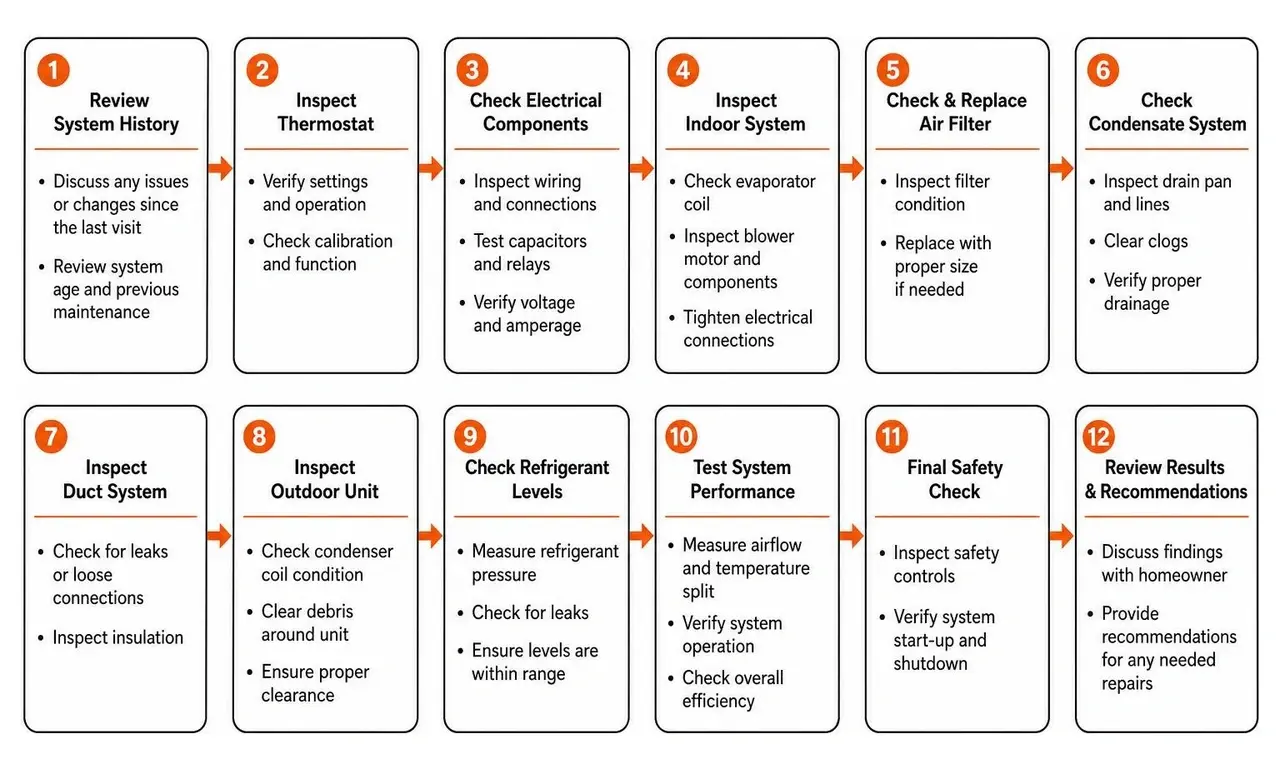
Knowing the difference between a rushed inspection and a comprehensive tune-up helps protect your investment. For a deeper dive into what a professional checkup looks like, you can read our Best AC Checkup Guide.
To give you a quick reference, here is a comparison of what you get with a basic visual check versus a comprehensive professional tune-up:
| Maintenance Task | Basic Visual Check | Comprehensive Professional Tune-Up |
|---|---|---|
| Air Filter Inspection | Yes | Yes (Plus replacement if homeowner has a spare) |
| Thermostat Test | Yes | Yes (Plus precise calibration check) |
| Visual Coil Inspection | Yes | Yes |
| Coil Deep Cleaning | No | Yes (Clearing dirt, debris, and outdoor obstructions) |
| Electrical Component Testing | No | Yes (Multimeter testing of capacitors and contactors) |
| Refrigerant Level Check | No | Yes (Digital gauge measurement of subcooling and superheat) |
| Condensate Drain Flush | No | Yes (Clearing algae, sludge, and testing safety switches) |
| Airflow & Static Pressure Test | No | Yes (Measuring temperature split and system resistance) |
Electrical and Control Inspections on the AC Tune Up Checklist What Your Technician Should Check
Your air conditioner's electrical system is the brain and muscle of the operation. If the electrical components are failing, the mechanical parts won't run safely—or at all. During a professional tune-up, your technician must focus heavily on these critical electrical inspections:
- Thermostat Calibration: If your thermostat is miscalibrated, your system will cycle too frequently or fail to reach your desired temperature, wasting energy. The technician should verify that the temperature your thermostat reads matches the actual room temperature.
- Motor Capacitors: Capacitors store electrical energy to start and run the fan motors and compressor. Over time, heat and electrical stress cause them to degrade. A technician will use a multimeter to measure their capacitance. If a capacitor's rating is 10% or more below its label value, it needs to be replaced before it leaves you stranded on a hot afternoon.
- Contactor Pitting: The contactor is an electrical switch that tells your compressor and outdoor fan to turn on. Because it handles high voltage, the electrical contacts can become pitted, burned, or even welded together over time. Technicians check for pitting and replace worn contactors to prevent system damage.
- Tightening Electrical Connections: Loose wires pose a serious fire hazard and can cause control boards to short out. Technicians will inspect the main disconnect box, the outdoor whip, and the indoor control panel to tighten all terminal screws.
- Voltage and Amperage Measurements: By measuring the voltage and amperage draw of the blower motor, condenser fan, and compressor, the technician can tell if a motor is working too hard. An amperage reading that exceeds the manufacturer's limit indicates a component that is on the verge of burning out.
Mechanical and Airflow Verification on the AC Tune Up Checklist What Your Technician Should Check
Once the electrical controls are verified, the physical movement of air and refrigerant must be inspected. Airflow problems can reduce your system's efficiency by up to 15%, while restricted mechanical components place immense strain on your compressor.
- Blower Motor and Fan Blades: The blower wheel in your indoor unit must be clean and balanced to move air effectively. A dirty blower wheel can reduce airflow by 20% to 30%. Outside, the condenser fan blade must be inspected for balance and physical damage.
- Condenser Coil Cleaning: The outdoor coil is responsible for releasing the heat collected from inside your home. Because it sits outside, it collects grass clippings, dirt, leaves, and cottonwood. Dirty coils act like an insulating blanket, trapping heat and forcing the compressor to run longer and hotter.
- Evaporator Coil Inspection: Located inside your home, the evaporator coil gets cold to absorb heat and moisture. If dust bypasses your air filter, it sticks to the wet coil, creating a breeding ground for mold and restricting airflow. Your technician will inspect this coil for dirt and signs of corrosion.
- Condensate Drain Line Clearing: As your AC cools the air, it removes humidity. This moisture collects in a drain pan and flows out of your home. If this line becomes clogged with algae or sludge, it can overflow, causing severe water damage to your ceilings, walls, or floors. Technicians flush this line and verify that the overflow safety switch works properly to shut the system down if a clog occurs.
- Refrigerant Level Verification: Refrigerant is the substance that carries heat out of your home. Because your AC is a sealed system, it should never "use up" or lose refrigerant. If levels are low, there is a leak. Technicians must use digital gauges to measure superheat and subcooling to ensure the charge is precisely within manufacturer specifications.
- Measuring the Temperature Split: A key performance metric is the temperature split—the difference in temperature between the air entering the return vent and the cold air blowing out of the supply registers. A healthy system should have a temperature split of 15°F to 20°F. If the split is lower than 15°F, it indicates a problem with airflow, refrigerant levels, or compressor efficiency.
How to Verify Your Technician Performed a Thorough Inspection
Unfortunately, not all HVAC service visits are created equal. Some companies use "tune-ups" as a quick sales tactic to get in your door and pressure you into buying a brand-new system before checking the one you have.
To protect yourself, you should know what a real service visit looks like. First, pay attention to the clock. A thorough residential AC tune-up should take between 60 and 90 minutes. If a technician is in and out of your home in 15 to 20 minutes, they have not performed a real service—they've likely only done a quick visual check.
Second, look at their tools. A professional technician should carry a multimeter to test electrical components and digital manifold gauges to check refrigerant pressures. Digital gauges are highly precise, unlike older analog gauges which only provide a general range.
Finally, a reputable technician will always provide you with a written report of their findings. This report should include specific measurements, such as capacitor microfarad readings, motor amperage draws, the temperature split, and photos of any dirty coils or worn parts.
If you want to keep your system running at its absolute best year after year, check out our guide on Regular AC Maintenance Peak Performance.
DIY Maintenance Tasks to Handle Before Your Professional Visit
While complex electrical testing and refrigerant measurements require a licensed professional, there are several simple maintenance tasks you can handle yourself to keep your system running smoothly between professional visits:
- Inspect and Change Your Air Filter: This is the single most important task for any homeowner. A dirty air filter restricts airflow, forces your system to run longer, and can even cause your indoor coil to freeze up. Check your filter monthly, especially if you have pets. Standard filters should be replaced every 60 to 90 days.
- Maintain Outdoor Clearance: Your outdoor condenser unit needs plenty of "breathing room" to release heat. Ensure there is at least a two-foot clear zone around the unit. Clear away weeds, trim back bushes, and remove any fallen leaves or twigs.
- Unblock Indoor Vents: Walk through your home and make sure that furniture, curtains, or rugs are not blocking your supply registers or return air vents. Restricting airflow can cause pressure imbalances in your ductwork.
- Replace Thermostat Batteries: Many thermostats rely on batteries to retain their programming and communicate with your AC. Replace them annually to prevent your system from unexpectedly shutting down.
If you are experiencing minor issues with your system and want to check a few things before scheduling a service call, read our AC Troubleshooting Tips Before Calling a Pro. Taking care of these basic items is also a great way of Saving Money AC Maintenance over the long run.
Frequently Asked Questions About AC Maintenance
How often should I schedule an AC tune-up?
You should schedule a professional AC tune-up once a year, ideally in the spring before the summer heat arrives. If you have a heat pump system that provides both heating and cooling, it should be serviced twice a year—once in the spring for the cooling side, and once in the fall for the heating side.
What is a normal temperature split for a healthy AC?
A healthy, properly functioning air conditioner should have a temperature split of 15°F to 20°F. This is the difference between the temperature of the warm air entering your return vent and the cold air coming out of your supply vents. If your split is under 15°F, your system is not cooling as efficiently as it should.
What happens if I skip my annual AC tune-up?
Skipping annual maintenance leads to a gradual loss of efficiency, which drives up your monthly energy bills. Over time, neglected systems suffer from dirty coils, clogged drain lines (which can cause severe water damage), frozen evaporator coils, and premature compressor failure. Routine maintenance prevents these major headaches.
Conclusion
Your air conditioning system is critical to your family's comfort during our hot, humid summer months. By understanding the ac tune up checklist what your technician should check, you can ensure your system receives the thorough, high-quality care it needs to run efficiently, keep your bills low, and last for years to come.
At Sureway Comfort, we take pride in serving our neighbors in Bridgeville, McDonald, Mt Lebanon, Bethel Park, Canonsburg, Collier, South Fayette, Upper St. Clair, Carnegie, Green Tree, Scott Township, Brookline, and Oakdale. Our experienced technicians provide honest diagnostics, comprehensive tune-ups, and reliable maintenance plans. We also offer flexible financing options and rapid emergency services when you need us most.
Don't wait for the first heatwave of the season to find out if your air conditioner is ready. Schedule your professional AC service with Sureway Comfort today!
Need Service?
Family owned · once & done · 24/7 emergency service across the South Hills of Pittsburgh.
(412) 643-4118 Schedule ServiceMore Services
Ready to Do It Right With Sureway?
Request a quote, schedule HVAC service, or ask about HVAC and plumbing project financing across the South Hills of Pittsburgh.