The Ultimate Guide to Tankless Water Heater Cost Comparison
Compare tankless water heater vs traditional costs to discover the long-term savings and energy efficiency for your Bridgeville home.
Is a Tankless Water Heater Worth It? Here's What the Costs Actually Look Like
When homeowners start researching the tankless water heater vs traditional cost comparison, the first thing they notice is the price gap. Tankless units cost more upfront than a standard storage tank. But that's only part of the story.
The real question isn't which costs more to buy — it's which costs less to own.
Here's a quick breakdown to answer that right away:
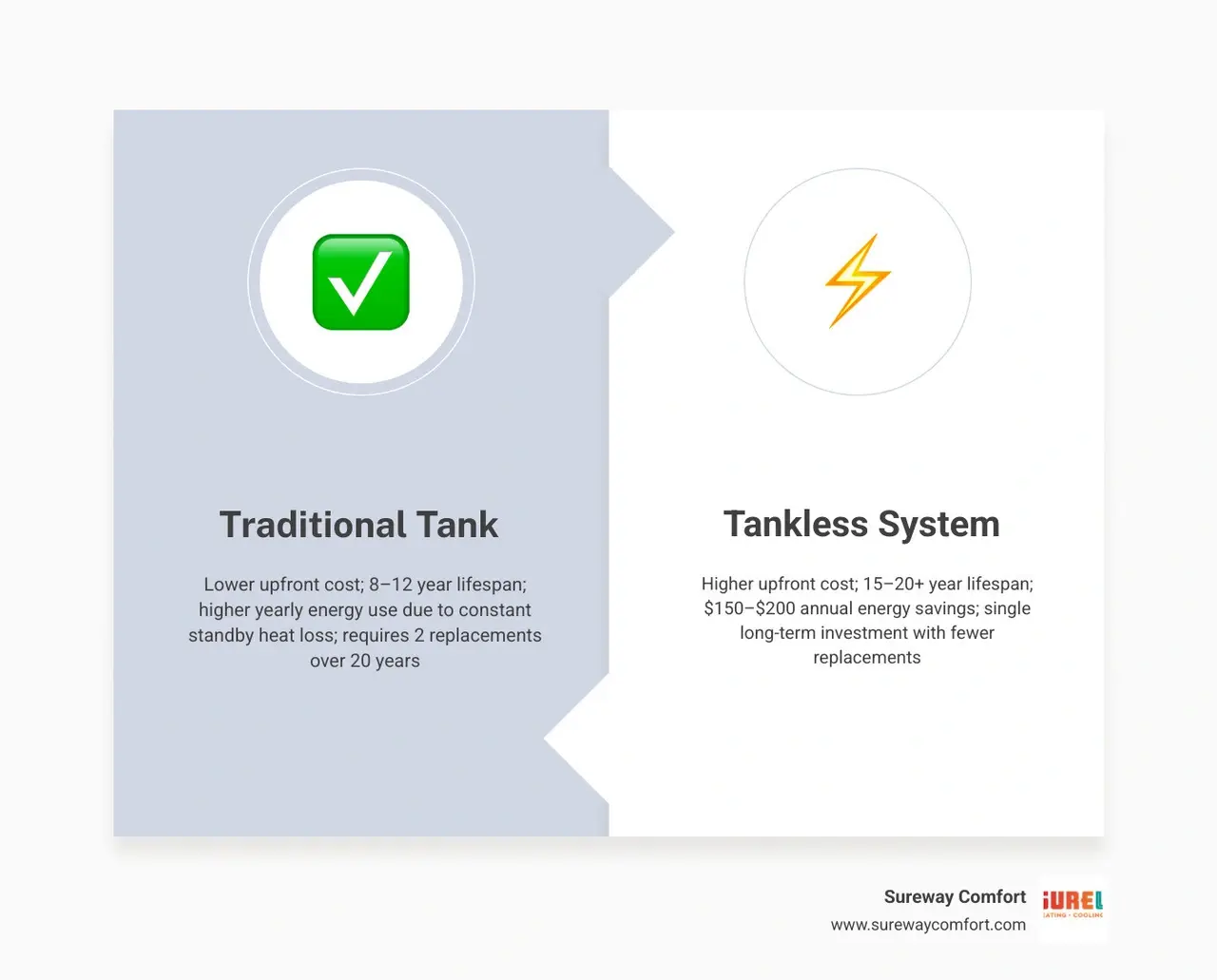
| Factor | Traditional Tank | Tankless |
|---|---|---|
| Upfront installed cost | Lower | Higher |
| Annual energy savings | Baseline | $150–$200 less per year |
| Typical lifespan | 8–12 years | 15–20+ years |
| Replacements over 20 years | Likely 2 | Likely 0 |
| 20-year total cost | Higher | Lower for most households |
| Best for | Tight budgets, high simultaneous demand | Long-term homeowners, energy savings |
For most homeowners who plan to stay in their home for 10 or more years, a tankless system tends to come out ahead when you factor in energy savings, fewer replacements, and a longer service life. But the right answer depends on your household size, your home's existing infrastructure, and how you use hot water day to day.
If you've ever been the last one to shower and stepped into a stream of cold water — or come home to find your water heater leaking across the basement floor — you already know how much your water heater matters. What you might not know is how much the type of water heater you choose affects what you'll spend over the next two decades.
This guide breaks down the best tips and tricks for comparing these systems so you can make a confident, informed decision for your home.
Basic tankless water heater vs traditional cost comparison glossary:
- hybrid high recovery vs tankless water heater
- switching from tank to tankless what to know
- tankless vs tank water heater comparison
Tankless Water Heater vs Traditional Cost Comparison: Upfront Investment and Long-Term Value
When evaluating a new water heater, the initial purchase price is often the first hurdle. Traditional storage tank water heaters are simpler systems that have been the industry standard for decades. Because they require less complex technology and are generally easier to install as direct replacements, their upfront setup expense is relatively low.
In contrast, a tankless water heater represents a more significant upfront investment. The units themselves are highly sophisticated, utilizing advanced heat exchangers and modulating burners to heat water instantly. Additionally, retrofitting a home to accommodate a tankless system often involves modifying water lines, gas connections, or electrical configurations.
However, looking strictly at the purchase price misses the bigger financial picture. To understand the true value of your investment, you must weigh these initial expenses against long-term operating costs. A detailed Tankless vs Tank Water Heater Comparison reveals that while traditional systems save you money on day one, they continue to demand more from your wallet every single month through higher utility consumption and a shorter overall lifespan.
Analyzing the Tankless Water Heater vs Traditional Cost Comparison for Energy Savings
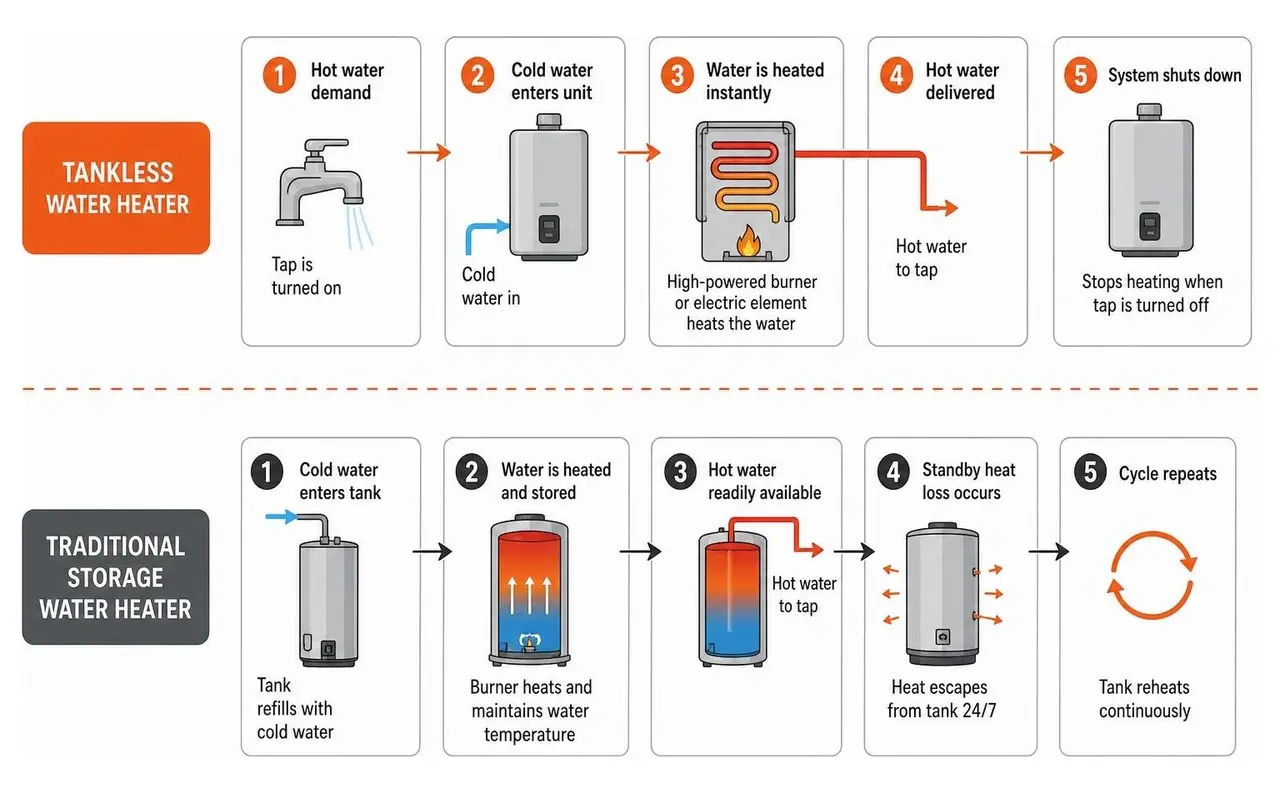
The primary driver of long-term savings for tankless owners is the elimination of standby energy loss. Traditional water heaters maintain a large volume of water—usually between 30 and 80 gallons—at a constant, high temperature 24 hours a day, 7 days a week. Whether you are sleeping, at work, or away on vacation, that tank is constantly burning fuel to keep that water hot. This continuous heating cycle results in significant standby heat loss, which quietly inflates your monthly utility bills.
Tankless systems operate on an entirely different principle: they only consume energy when a hot water tap is turned on. When you open a faucet, cold water flows into the unit, where a powerful burner or electric element heats it instantly before sending it to your fixture. When you turn off the tap, the system immediately shuts down.
By eliminating standby loss, tankless systems are highly efficient. Many models achieve excellent ENERGY STAR ratings and can be up to 34% more energy-efficient than traditional tanks for households with moderate daily hot water usage. Over the course of a year, these efficiency gains translate into substantial savings on your energy bills. Depending on whether your system runs on natural gas, propane, or electricity, choosing a highly efficient system can drastically reduce your household's carbon footprint while keeping more money in your bank account. To explore these efficiency advantages further, check out our guide on Tankless Water Heaters Benefits.
How Lifespan Affects the Tankless Water Heater vs Traditional Cost Comparison
Another critical component of the tankless water heater vs traditional cost comparison is equipment longevity. Traditional storage tanks have a relatively short life expectancy, typically lasting between 8 and 12 years. Because they constantly hold water, they are highly susceptible to internal corrosion, rust, and sediment accumulation. No matter how well you maintain them, the tank will eventually degrade, and when it does, the only solution is a complete system replacement.
Tankless water heaters, on the other hand, are engineered for durability. Because they do not store water, they are far less prone to the rust and structural failures that plague traditional tanks. With routine maintenance, a high-quality tankless unit can easily operate reliably for 15 to 20 years, and often even longer.
When you look at a 20-year total cost of ownership, the math shifts dramatically. Over a 20-year span, a homeowner utilizing traditional technology will almost certainly have to purchase and install two complete storage tank systems. A tankless homeowner, however, will likely only need to purchase a single unit. When you combine the avoided replacement cycles with two decades of monthly utility savings, the long-term financial advantages of going tankless become clear. You can learn more about this long-term equation by reading about the Tankless Water Heater Cost vs Value Long Term.
Key Factors Influencing Your Water Heater Selection in Bridgeville, PA
Choosing the right water heater isn't just about comparing numbers on a spreadsheet; it's about matching the system to the unique demands of your home and local environment. In Bridgeville, PA, and surrounding communities like Mt Lebanon, Upper St. Clair, and Bethel Park, seasonal changes play a major role in how water heating systems perform.
One of the most critical variables is groundwater temperature. During our cold Western Pennsylvania winters, the water entering your home from municipal lines or private wells is significantly colder than it is in the summer. This lower starting temperature means your water heater has to work much harder to raise the water to a comfortable showering temperature.
Additionally, you must consider your household size and peak usage patterns. If you have a busy household where multiple people need to shower, wash dishes, and run the laundry simultaneously, your hot water system will face intense demand. Understanding the Different Types of Water Heaters and how they handle these peak periods is essential to avoiding unexpected cold showers.
Sizing Your System for Peak Demand
When sizing a traditional water heater, you look at the tank's capacity in gallons. If you have a large family, you simply buy a larger tank. However, sizing a tankless water heater requires a completely different approach. Instead of measuring storage volume, tankless units are sized based on flow rate, which is measured in gallons per minute (GPM).
To size a tankless system correctly, you must calculate your household's peak simultaneous hot water demand. This involves adding up the GPM requirements of every fixture you might realistically use at the exact same time. For example, running a shower, a dishwasher, and a washing machine simultaneously might require a total flow rate of 6 to 8 GPM.
In colder climates like ours, the incoming groundwater temperature can drop below 40°F in the winter. Because the temperature "rise" required to reach 120°F is so high, a tankless unit's maximum GPM capacity will naturally decrease in cold weather. If a system is undersized, you may experience a drop in water pressure or temperature when multiple fixtures are running. For a deeper dive into these sizing considerations, review our resource on Switching from Tank to Tankless What to Know.
Infrastructure Requirements and Hidden Installation Considerations
One of the most common surprises for homeowners upgrading to a tankless system is the need for infrastructure modifications. Unlike a standard tank replacement, which is often a straightforward "plug-and-play" swap, converting to tankless usually requires several critical upgrades to your home's existing utility lines.
For gas-powered tankless units, the most common requirement is a gas line upgrade. Traditional gas water heaters typically use a 1/2-inch gas supply line. However, because tankless units must heat water instantly, they require a much higher burner capacity (measured in BTUs) when they are actively running. This high demand often requires upgrading to a 3/4-inch or 1-inch gas line to ensure the unit receives adequate fuel pressure without starving other gas appliances in your home.
Electrical requirements are another major consideration. Even gas tankless units require electricity to power their digital control boards and electronic ignition systems. If you choose an electric tankless water heater, the electrical demands are immense. These systems often require multiple dedicated double-pole circuit breakers and may necessitate an upgrade of your home's main electrical panel to handle the increased load.
Venting is also highly specialized. Because modern gas tankless units are incredibly efficient, they produce cooler exhaust gases that can condense into acidic liquid inside the flue. This requires dedicated, sealed venting systems made of specialized Category III stainless steel or specific PVC piping, rather than the simple aluminum vents used by older tank heaters. If you live in Mt Lebanon or surrounding areas, you can learn more about these specific local requirements by visiting our page on Tankless Water Heater Installation Mt Lebanon PA.
Finally, don't overlook water quality. Western Pennsylvania is known for having hard water, which contains elevated levels of calcium and magnesium. When hard water is heated, these minerals precipitate out of the water and form a hard scale inside the water heater's narrow heat exchanger channels. Over time, this scale buildup acts as an insulator, forcing the system to work harder, reducing its efficiency, and potentially causing premature system failure. To protect your investment, installing a whole-home water softener or a dedicated scale-prevention system is highly recommended.
Maintenance and Lifespan: Maximizing Your Investment
To ensure your water heater operates at peak efficiency and achieves its maximum possible lifespan, consistent maintenance is non-negotiable. This is true for both traditional and tankless systems, though the specific tasks differ significantly.
For traditional storage tanks, the primary maintenance task is an annual tank flush to remove accumulated sediment from the bottom of the tank. Additionally, traditional tanks rely on a sacrificial anode rod to protect the steel tank from rusting. This rod attracts corrosive elements in the water, rusting away so the tank doesn't have to. Homeowners should inspect and replace this rod every three to five years to prevent catastrophic tank failure.
Tankless units do not have anode rods, but they require regular descaling to remove mineral deposits from the heat exchanger. This process involves circulating a food-grade descaling solution or white vinegar through the unit's internal plumbing for about an hour to dissolve scale buildup. Neglecting this maintenance can void your manufacturer's warranty and lead to a significant drop in heating efficiency.
To help you stay on top of these essential tasks, we've put together a comprehensive Water Heater Maintenance Checklist for Homeowners. For localized advice tailored to our specific regional water conditions, you can also consult our Tankless Water Heater Bridgeville Service Tips.
Frequently Asked Questions About Water Heater Upgrades
Making the switch to a new water heating system is a major decision, and it is completely normal to have questions about how these systems perform in real-world conditions. Here are some of the most common inquiries we receive from local homeowners.
Does a tankless water heater provide instant hot water?
A common misconception is that "on-demand" hot water means "instant" hot water at the faucet. A tankless water heater heats water instantly inside the unit, but that water still has to travel through your home's pipes to reach your shower or sink. If your bathroom is far away from the water heater, you will still have to wait for the cold water currently sitting in the pipes to clear out.
Additionally, some homeowners experience what is known as the "cold water sandwich" effect. This happens when you turn on a hot water tap, use it briefly, turn it off, and then turn it back on a moment later. A small pocket of unheated water can get caught between the two hot water cycles, resulting in a brief blast of cold water mid-shower. High-quality modern tankless systems often feature small built-in buffer tanks or bypass valves to eliminate this issue entirely.
How does hard water affect tankless water heaters?
As mentioned earlier, hard water is the number one enemy of tankless water heaters. Mineral scale accumulates quickly on the hot surfaces of the heat exchanger, restricting water flow and reducing heat transfer.
If your home has hard water, integrating a water softener or an inline scale inhibitor is highly recommended. Not only does this keep your tankless unit running efficiently, but it also protects your home's other appliances, like dishwashers and washing machines, from scale damage.
Are there tax credits or incentives available for high-efficiency upgrades in 2026?
Yes! Because energy efficiency is a major focus for federal and state governments, there are excellent financial incentives available for homeowners who upgrade to high-efficiency water heating systems.
Federal tax credits often cover a portion of the installation cost for qualifying high-efficiency tankless gas units or heat pump water heaters. Additionally, local utility providers frequently offer rebates for upgrading to energy-saving appliances. It is always a good idea to check with your local energy office or your plumbing professional before making a purchase to ensure you take advantage of every available incentive.
Conclusion
Navigating the tankless water heater vs traditional cost comparison requires looking beyond the initial purchase price to consider long-term energy savings, system longevity, and the daily comfort of your household. While traditional tanks remain a reliable option for those on a tight immediate budget, tankless systems offer unmatched energy efficiency, space savings, and a continuous supply of hot water that can elevate your home's comfort for decades.
At Sureway Comfort, we are dedicated to helping our neighbors throughout Bridgeville, Mt Lebanon, Bethel Park, and the surrounding South Hills communities find the perfect plumbing and heating solutions for their homes. Whether you are facing an emergency replacement or planning a future home renovation, our experienced team is here to guide you every step of the way with honest diagnostics, professional installation, and reliable ongoing maintenance.
Ready to find the perfect water heating system for your household? Schedule a professional water heater consultation with Sureway Comfort today, and let us help you bring reliable, energy-efficient comfort to your home!
Need Service?
Family owned · once & done · 24/7 emergency service across the South Hills of Pittsburgh.
(412) 643-4118 Schedule ServiceMore Services
Ready to Do It Right With Sureway?
Request a quote, schedule HVAC service, or ask about HVAC and plumbing project financing across the South Hills of Pittsburgh.