All About Water Heater Options for Homeowners
Explore the ultimate water heater options guide for homeowners to compare tank, tankless, and hybrid systems, size correctly, and plan maintenance.
Why the Right Water Heater Choice Can Save You Thousands
This water heater options guide for homeowners breaks down everything you need to know before buying or replacing a water heater, packed with practical tips and tricks to maximize your savings and efficiency. Here is a quick overview of your main options:
| Water Heater Type | Best For | Efficiency | Typical Lifespan |
|---|---|---|---|
| Storage Tank | Most homes, simple replacement | Moderate | 10-15 years |
| Tankless On-Demand | Small households, space savings | High | 20+ years |
| Heat Pump (Hybrid) | Electric homes, maximum savings | Very High | 10-15 years |
| Solar Thermal | Sunny climates, eco-conscious buyers | Very High | 20 years |
| Condensing Gas | Gas homes, high efficiency | High | 10-15 years |
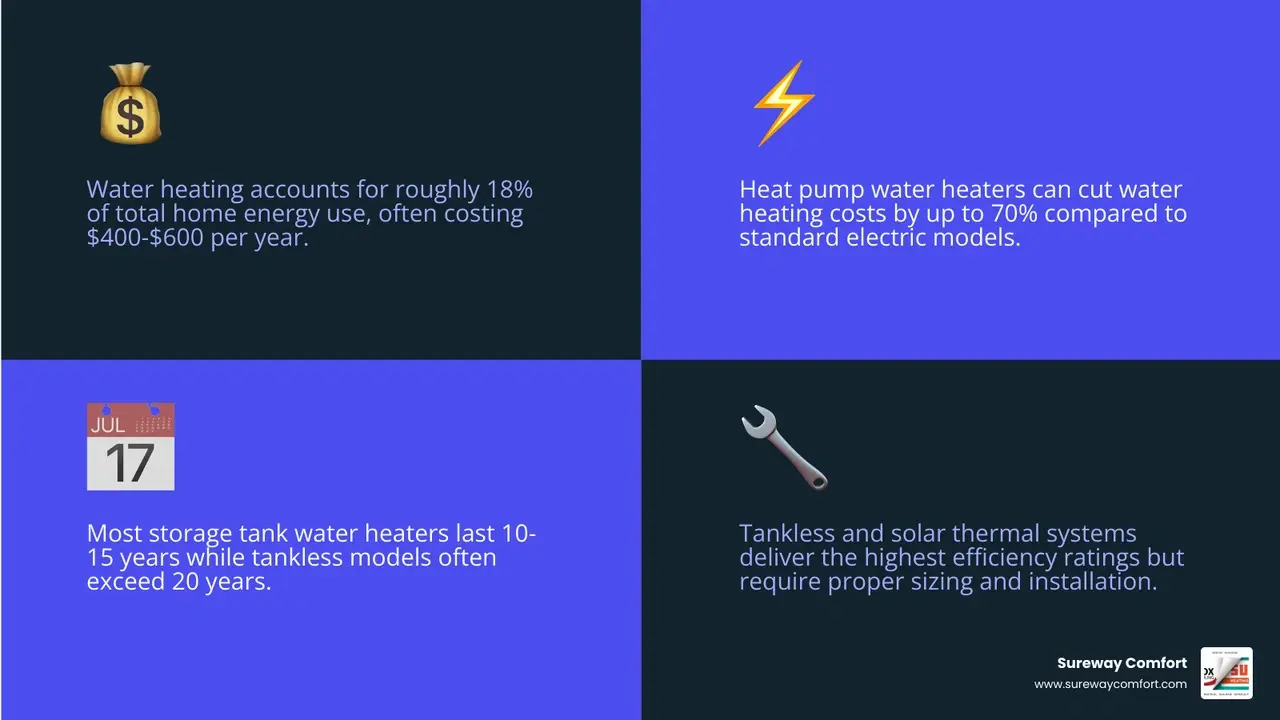
Water heating is not a small expense. It accounts for roughly 18% of your home's total energy use, making it the second-largest energy cost after heating and cooling. This means finding ways to optimize your system is one of the best ways to lower your monthly utility bills.
Yet most homeowners only think about their water heater when it stops working — usually at the worst possible time. A rushed decision under pressure often means settling for whatever is available rather than choosing the system that actually fits your home, your household size, and your budget.
The good news? There are more options available in 2026 than ever before, and some of them — like heat pump water heaters — can cut your water heating costs by up to 70% compared to a standard electric model. Knowing the differences before you need a replacement puts you in a much stronger position.
The Ultimate Water Heater Options Guide for Homeowners
Choosing a new water heater is about more than just picking a tank off a retail shelf. Your home's existing infrastructure—such as the size of your gas lines, the capacity of your electrical panel, and the physical space available in your utility closet—plays a massive role in determining which system is right for you.
When you begin researching your options, you will quickly discover that fuel types are the first major decision point. Depending on where you live in our local communities like Bridgeville, McDonald, or Mt Lebanon, your home may be set up for natural gas, electricity, or propane.
If you already have a natural gas line running to your existing water heater, sticking with gas is often highly convenient. Gas units typically heat water faster than standard electric resistance models. However, if your home is fully electric, or if you are looking to reduce your fossil fuel consumption, modern electrical options have made incredible leaps in efficiency. Before you make any commitments, it is highly beneficial to read our detailed breakdown on Choosing the Right Water Heater to align your household goals with your home's physical layout.
Why You Need a Water Heater Options Guide for Homeowners
If you have ever had your shower turn icy cold while you still had shampoo in your hair, you already know why sizing and system selection matter. Traditional storage tanks are subject to standby heat loss, which occurs when a tank constantly reheats water to keep it hot, even when nobody is home. This constant cycling consumes energy throughout the day and night.
Furthermore, if your system is undersized, peak usage periods—such as the morning rush when multiple family members are showering, the dishwasher is running, and the washing machine is cycling—will quickly deplete the hot water supply. To protect your household comfort and ensure your family never has to coordinate a shower schedule, you must carefully evaluate your system options. If you are located in the Bethel Park area and need help assessing your peak usage demands, we invite you to check out our dedicated guide on Water Heater Installation Bethel Park PA.
How to Use This Water Heater Options Guide for Homeowners
As you navigate this guide, we recommend focusing on three primary pillars: system lifespan, long-term energy efficiency, and how a new unit fits your lifestyle.
One of the most important metrics you will encounter on the yellow EnergyGuide label of any new water heater is the Uniform Energy Factor (UEF). The UEF is the industry-standard measure of water heater efficiency; the higher the number, the more efficiently the unit converts energy into hot water.
Balancing upfront installation requirements with decades of utility savings is the key to making a decision you won't regret. For our neighbors planning upgrades in Scott Township, we have compiled localized tips and infrastructure considerations in our resource on Water Heater Installation Scott Township PA.
Comparing Storage Tanks, Tankless Systems, and Hybrid Technology
To help you visualize how these technologies stack up against one another, let's look at a head-to-head comparison of the three most common configurations installed in modern homes:
| Feature | Storage Tank | Tankless On-Demand | Heat Pump Hybrid |
|---|---|---|---|
| Primary Energy Source | Gas, Propane, or Electricity | Gas, Propane, or Electricity | Electricity (with air heat transfer) |
| Space Required | High (requires floor space) | Very Low (wall-mounted) | High (requires ample airspace) |
| Hot Water Delivery | Limited by tank capacity | Endless (limited by flow rate) | Limited by tank capacity |
| Standby Energy Loss | Yes | No | Minimal |
| Primary Benefit | Simple, reliable, lower initial cost | Space-saving, endless hot water | Unmatched electrical efficiency |
Beyond these three main categories, some homeowners also consider solar thermal systems (which use rooftop collectors to heat water using the sun) or high-efficiency condensing models (which capture hot exhaust gases that would normally escape up the flue and use them to preheat incoming cold water). Understanding the core differences between these technologies is the first step in deciding which direction to go. For a deeper dive into how traditional tanks compare to on-demand units, read our comprehensive Tankless vs Tank Water Heater Comparison.
Conventional Storage Tank Water Heaters
Conventional storage tank water heaters remain the most popular choice for replacement because they are straightforward and familiar. These systems maintain a ready reservoir of hot water (typically holding between 30 and 80 gallons) in an insulated tank.
- How they heat: Electric models use internal electric resistance elements submerged in the water, while gas models utilize a burner at the bottom of the tank with a chimney venting through the middle or top.
- Recovery rate: A key consideration for storage tanks is their recovery rate—the amount of water the heater can raise to a set temperature within one hour. Gas storage tanks generally have a faster recovery rate than electric resistance models.
If you have an older electric tank, it could be consuming a significant portion of your monthly utility bill. For homeowners in Brookline looking to understand their options for electric systems, we recommend reading the Electric Water Heater Company Brookline PA Guide for expert local advice.
Tankless On-Demand Water Heaters
Tankless water heaters do away with the storage tank entirely. Instead of keeping dozens of gallons of water hot all day, they use high-powered heating elements or gas burners to heat water instantly as it flows through the unit.
The primary appeal of a tankless system is the promise of endless hot water. Because it heats on demand, you can theoretically take a shower that lasts for hours without the water ever turning cold. Tankless units also offer incredible space savings, as they are compact, wall-mounted boxes that free up valuable floor space in closets or basements.
However, they are limited by their maximum flow rate—measured in Gallons-Per-Minute (GPM). If you run too many hot water fixtures simultaneously, the unit may struggle to keep up. If you are considering transitioning to an on-demand system in Upper St. Clair, you can learn more about the process by visiting Tankless Water Heater Installation Upper St Clair PA.
Heat Pump Hybrid Water Heaters
Heat pump water heaters—often called hybrid water heaters—represent the cutting edge of energy-efficient electrical design. Instead of generating heat directly through electric resistance elements, they work like a refrigerator in reverse. They pull warmth from the surrounding air, concentrate it, and transfer that heat into the water tank.
Because they transfer heat rather than creating it, hybrid water heaters are up to three times more efficient than standard electric tanks. As a side benefit, they also dehumidify and cool the space around them, which is incredibly helpful in damp basements.
However, they do have specific installation requirements:
- They typically require a minimum of 700 to 1,000 cubic feet of surrounding airspace to draw enough heat from the air.
- They require a condensate drain or pump to carry away the moisture they pull from the air.
- They perform best in spaces that remain between 40°F and 120°F.
If you live in Oakdale and want to explore whether a hybrid or tankless system fits your home's layout, check out our local insights at Tankless Water Heater Oakdale PA.
Sizing Your System for Peak Household Demand
Sizing a water heater is not a guessing game. If you buy a system that is too small, you will face constant shortages. If you buy a system that is too large, you will pay to heat water you never use, wasting energy and causing unnecessary wear on the equipment.
To size your system correctly, you must calculate your household's peak demand. This is the maximum amount of hot water your home uses during its busiest one-hour window of the day. You will also need to consider your climate and local groundwater temperature. In Western Pennsylvania, our winter groundwater temperatures can drop significantly. This means your water heater has to work much harder to raise incoming water from 45°F to a comfortable 120°F than a system installed in a warmer southern climate.
Sizing Storage Tanks: First-Hour Rating
When sizing a traditional storage tank, ignore the physical size of the tank for a moment and look instead for the First-Hour Rating (FHR) on the top-left corner of the yellow EnergyGuide label. The FHR is the number of gallons of hot water the heater can supply in a single hour, starting with a fully heated tank.
To estimate your household's peak hour demand:
- A single shower: Uses approximately 10 to 20 gallons.
- An automatic dishwasher: Uses about 6 gallons.
- A hot-water laundry load: Uses up to 15 to 20 gallons.
If your family typically runs a load of laundry while two people take back-to-back showers in the morning, your peak demand might be 40 to 50 gallons. You will want to select a storage tank with an FHR that matches or slightly exceeds this number.
Sizing Tankless Systems: Gallons-Per-Minute
Tankless water heaters are sized based on flow rate (GPM) and the required temperature rise. To size a tankless unit, you must add up the flow rates of all the hot water fixtures you expect to run at the exact same time.
For example, a typical modern showerhead flows at about 2.0 GPM, while a kitchen faucet flows at 1.5 GPM. If you want to be able to run two showers and the kitchen sink simultaneously, your tankless unit must be able to deliver a flow rate of at least 5.5 GPM.
In cold climates, you must also account for the temperature rise. If your winter groundwater is 45°F and your desired output temperature is 120°F, your system needs to achieve a 75°F temperature rise. A tankless unit that delivers 7 GPM in a warm climate might only deliver 4.5 GPM in our cold Pennsylvania winters because of this steep temperature gap.
Proactive Maintenance Tips and Tricks: When to Replace Your System
The average storage tank water heater lasts between 10 and 15 years, while tankless units can easily last 20 years or more with proper care. However, waiting for your water heater to rupture and flood your basement is a stressful and incredibly expensive way to handle replacement.
By keeping an eye out for warning signs and performing basic, proactive maintenance, you can maximize your system's lifespan and replace it on your own terms before an emergency strikes. If you are currently dealing with a system that is acting up in Bethel Park, consult our Water Heater Repair Bethel Park PA Guide for professional troubleshooting steps.
Essential Maintenance Tips and Tricks for Longevity
To keep your water heater running at peak efficiency, you should establish a routine maintenance schedule. Sediment buildup is the number-one killer of water heaters; as water is heated, minerals like calcium settle to the bottom of the tank, forming a barrier that forces the burner or heating elements to work harder.
Here are the key maintenance tips and tricks that will extend your system's life:
- Tank Flushing: Drain and flush a few gallons of water from your storage tank at least once a year to clear out mineral sediment.
- Anode Rod Inspection: Storage tanks contain a sacrificial anode rod—a metal rod that attracts corrosive elements in the water so they eat the rod instead of the steel tank. Inspect this rod every 3 to 5 years and replace it when it is heavily corroded.
- T&P Valve Testing: Test the Temperature and Pressure (T&P) relief valve annually by lifting the lever to ensure it releases water and seals back up correctly.
- Tankless Descaling: If you have a tankless unit, flush it annually with a descaling solution (like food-grade white vinegar) to clear mineral deposits from the narrow copper heat exchanger.
Pro Tip: Setting your water heater's thermostat to 120°F instead of the factory default 140°F is an easy trick that prevents scalding, slows down mineral buildup, and reduces standby heat loss.
For step-by-step instructions on keeping an on-demand system in perfect shape, read our Tankless Water Heater Repair Bethel Park Tips.
Signs It Is Time for a Replacement
If your water heater is approaching the end of its typical lifespan, you should watch closely for these red flags:
- Rusty or Discolored Water: If your hot water looks rusty but your cold water runs clear, your tank's interior lining or anode rod is likely deteriorating.
- Rumbling or Popping Noises: This is the sound of water boiling through a thick layer of hardened sediment at the bottom of the tank. It indicates severe buildup that can cause the metal to overheat and crack.
- Inconsistent Temperatures: If your water takes forever to heat up or swings wildly between hot and cold, the heating elements, burners, or thermostats are failing.
- Active Leaking: Any pooling water around the base of a storage tank is an immediate emergency. It usually means the inner steel tank has fractured due to corrosion, and a total rupture could be imminent.
Frequently Asked Questions about Water Heaters
What is the most energy-efficient water heater available in 2026?
In 2026, the undisputed efficiency champion for homes with electrical hookups is the heat pump hybrid water heater. By transferring heat from the surrounding air rather than creating it through resistance, these systems can achieve a Uniform Energy Factor (UEF) of 3.3 to 4.1. This means they are over 300% to 400% efficient. For homes utilizing natural gas, a high-efficiency condensing tankless water heater with a UEF of 0.95 or higher is the gold standard, capturing waste heat from exhaust gases to maximize every therm of gas used.
How long do different types of water heaters typically last?
A standard storage tank water heater typically lasts between 10 and 15 years. Tankless on-demand water heaters have a significantly longer lifespan, often lasting 20 to 25 years because they do not store water constantly and have easily replaceable internal parts. The single biggest factor influencing these lifespans is regular maintenance—specifically, routine anode rod replacement in tank systems and annual descaling in tankless units.
Where can I find a local water heater options guide for homeowners?
Right here! The best way to transition from general research to an actual installation is to work with local plumbing experts who understand our regional water chemistry, building codes, and climate challenges. A professional technician can perform a comprehensive home infrastructure assessment to ensure your electrical panel, gas lines, and physical space are perfectly matched to your new system.
Conclusion
Selecting the perfect water heater is one of the most important comfort and financial decisions you will make for your home. Whether you opt for the proven reliability of a traditional storage tank, the endless convenience of a tankless system, or the incredible energy savings of a hybrid heat pump, matching the unit to your household's unique demands is key.
At Sureway Comfort, we are proud to serve our neighbors throughout Bridgeville, McDonald, Mt Lebanon, Bethel Park, Canonsburg, Collier, South Fayette, Upper St. Clair, Carnegie, Green Tree, Scott Township, Brookline, and Oakdale. We believe in providing honest diagnostics, responsive scheduling, and reliable, year-round service. If your current water heater is acting up or nearing the end of its life, we are here to help with professional installation, maintenance, and emergency same-day options.
Ready to find your perfect match? Explore our Sureway Comfort Water Heater Services today, and let our experienced local team help you secure reliable, energy-efficient hot water for your home's future.
Need Service?
Family owned · once & done · 24/7 emergency service across the South Hills of Pittsburgh.
(412) 643-4118 Schedule ServiceMore Services
Ready to Do It Right With Sureway?
Request a quote, schedule HVAC service, or ask about HVAC and plumbing project financing across the South Hills of Pittsburgh.