


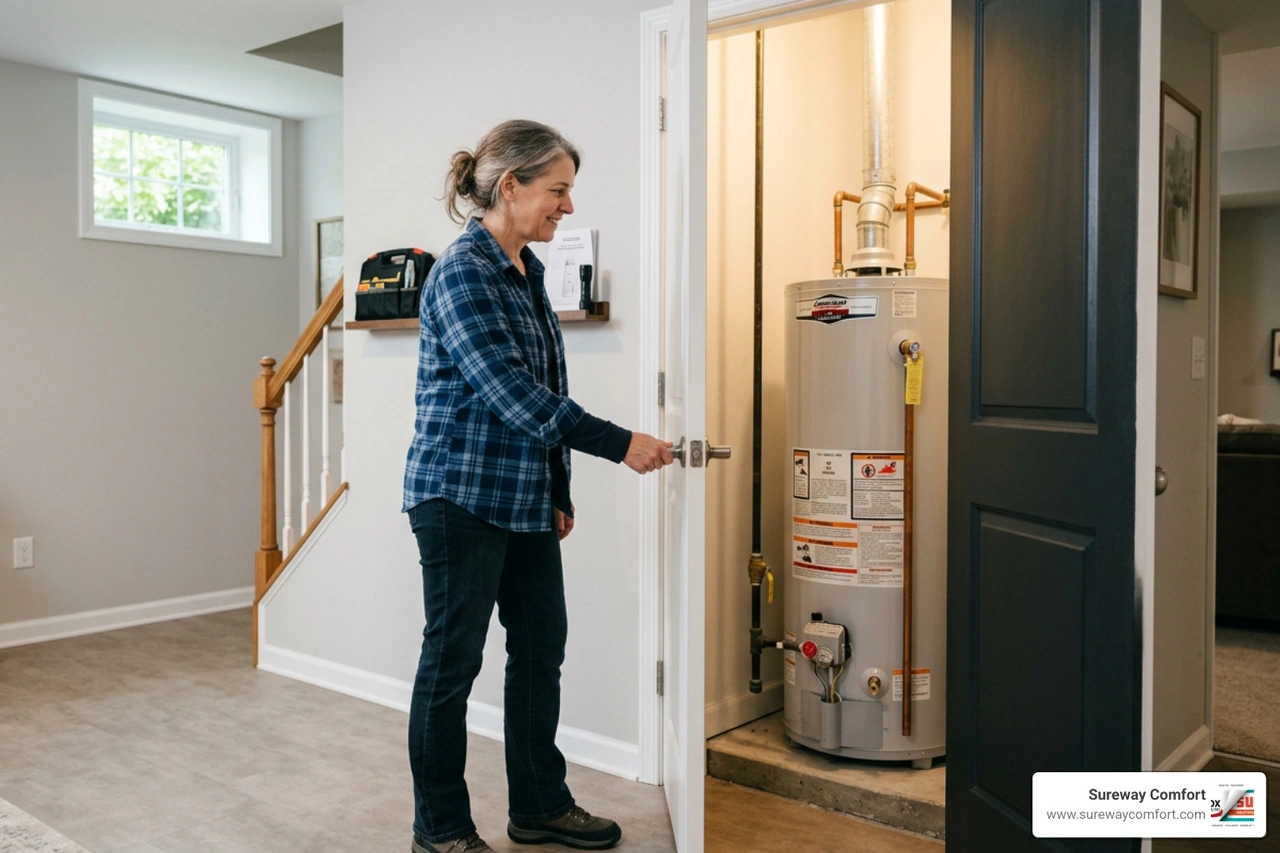
Why Knowing How Often to Flush Your Water Heater in Pennsylvania Can Save You Money
How often to flush your water heater in Pennsylvania depends mainly on your local water hardness — but here's the short answer most homeowners need:
Quick Answer: Water Heater Flushing Frequency in Pennsylvania
• Average water quality — Recommended Flushing Frequency: Once per year
• Hard water (7–11 gpg, e.g. Lancaster, York) — Recommended Flushing Frequency: Every 6–9 months
• Very hard water (15+ gpg, e.g. Hanover area wells) — Recommended Flushing Frequency: Every 6 months or sooner
• Tankless water heater, average water — Recommended Flushing Frequency: Once per year (descaling)
• Tankless water heater, hard water — Recommended Flushing Frequency: Every 6 months (descaling)
Most Pennsylvania homeowners don't think about their water heater until something goes wrong — a cold shower, a strange rumbling noise from the basement, or an energy bill that suddenly jumps. By then, sediment buildup may have already been quietly working against your system for years.
Pennsylvania's water supply — especially in Central PA counties like Lancaster, York, and surrounding areas — is notoriously hard. That means minerals like calcium and magnesium are constantly settling at the bottom of your water heater tank, forming a layer that forces your system to work harder, use more energy, and wear out faster.
The good news? Regular flushing is one of the simplest and most effective things you can do to protect your water heater and keep your home's hot water running reliably.
How often to flush your water heater in pennsylvania word guide:
• how to extend the life of your water heater
• water heater maintenance checklist for homeowners
How Often to Flush Your Water Heater in Pennsylvania
While the general rule of thumb across the country is to drain and flush your water heater once a year, living in Pennsylvania introduces local environmental factors that can alter this timeline. The mineral composition of our regional water supply means that a single, rigid calendar schedule does not work for every household.
For most homes in our service areas — including Bridgeville, Mt. Lebanon, Bethel Park, and Upper St. Clair — an annual flushing is the absolute baseline. However, if your household has high water demands, or if you live in an area known for mineral-rich soil, a 6-month interval is highly recommended.
Water quality is the primary driver behind how quickly sediment accumulates. As water is heated inside your tank, dissolved minerals crystallize and settle to the bottom. Over time, this creates a thick, stony layer of scale. If you wait too long between flushes, this sediment can "bake" onto the bottom of the tank, making it much harder to remove and significantly reducing the heating efficiency of your system.
To keep your entire system in top shape, we recommend incorporating this task into a broader home care routine. You can refer to our comprehensive Water Heater Maintenance Checklist for Homeowners to make sure you are not overlooking other critical components, like the temperature and pressure relief valve or the sacrificial anode rod.
Determining How Often to Flush Your Water Heater in Pennsylvania Based on Water Hardness
To understand why your water heater needs such frequent attention, we have to look at the chemistry of Pennsylvania’s water. Water hardness is measured in grains per gallon (gpg). Any reading above 7 gpg is classified as hard water, and much of Pennsylvania easily clears this threshold.
While eastern and central regions like Lancaster County (averaging 9–11 gpg) and York County (averaging around 5–9 gpg) deal with high mineral counts, well water users in places like Hanover can face extreme hardness levels reaching 17 gpg or more. Here in Southwestern Pennsylvania, including communities like Canonsburg, McDonald, and South Fayette, municipal water and private wells alike carry dissolved limestone, calcium, and magnesium that actively settle inside your appliances.
When hard water is heated, these minerals precipitate out of the liquid and form a chalky, white substance known as limescale.
• Moderate Water (Under 7 gpg): An annual flush is usually sufficient to keep sediment from affecting performance.
• Hard Water (7–11 gpg): You should adjust your schedule to flush the tank every 6 to 9 months.
• Extremely Hard/Well Water (12+ gpg): A strict 6-month flushing schedule is necessary to prevent the lower heating elements (in electric units) or the tank bottom (in gas units) from becoming completely buried in minerals.
If you are a resident looking to keep your system running efficiently, staying ahead of local water conditions is key. For those living in the southern suburbs of Pittsburgh, checking out our localized guide on Water Heater Maintenance Bethel Park PA can help you tailor your maintenance schedule to our specific regional water profile.
Why You Should Know How Often to Flush Your Water Heater in Pennsylvania for Tankless Systems
There is a common misconception that tankless water heaters are entirely maintenance-free because they do not store water. While it is true that they do not suffer from the massive mud-like sediment pools that traditional tanks do, they are actually more sensitive to hard water.
Instead of a large storage tank, tankless systems rely on narrow, winding copper passages inside a heat exchanger to heat water instantly on demand. When hard water passes through these hot, tight coils, mineral scale quickly binds to the metal walls. If you do not perform regular tankless descaling, this scale acts as an insulator, trapping heat inside the exchanger and causing the system to overheat, throw error codes, or fail prematurely.
Because the heat exchanger is the most critical and expensive component of a tankless unit, regular descaling is essential to keep your warranty valid. Most manufacturers require this maintenance annually, but in areas with hard water, descaling should be done every 6 months. For a detailed breakdown of how to handle this specialized process, you can read our Tankless Water Heater Descaling Complete Guide.
You do not always have to rely solely on the calendar to tell you when it is time to service your system. Your water heater will often send clear, physical distress signals when sediment has reached a critical level.
If you notice any of the following warning signs, you should schedule or perform a flush immediately:
• Rumbling and Popping Noises: If your basement sounds like it is hosting a tiny rock concert, sediment is the culprit. When water gets trapped beneath a thick layer of mineral buildup at the bottom of the tank, it boils and turns to steam. As these steam bubbles burst through the heavy crust of sediment, they create loud popping, rumbling, or percolating sounds.
• Cloudy or Rusty Hot Water: If the water coming out of your hot taps looks hazy, gritty, or has a distinct reddish-brown tint, sediment is actively breaking free from the bottom of the tank and entering your household plumbing.
• Reduced Hot Water Supply: Have your hot showers been cut short lately? A heavy accumulation of sediment takes up physical space inside the tank. In a neglected system, sediment can reduce a standard tank's usable hot water capacity by several gallons, leaving you with less hot water when you need it most.
• Slower Recovery Times: If it takes hours for your water heater to warm up again after someone takes a shower, the heating elements or burners are likely buried under an insulating blanket of scale, dragging down the system's heating transfer rate.
Ignoring these warnings can lead to system leaks or complete element burnout. To learn more about identifying these symptoms early, read our guide on Water Heater Check-Up Signs.
Step-by-Step Guide to Safely Flushing Your Water Heater
If you are comfortable with basic home maintenance, flushing a standard tank-style water heater is a highly manageable DIY project. However, working with hot water, high pressure, and electricity or gas requires strict adherence to safety protocols.
Before you begin, gather a standard garden hose, a flathead screwdriver, and a bucket (ideally a clear one, so you can see when the sediment has fully cleared).
Here is how to safely flush your water heater:
1. Turn Off the Power Source: For an electric water heater, turn off the dedicated circuit breaker in your electrical panel. For a gas water heater, turn the gas valve dial on the thermostat to the "Pilot" or "Vacation" setting. Never drain a water heater while the power is active, as this will quickly burn out the heating elements or crack the tank.
2. Shut Off the Cold Water Supply: Locate the cold water inlet valve at the top of the water heater and turn it completely off.
3. Let the Water Cool: Ideally, let the water sit for a few hours to cool down to prevent accidental scalding. If you must flush it immediately, exercise extreme caution.
4. Attach the Garden Hose: Connect your garden hose to the drain valve located near the bottom of the water heater tank. Route the other end of the hose to a safe drainage location, such as a floor drain, a sump pump pit, or outdoors.
5. Open a Hot Water Faucet: Open a hot water faucet on an upper floor of your home (or a nearby sink). This introduces air into the plumbing system, breaking the vacuum and allowing the tank to drain smoothly.
6. Open the Drain Valve: Carefully open the drain valve using your flathead screwdriver or by turning the handle. Water will begin flowing through the hose.
7. Perform the Flush: Once the tank is empty, turn the cold water inlet valve back on in short bursts. This will agitate and stir up the stubborn sediment resting at the bottom of the tank, forcing it out through the drain hose. Repeat this until the water exiting the hose runs completely clear.
8. Refill and Restore Power: Close the drain valve and disconnect the hose. Turn the cold water supply valve back on fully. Keep your household hot water taps open until water flows steadily without sputtering (this purges trapped air from the lines). Once the tank is completely full, restore power at the circuit breaker or turn your gas valve back to your desired temperature setting (recommended at 120°F).
To help you understand the differences between servicing these two system types, we have outlined the key procedural variations below:
• Power Shutoff — Gas Water Heaters: Turn thermostat dial to "Pilot" or "Vacation" — Electric Water Heaters: Turn off the dedicated circuit breaker
• Heating Elements — Gas Water Heaters: Heat comes from a burner under the tank floor — Electric Water Heaters: Uses internal upper and lower heating elements
• Risk of Neglect — Gas Water Heaters: Sediment causes the tank bottom to overheat and weaken — Electric Water Heaters: Sediment buries and burns out the lower element
• Refilling Safety — Gas Water Heaters: Safe to relight once the tank is full — Electric Water Heaters: Must be completely full before restoring power to avoid dry-firing
Taking these steps regularly is one of the most reliable ways to keep your unit operating efficiently. For more expert tips on maximizing your system's longevity, check out our article on How to Extend the Life of Your Water Heater.
The Risks of Neglecting Water Heater Maintenance
Leaving your water heater to fend for itself against Pennsylvania's hard water is a recipe for premature system failure. When sediment is allowed to accumulate unchecked, it creates a cascade of physical and mechanical issues inside your system.
Accelerated Tank Corrosion
Every tank-style water heater is equipped with a sacrificial anode rod. This metal rod is designed to attract corrosive elements in the water, sacrificing itself so that the steel tank doesn't rust. However, when sediment piles up at the bottom of the tank, it can bury the anode rod and block it from doing its job. Once the anode rod is spent or covered, minerals and electrical currents will attack the steel tank lining directly, leading to rust-colored water and eventual tank rupture.
Massive Efficiency Loss
Sediment acts as a powerful thermal insulator. In a gas water heater, the burner is located underneath the steel tank. When a thick layer of mineral scale sits on the bottom of the tank, the burner has to heat the sediment before it can heat the water. This forces the system to run longer, drastically increasing your household energy consumption and adding unnecessary stress to the metal tank.
Early Heating Element Failure
In electric models, the lower heating element sits close to the bottom of the tank. As sediment levels rise, this element can become completely submerged in sand-like minerals. Unable to dissipate its heat into the surrounding water, the element will quickly overheat and burn out, leaving you with lukewarm water and a repair bill.
Frequently Asked Questions About Water Heater Maintenance
Can I flush my water heater myself or should I hire a professional?
While a basic flush is a highly doable DIY project for many homeowners, there are several scenarios where calling a professional plumber is the safer, smarter choice.
If your water heater is older and has never been flushed, sediment can actually settle into tiny micro-cracks in the tank, acting as a temporary seal. Flushing a heavily neglected tank can sometimes wash away this sediment and reveal existing leaks. Additionally, plastic drain valves on older units can easily become brittle and snap off when turned, or fail to close completely after being opened.
A professional plumber has the tools to safely clear stubborn blockages, inspect the internal components, and replace worn parts like the anode rod or a faulty drain valve on the spot.
How long does a water heater last with regular flushing in PA?
With consistent, annual flushing and regular anode rod replacements, a conventional tank-style water heater can easily last 10 to 15 years. In contrast, a neglected system subjected to Pennsylvania's hard water can fail in as little as 7 to 8 years due to severe corrosion or tank cracking.
Tankless water heaters perform exceptionally well with regular care, often lasting 20 years or more when descaled properly.
What is the difference between flushing a tank vs. tankless water heater?
Flushing a traditional tank involves using gravity and municipal water pressure to wash out loose sediment through a garden hose.
Tankless systems do not store water, so they require a process called descaling. This involves connecting a small utility pump to the unit's service valves and circulating a mild, food-grade acid (typically pure white vinegar or a specialized descaling solution) through the heat exchanger for about 45 minutes to dissolve and flush out bound calcium scale.
Conclusion
Regularly flushing your water heater is one of the most effective ways to protect your investment, maintain strong water pressure, and keep your energy bills under control. Whether you live in Bridgeville, Bethel Park, Mt. Lebanon, Upper St. Clair, or South Fayette, our local water conditions require proactive home maintenance to avoid sudden plumbing emergencies.
At Sureway Comfort, we make keeping your home comfortable simple and stress-free. Our experienced, local plumbers are proud to serve our neighbors across Allegheny and Washington Counties with transparent diagnostics, reliable maintenance plans, and responsive service.
If you would rather leave the hose, valves, and sediment to the experts, we are here to help. Contact us today to schedule your annual water heater service and keep your home's hot water flowing reliably through every season by visiting our Professional Water Heater Services page.




.svg)
.avif)


