


Pro Tips: Why Knowing How to Detect a Water Leak Behind Walls Can Save Your Home
Knowing how to detect a water leak behind walls early can be the difference between a simple repair and extensive structural damage. Water is patient — it seeps silently through drywall, insulation, and framing for weeks or months before you ever see a single drop. By the time a stain appears, the damage behind it is often already serious.
Here are our top tips for detecting a hidden wall leak:
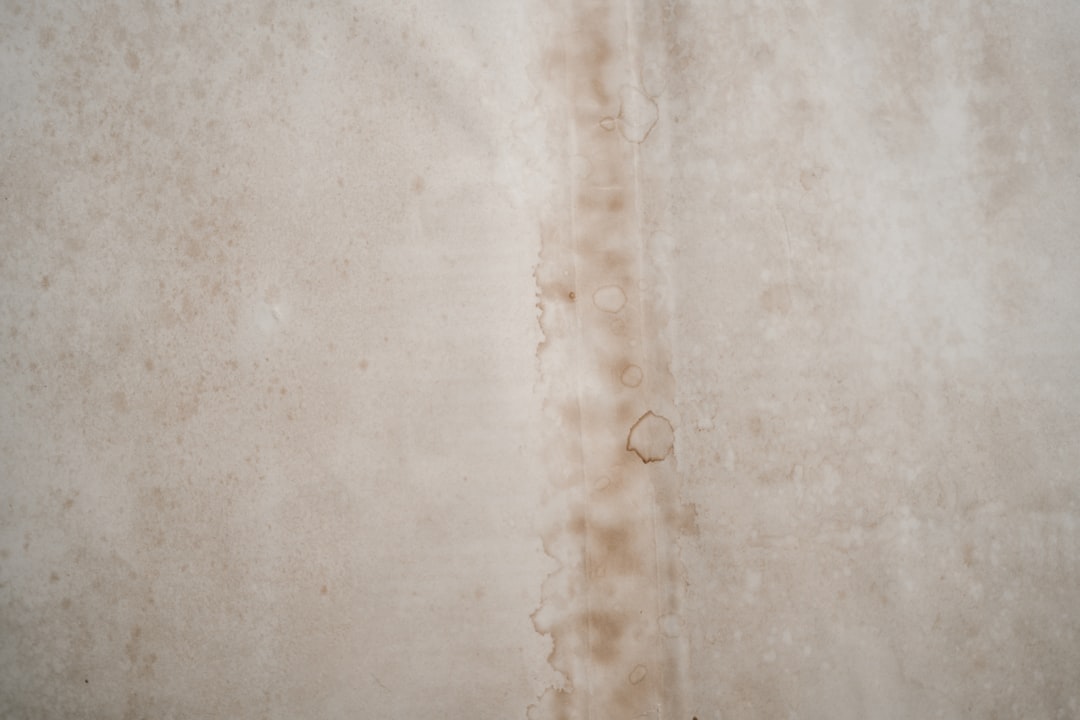
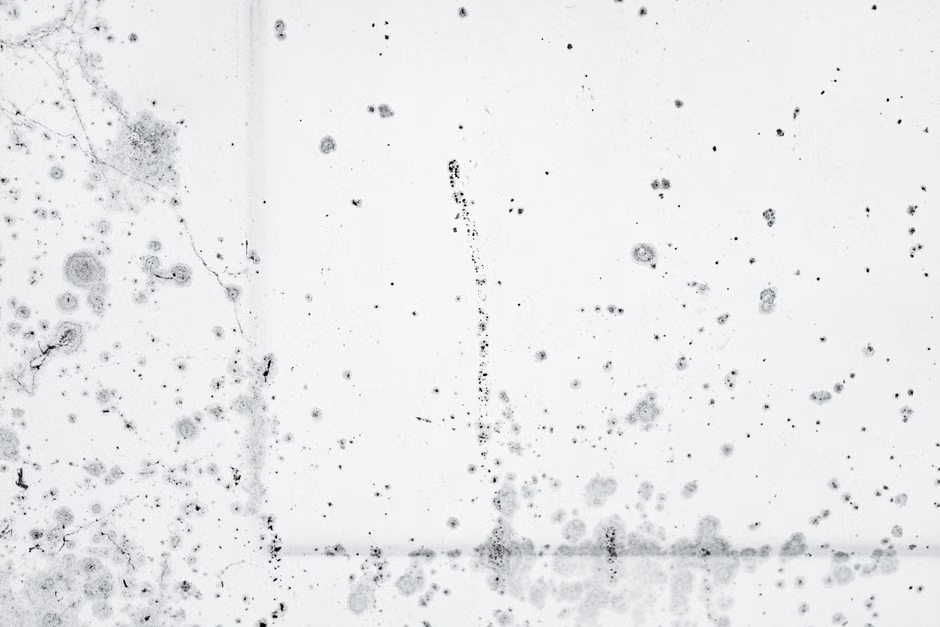
1. Check for visible signs — Look for discolored patches, bubbling or peeling paint, sagging drywall, warped baseboards, or mold spots along walls and ceilings.
2. Smell for musty odors — A persistent damp or mildew smell in a room, especially near walls or floors, often points to hidden moisture.
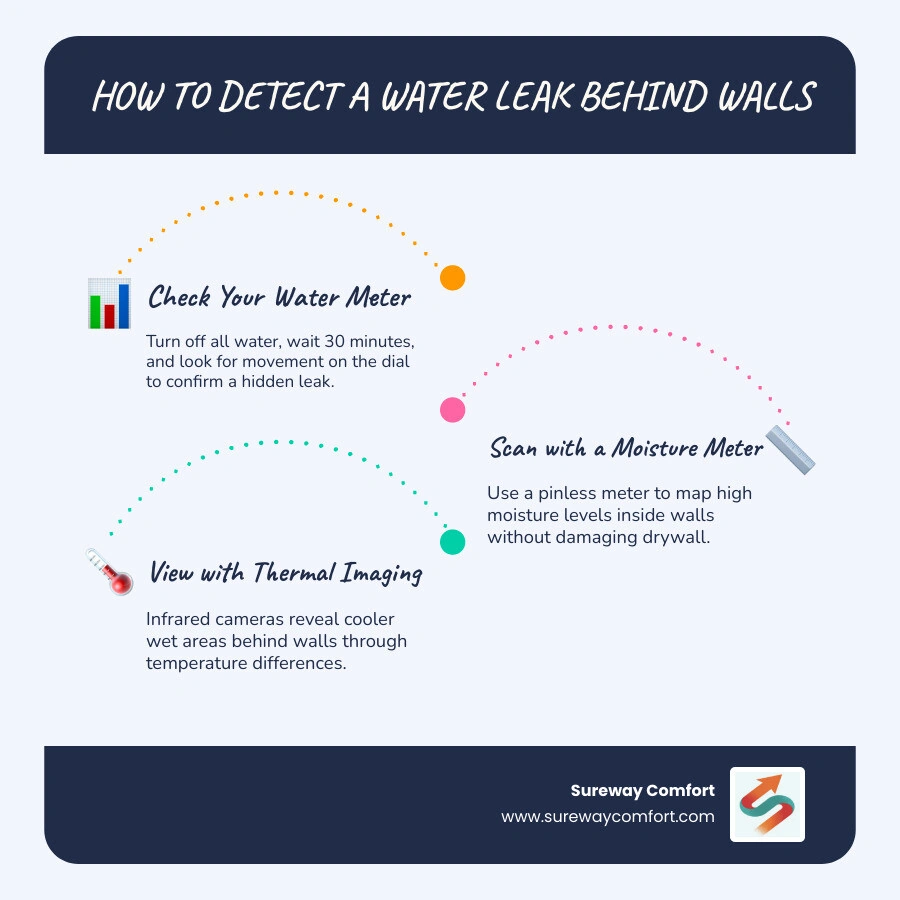
3. Run the water meter test — Turn off all water in your home, check your meter, wait 30 minutes without using any water, then check again. Any movement confirms a leak.
4. Monitor your water usage — According to the EPA, a household of four using more than 12,000 gallons per month during cooler seasons likely has a serious leak somewhere.
5. Use a moisture meter — Scan your walls with a pinless moisture meter to find areas with unusually high moisture content.
6. Try thermal imaging — An infrared camera picks up temperature differences caused by wet areas behind walls, even when there's no visible damage yet.
7. Listen carefully — After turning off all appliances, listen near plumbing walls for faint hissing, dripping, or splashing sounds.
Across the U.S., household leaks waste up to 1 trillion gallons of water every year — the equivalent of annual water use in more than 11 million homes. Many of those leaks are hidden inside walls, slowly rotting wood, feeding mold, and driving up water usage without a single visible puddle on the floor.
If you suspect a leak in your Bridgeville area home, understanding these tips and knowing what steps to take next is the fastest way to protect your property.
As of May 2026, we’ve seen that homeowners in our local communities—from the historic homes in Brookline to the newer builds in Scott Township—often face the same invisible enemy: the slow-motion disaster of a wall leak. Because drywall is incredibly absorbent, it acts like a sponge, soaking up gallons of water before the surface ever feels wet to the touch.
The first step in how to detect a water leak behind walls is to use your senses. Look for these red flags:
• Discolored Patches: Yellow, brown, or copper-colored stains on the wall or ceiling are classic indicators. These often grow in size over time.
• Bubbling Paint or Wallpaper: When water gets trapped between the drywall and the surface finish, the paint will lose its adhesion. If you see paint that looks like it's "blistering," there is likely moisture pushing from behind.
• Warped Wood and Sagging Drywall: Water weight causes drywall to lose its structural integrity. You might notice a slight curve in the wall or baseboards that are pulling away from the floor.
• The "Musty" Smell: If a room smells like a damp basement or a wet towel that’s been sitting too long, mold is likely growing inside the wall cavity. Mold can begin to grow within 24 to 48 hours of a leak starting.
• Damp Carpets: Sometimes a wall leak doesn't show up on the wall at all; instead, the water runs down the studs and pools under the carpet or hardwood flooring.
If you are noticing these signs and live in the South Hills, you can find more information about leak detection in Brookline PA or leak detection in Scott Township PA to help narrow down the source.
Pro Tip: How to Detect a Water Leak Behind Walls Using Your Water Meter
Your water meter is one of the most reliable tools for confirming a "phantom leak"—a leak you suspect exists but cannot see. This test is essential because it rules out other moisture sources like high humidity or foundation seepage.
Follow these steps to conduct a professional-grade meter test:
1. Shut Off All Water: Ensure every faucet, showerhead, dishwasher, and washing machine is completely off. Don't forget to tell everyone in the house not to flush the toilet during the test!
2. Locate Your Meter: In most of our service areas like Bethel Park or Bridgeville, your water meter is likely in the basement, a utility closet, or an outdoor pit near the curb.
3. Check the Leak Indicator: Many modern meters have a small "leak indicator" triangle or silver wheel. If this is spinning even slightly while all water is off, you have an active leak.
4. The 30-Minute Wait: Even if the indicator isn't moving, record the exact reading on the meter. Wait at least 30 to 60 minutes (making sure no water is used), and check again. If the numbers have changed, you have a slow, hidden leak.
5. Calculate the Volume: If you find you're using more than 12,000 gallons a month (for a family of four) during the cooler months, the EPA suggests this is a surefire sign of a serious plumbing issue.
For homeowners in the area, getting a jump on this can prevent excessive water waste and structural issues. You can find more info about leak detection in Bethel Park or leak detection in Bridgeville PA if your meter test comes back positive.
When a meter test confirms a leak, the last thing you want to do is start swinging a hammer at every wall in the house. Modern technology allows us to find the exact location of a leak without unnecessary demolition.
• Moisture Meter — How It Works: Measures the electrical resistance or capacitance of the wall. — Best Used For: Mapping the spread of water and finding the "wettest" spot.
• Thermal Camera — How It Works: Detects infrared radiation (heat signatures). — Best Used For: Finding cold spots caused by evaporative cooling of leaking water.
• Acoustic Device — How It Works: Amplifies the sound of dripping or hissing pipes. — Best Used For: Pinpointing high-pressure supply line leaks behind thick materials.
• Borescope — How It Works: A tiny camera on a flexible cable inserted through a small hole. — Best Used For: Visual confirmation of a leak inside a dark wall cavity.
Using these tools in combination is the gold standard for how to detect a water leak behind walls. For residents in Carnegie or Green Tree, we often utilize these methods to save our clients from the mess of exploratory holes. Learn more about leak detection in Carnegie PA and leak detection in Green Tree PA.
Pro Tip: How to detect a water leak behind walls with a moisture meter
A moisture meter is a handheld device that tells you exactly how much water is trapped inside a material. There are two types: "pin" (which requires poking small holes) and "pinless" (which uses sensors to scan through the surface).
In places like McDonald, we recommend using a pinless moisture meter to create a "moisture map." By scanning the wall in a grid pattern, you can follow the higher readings. Water often travels along framing or wiring, so the highest reading on the meter usually indicates the leak's origin. This is much more effective than simply guessing where the water is coming from. More info about leak detection in McDonald PA.
Pro Tip: How to detect a water leak behind walls using thermal imaging
Thermal imaging is perhaps the most impressive "magic trick" in a plumber's arsenal. It doesn't actually "see" water; instead, it sees temperature. Because water evaporating from drywall or a pipe is usually cooler than the surrounding dry wall, it shows up as a dark blue or purple "plume" on the camera screen.
This is particularly useful in Oakdale homes where large rooms or high ceilings make visual inspection difficult. An infrared scan can reveal a hidden leak in minutes that might have taken a homeowner weeks to notice otherwise. More info about leak detection in Oakdale PA.
Once you’ve confirmed a leak is hiding behind your drywall, you need to act fast to minimize the damage. Here is your emergency checklist:
1. Shut Off the Main Water Valve: This is the most critical step. Stopping the flow of water prevents the leak from worsening and protects your home's structural integrity.
2. Turn Off the Electricity: If the leak is near outlets, light switches, or electrical panels, shut off the power to that specific zone at the breaker box. Water and electricity are a deadly combination.
3. Protect Your Belongings: Move furniture, electronics, and rugs away from the affected wall. If the leak is in the ceiling, place a bucket under the drip to catch water.
4. Document Everything: Take clear photos and videos of the damage, the meter readings, and any visible signs. This is crucial for insurance claims. At least one in four insurance claims are due to "escape of water," and having a paper trail helps.
5. Call the Professionals: While DIY detection is great for confirmation, repairing a pipe inside a wall often requires specialized tools and knowledge to ensure the fix is permanent and up to code.
For our neighbors in South Fayette and Upper St. Clair, we are always ready to help with rapid response diagnostics. Check out leak detection in South Fayette PA and leak detection in Upper St. Clair PA for local assistance.
How do I differentiate between a wall leak and a roof leak?
A roof leak usually appears after a rainstorm or heavy snow melt and is typically found on the highest floor of the home or near the attic. A plumbing wall leak can happen anytime, regardless of the weather, and is often located near "wet walls" where bathrooms, kitchens, or laundry rooms are situated. If the stain is consistent and growing on a sunny day, it’s likely a pipe.
Can a small pinhole leak cause significant mold growth?
Absolutely. In fact, pinhole leaks are often more dangerous than a burst pipe because they go unnoticed for longer. A tiny misting of water provides the perfect constant humidity for mold to thrive. Undetected leaks can waste up to 10,000 gallons of water per year, providing plenty of moisture to rot out your wall studs and ruin your indoor air quality.
Why is my water usage high if I don't see any puddles?
This is the classic sign of a hidden leak. Many leaks occur in the slab (the concrete floor) or behind walls where the water drains into the soil or the crawl space. If your usage has spiked but your floors are dry, it’s time to perform a water meter test immediately.
Conclusion
Finding a leak behind your walls doesn't have to be a nightmare. By staying vigilant and using the right tips—like the water meter test, moisture meters, and thermal imaging—you can catch problems before they lead to extensive structural repairs or mold remediation.
At Sureway Comfort, we understand that your home is your biggest investment. We serve our neighbors throughout Bridgeville, Mt Lebanon, Canonsburg, and the surrounding areas with a streamlined process and experienced technicians who treat your home with respect. Whether you need a quick diagnostic check or a complex pipe repair, we provide the reliable plumbing services you need to keep your home dry and safe.
Don't let a hidden leak damage your home. If you suspect a problem, we’re here to help with expert diagnostics and professional solutions to get your plumbing back in top shape. For more information on how we can help, visit our plumbing services page.






.svg)
.avif)


