


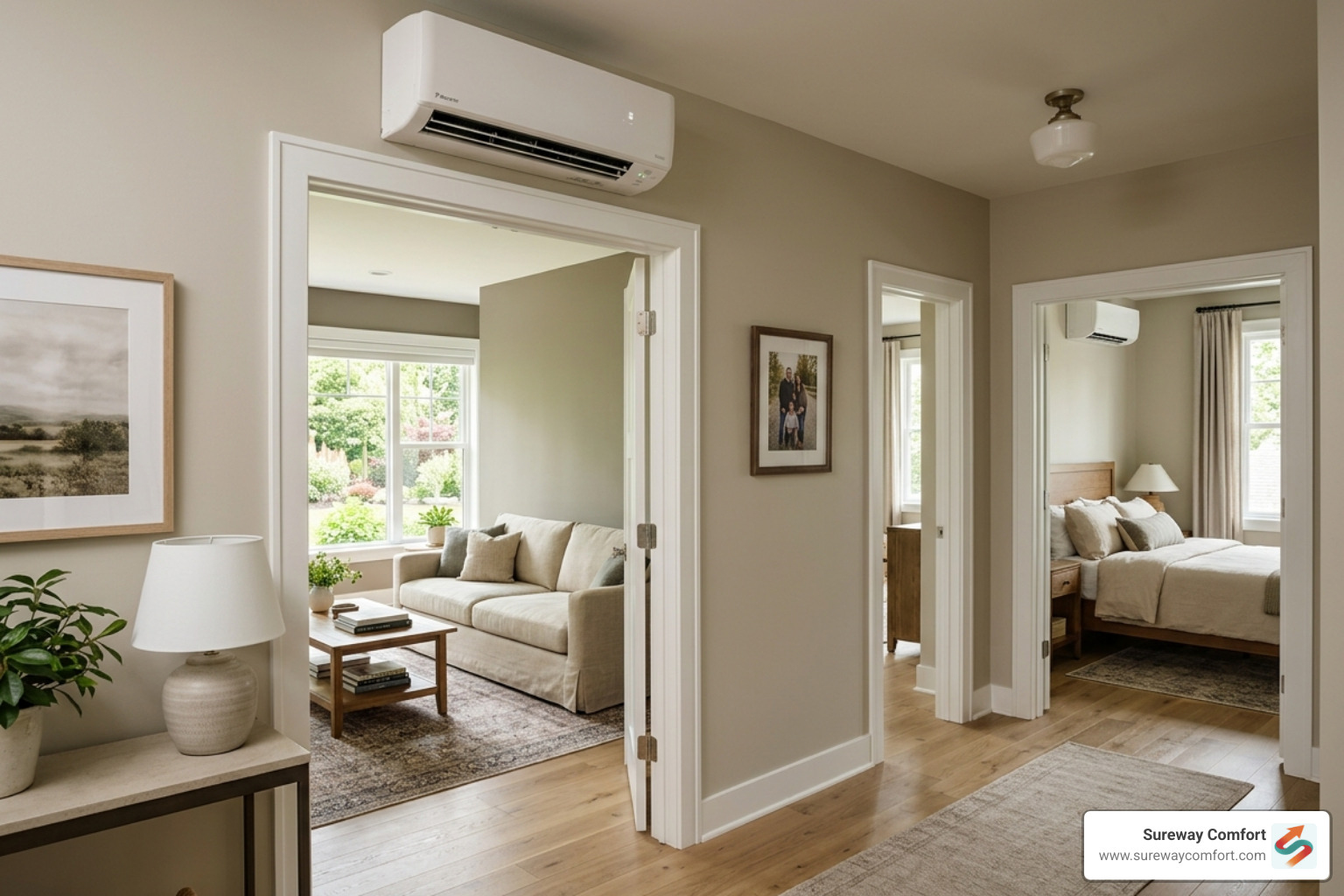
How many mini split heads do I need is one of the first questions homeowners ask before going ductless — and the honest answer is: it depends on your home's layout, not just its size.
Quick Tip: Estimate by home size and layout:
• Under 600 sq. ft. (open plan) — Typical Number of Heads: 1 head
• 600 – 1,200 sq. ft. — Typical Number of Heads: 2 – 3 heads
• 1,200 – 2,000 sq. ft. — Typical Number of Heads: 3 – 4 heads
• 2,000 – 3,000 sq. ft. — Typical Number of Heads: 4 – 5 heads
• 3,000+ sq. ft. — Typical Number of Heads: 5 – 8 heads
The simple rule: plan for one indoor air handler per room that has a door and needs its own temperature control. Open-concept spaces — like a combined kitchen, dining, and living area — can often share a single head. Bathrooms typically don't need one at all.
That said, square footage alone won't give you the full picture. Homes in the Bridgeville area deal with real seasonal swings, and factors like insulation quality, ceiling height, sun exposure, and how you actually use each room all play a role in getting the count right. Size it wrong and you'll either be sweating through August or watching your system short-cycle itself into an early breakdown.
Whether you're retrofitting an older home or planning a new installation, understanding what drives the head count will save you from costly mistakes — and keep every room in your home genuinely comfortable year-round.

Expert Tips: Understanding the Factors for Mini Split Heads
When we sit down with homeowners in Upper St. Clair or Bethel Park to discuss a ductless upgrade, we start by looking at the "temperature personalities" of their rooms. Every home is a unique puzzle, and the number of indoor heads (the air handlers mounted on your walls or ceilings) is determined by how air moves — or doesn't move — through your space.
The "Door Rule" Tip
The most important factor in answering how many mini split heads do i need is what we call the "Door Rule." While a high-powered mini split head can certainly cool a large area, it cannot "see" through walls or around tight corners. If you have a bedroom separated by a door that stays closed most of the night, that room needs its own head. Airflow is a bit like a lazy houseguest; it won't go into a room unless the path is wide open and inviting.
According to our Ductless Mini-Split Systems Overview, these systems thrive on creating independent zones. If you try to cool three bedrooms with one hallway unit, you’ll end up with a freezing hallway and three stuffy bedrooms.
Insulation and Home Construction
Are you living in a historic home in Carnegie with original windows, or a modern build in South Fayette with high-efficiency R-value insulation? Poor insulation means your rooms lose treated air faster, which might require more powerful heads or a more strategic layout to maintain comfort.
Ceiling Height and Sun Exposure
Heat rises. If you have vaulted ceilings in your living room, that air handler has to work harder to push conditioned air down to where you actually sit. A standard 8-foot ceiling is the baseline for most calculations, but for every two feet of extra height, we generally need to add about 10% more cooling capacity. Similarly, a south-facing room with giant windows in McDonald will naturally be much warmer than a shaded basement. When considering a Mini-Split Air Conditioner in McDonald, we always account for that "solar gain."
Room Usage
A home office with two computers, a printer, and a sunny window generates more heat than a guest bedroom that stays empty three weeks out of the month. We look at how you use the space to decide if a dedicated head is necessary for your specific lifestyle.
Calculating BTUs: A Pro Tip
Once we know which rooms need a head, we have to figure out how powerful those heads should be. This is measured in BTUs (British Thermal Units).
A common "rule of thumb" in the HVAC industry is 20 BTUs per square foot. However, as we approach May 2026, we’ve learned that this is just a starting point. Here is how we break it down:
1. Measure the Square Footage: Multiply the length of the room by the width.
2. Apply the 20 BTU Rule: A 500-square-foot room typically needs 10,000 BTUs.
3. The Kitchen Factor: Kitchens are heat magnets. Between the oven, the dishwasher, and the fridge, we usually add a flat 4,000 BTUs to any kitchen zone to ensure it stays cool while you're cooking Sunday dinner.
4. The Manual J Load Calculation: This is the gold standard. Instead of guessing, we perform a professional load calculation that factors in your specific windows, insulation, and local Bridgeville climate.
Our Mini-Split Services team uses these calculations to ensure your system isn't just powerful enough for the hottest day of the year, but also efficient enough for a mild spring afternoon.
Configuration Tricks: Single-Zone vs. Multi-Zone
When you decide on the number of heads, the next step is choosing the "muscle" — the outdoor condenser unit. You have two primary paths:
• Outdoor Units — Single-Zone System: One outdoor unit per indoor head — Multi-Zone System: One outdoor unit for multiple heads
• Best For — Single-Zone System: Room additions, garages, or sunrooms — Multi-Zone System: Whole-home comfort
• Control — Single-Zone System: Individual thermostat — Multi-Zone System: Independent control for each head
• Expansion — Single-Zone System: Limited to one head — Multi-Zone System: Can support 2 to 5 (or more) heads
Outdoor Condenser Capacity and Expansion Ports
A multi-zone condenser has a specific number of "ports." If you buy a 3-zone condenser, you can hook up three indoor heads. One common strategy we use for Ductless Mini-Split Systems Installation is "future-proofing." If you think you might want to add air conditioning to the basement next year, we might suggest an outdoor unit with an extra port now so you don't have to replace the whole outdoor system later.
In places like Carnegie, where yard space might be tight, a multi-zone system is a lifesaver. Instead of having four different "boxes" buzzing outside your house, you have one sleek unit doing all the heavy lifting. This is why Mini-Split Installation in Carnegie often leans toward multi-zone configurations.
Layout Tricks for Open Floor Plans vs. Enclosed Rooms
The layout of your home is the ultimate tie-breaker when deciding on head counts.
Open Floor Plans:If your kitchen flows directly into the dining area and living room without any doors or major wall obstructions, you can often get away with one high-capacity head. For example, an 18,000 or 24,000 BTU unit can effectively sweep air across a large, open first floor. We often see this in newer homes in Upper St. Clair.
Enclosed Rooms:As soon as you add a door, you create an airflow bottleneck. This is common in the classic "choppy" layouts of older homes in Bridgeville. Each bedroom, the home office, and the finished basement will likely need its own dedicated head.
The Pitfall of Hallway Placement:One of the most common mistakes homeowners make is trying to save money by putting one large mini split head in a central hallway to cool three adjacent bedrooms. We strongly advise against this. Once those bedroom doors close for privacy or sleep, the cold air stays in the hallway, and the bedrooms stay warm. It’s much better to have three smaller, 6,000 BTU heads in the rooms than one 18,000 BTU head in the hall.
For those in more complex layouts, our Ductless HVAC Services in Bridgeville can help map out exactly where the air will travel. Whether it's managing heat stratification in a two-story home or ensuring Mini-Split Installation in Upper St. Clair covers every corner, the goal is "homogeneous temperature dispersion" — a fancy way of saying every room feels the same.
Troubleshooting Tips: Avoiding Common Sizing and Layout Mistakes
If you’re wondering how many mini split heads do i need, you might be tempted to just "go big" to be safe. In the HVAC world, bigger is definitely not always better.
The Danger of Oversizing (Short-Cycling)
If you put a 12,000 BTU head in a tiny 150-square-foot room, the unit will cool the room so fast that it shuts off before it has a chance to remove the humidity. This is called "short-cycling." You’ll end up with a room that feels "cold and clammy" rather than crisp and comfortable. Short-cycling also puts immense wear and tear on the compressor, leading to a much shorter lifespan for your equipment.
The Struggle of Undersizing
Conversely, if you try to cool a large sunroom in Bethel Park with a tiny unit, it will run 24/7, never reaching the target temperature and sending your utility bills through the roof. This is why Mini-Split AC in Bethel Park requires an accurate assessment of "glass load" — the amount of heat coming through those windows.
Proper sizing ensures your system can "sip" electricity using inverter technology, which allows the unit to slow down and speed up like a dimmer switch rather than just clicking on and off. We focus on this balance during Mini-Split Installation in South Fayette to maximize your long-term savings.
Frequently Asked Questions About Mini Split Sizing
Do I need a mini split head in every room?
Not necessarily. You need a head in every "zone" you want to control. If you have a cluster of small rooms that always stay open to each other, they can share. However, any room with a door that stays closed (like a bedroom or a nursery) should have its own.
What about bathrooms? We generally don't put mini split heads in bathrooms. The "overflow" air from the adjacent bedroom or hallway is usually enough to keep it comfortable. Plus, the high humidity from showers can sometimes mess with the unit's sensitive electronics.
How many rooms can one outdoor unit support?
Most residential multi-zone condensers can support between 2 and 5 indoor heads. However, high-capacity systems are available that can handle up to 8 zones. If your home in McDonald is particularly large, we might even suggest two separate outdoor units — one for the east side and one for the west side — to keep the refrigerant line runs shorter and more efficient. This is a common strategy for Mini-Split Installation in McDonald.
Can I add more heads to my system later?
Yes, but only if your outdoor unit has an open port and enough BTU capacity left over. If you install a 2-zone outdoor unit and hook up two heads on day one, you cannot add a third head later without replacing that outdoor unit. We always recommend checking the "port count" before finalizing your purchase. If you’re planning a multi-phase renovation in Upper St. Clair, let us know so we can help you choose the right base unit during your Mini-Split Installation in Upper St. Clair.
Final Tips for Your Ductless Journey
Choosing the right number of mini split heads doesn't have to be a headache. By following the "Door Rule," calculating your BTUs accurately, and understanding the difference between open-concept and enclosed layouts, you can build a system that delivers perfect comfort to every corner of your home.
At Sureway Comfort, we’re your neighbors in Bridgeville, and we’ve seen every type of home layout the area has to offer — from historic Carnegie townhomes to sprawling South Fayette estates. We don't believe in a one-size-fits-all approach. We’re here to provide honest diagnostics and a streamlined process that takes the guesswork out of your HVAC upgrades.
Ready to stop the "thermostat wars" and start enjoying personalized comfort in every room? Reach out to us for a professional assessment. We'll help you figure out exactly how many mini split heads do i need to make your home the most comfortable place on the block.
Explore our Mini-Split Services today and let's get your home ready for whatever the Pennsylvania weather throws our way!






.svg)
.avif)


