


The Small Part That Keeps Your Water Heater Alive
How the anode rod protects your water heater tank comes down to one simple idea: it corrodes so the tank doesn't have to. Inside every traditional tank water heater sits a metal rod — usually made of magnesium, aluminum, or zinc — that quietly sacrifices itself to prevent rust from attacking the steel tank walls. Most homeowners have never heard of it, yet without it, a water heater can fail years ahead of schedule.
Quick answer: How does an anode rod protect your water heater tank?
• The anode rod is made of metal that is more reactive than steel
• When water contacts both the rod and the tank, corrosion targets the rod first
• The rod slowly dissolves over time, drawing rust away from the tank walls
• This process is called sacrificial or galvanic protection
• Once the rod is fully depleted, the tank itself becomes the target of corrosion
• Replacing the rod on schedule can extend your water heater's life to 10-15 years
Most water heaters fail not because of a mechanical breakdown, but because this one small, overlooked part quietly wore out — and nobody noticed. Understanding how it works gives you a real advantage as a homeowner.
Handy how the anode rod protects your water heater tank terms:
• how sediment buildup shortens your water heater life
• how to extend the life of your water heater
• water heater maintenance checklist for homeowners
What Is an Anode Rod and Where Is It Located?
To understand how this little component saves your plumbing system, we first need to look at what it is and where it hides.
A traditional water heater is essentially a large steel cylinder that holds hot water under pressure. Because steel and water are natural enemies that love to create rust, manufacturers coat the inside of the steel tank with a porcelain glass lining. However, this glass lining isn't perfect. Over time, the constant heating and cooling cycles cause the steel tank to expand and contract. This process creates microscopic cracks in the glass lining, exposing the raw steel underneath to water.
This is where the anode rod comes to the rescue.
An anode rod is a long, metal rod constructed around a central steel core wire. The outer layer is made of a highly active metal — typically magnesium, aluminum, or a zinc-aluminum alloy.
Where to Find It
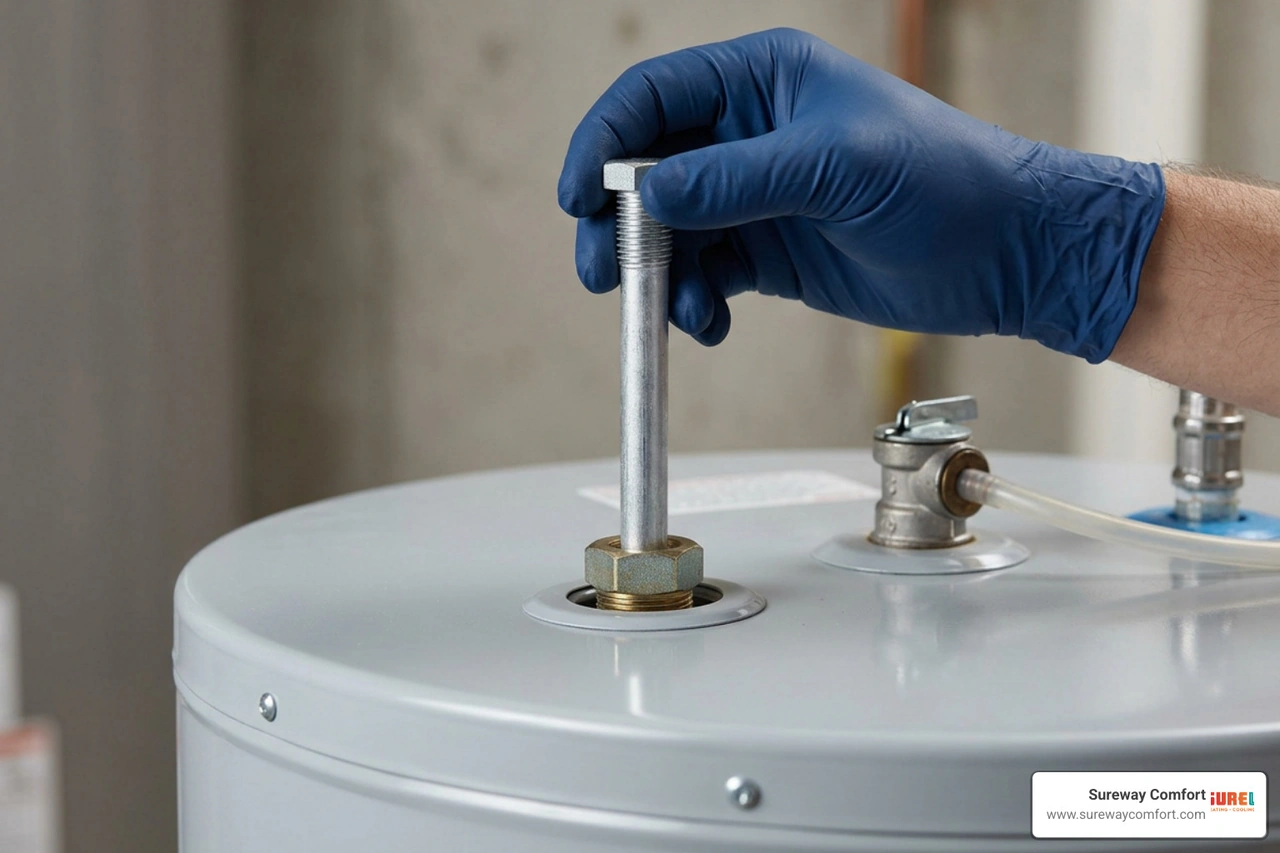
The anode rod is suspended vertically inside the water heater tank, running from the very top down to almost the bottom. From the outside of your water heater, you will usually only see its hex head plug. This looks like a large bolt (typically requiring a 1-1/16-inch socket to remove) located on the top cap of the water heater.
On some models, the anode rod is integrated directly into the hot water outlet nipple, making it a bit more hidden, but its protective mission remains exactly the same.
Whether you run an Electric Water Heater or enjoy the rapid recovery and Gas Water Heaters Benefits, your tank relies heavily on this single component to keep water from eating through the steel.
How the Anode Rod Protects Your Water Heater Tank
The way this system works is pure chemistry, operating like a continuous science experiment right inside your utility closet.
The Chemistry of Protection
When you put two different metals in water and connect them electrically, they form a galvanic cell. Water acts as an electrolyte, allowing electrical current and charged particles (ions) to flow between the metals.
In the galvanic series — which lists metals based on how easily they corrode — metals like magnesium, aluminum, and zinc are much more reactive (or "less noble") than the steel of your water heater tank. This means they have a higher electrochemical potential to give up electrons.
When water enters the tank and contacts both the steel walls and the anode rod, an electrochemical reaction begins:
1. Electron Generation: The anode rod begins to oxidize (corrode) on purpose. As it does, it releases electrons.
2. Cathodic Protection: These electrons flow through the metal connection at the top of the tank and into the steel walls.
3. The Protected State: By flooding the steel tank with electrons, the anode rod forces the steel into a cathodic state. In chemistry terms, a cathode cannot rust.
4. Sacrificial Action: Because the anode rod is supplying all the electrons, the oxygen and corrosive minerals in your water attack the highly reactive rod instead of the steel.
Essentially, the rod acts as a lightning rod for corrosion. It is designed to degrade and dissolve over time so that the steel structure of your water heater remains completely untouched.
Understanding this electrochemical dance is crucial because your local water quality plays a massive role in how fast this reaction occurs. You can learn more about this by reading about How Water Quality Affects Water Heater Lifespan.
Comparing Anode Rod Materials: Magnesium, Aluminum, and Zinc
Not all anode rods are created equal. Depending on your home's water chemistry, one material may perform significantly better than another. Let’s break down the three primary sacrificial materials used in residential water heaters today.
1. Magnesium Anode Rods
Magnesium is the industry standard and comes pre-installed in most brand-new water heaters. Because magnesium is highly reactive, it provides excellent, strong cathodic protection. It is highly effective in areas with soft or moderately hard water.
However, because it is so reactive, it can degrade very quickly in aggressive water conditions. Additionally, if your water contains high levels of sulfates, a magnesium rod can react with native bacteria in the tank to produce hydrogen sulfide gas, leaving you with a distinct "rotten egg" smell when you turn on the hot water.
2. Aluminum Anode Rods
Aluminum rods are much more durable and slower to corrode than magnesium, making them a popular choice for areas with very hard water or high mineral content.
The main drawback of aluminum is that as it corrodes, it can create a white, gelatinous byproduct (aluminum hydroxide) that settles at the bottom of the tank. This sediment can accumulate and clog faucet aerators or drain valves if the tank isn't flushed regularly.
3. Zinc-Aluminum Alloy Anode Rods
This specialty rod is actually mostly aluminum, with a small portion of zinc added (usually around 10%). The zinc is added specifically to eliminate the rotten egg odor. Zinc has natural antifungal and antibacterial properties that prevent sulfate-reducing bacteria from producing smelly hydrogen sulfide gas. If you have well water or suffer from smelly hot water, this is often the go-to solution.
Comparison Table: Sacrificial Anode Rod Materials
• Reactivity Level — Magnesium Rod: Extremely High — Aluminum Rod: Moderate — Zinc-Aluminum Rod: Moderate
• Expected Lifespan — Magnesium Rod: 2 to 4 years — Aluminum Rod: 3 to 5 years — Zinc-Aluminum Rod: 3 to 5 years
• Best Water Type — Magnesium Rod: Soft to moderately hard water — Aluminum Rod: Hard water, high mineral content — Zinc-Aluminum Rod: Well water, high sulfate water
• Odor Prevention — Magnesium Rod: Can cause "rotten egg" smell — Aluminum Rod: Neutral — Zinc-Aluminum Rod: Eliminates sulfur odors
• Byproducts — Magnesium Rod: Minimal sediment — Aluminum Rod: White gelatinous buildup — Zinc-Aluminum Rod: Moderate sediment
Sacrificial vs. Powered Anode Rods
If you are tired of checking and replacing a metal rod every few years, there is an alternative: the powered (or impressed-current) anode rod.
Unlike sacrificial rods that protect the tank by physically dissolving, a powered anode rod uses a small amount of household electricity to get the job done.
How a Powered Anode Rod Works
A powered anode consists of a non-corrosive titanium rod connected to a small wall adapter. When plugged into a standard outlet, the system sends a tiny, continuous low-voltage direct current (DC) into the tank. This electrical current feeds electrons directly to the steel tank walls, keeping them in a cathodic state and preventing rust.
Because titanium does not degrade, the rod itself never needs to be replaced. The electronics are typically designed to last between 10 to 20 years, matching or exceeding the lifespan of the water heater itself.
Key Trade-offs to Consider
• Odor Control: Powered anodes do not produce hydrogen gas, making them incredibly effective at permanently stopping "rotten egg" odors caused by sulfur-reducing bacteria.
• Maintenance: They are truly "set it and forget it" systems, eliminating the need for regular physical replacements.
• Power Dependency: A powered anode only protects your tank when it is plugged in and receiving electricity. If the power goes out for an extended period, or if the unit is unplugged, your tank is temporarily left unprotected.
• Upfront Investment: Powered systems require a higher initial investment compared to a standard sacrificial rod. However, many homeowners find the long-term convenience and odor elimination well worth the trade-off.
To see how upgrading your anode rod fits into your long-term appliance planning, check out our guide on How Long Does a Water Heater Last.
Signs Your Anode Rod Needs Inspection or Replacement
Because the anode rod is hidden deep inside the tank, it is easy to forget about it until a major problem arises. However, your plumbing system will often drop subtle hints when the rod is nearing the end of its useful life.
What Speeds Up Anode Rod Wear?
Several environmental factors can cause your anode rod to degrade much faster than normal:
• Water Softeners: Water softeners replace calcium and magnesium minerals with sodium. While this prevents scale buildup, the increased sodium content makes the water highly conductive. This accelerated electrical pathway causes sacrificial anode rods to dissolve up to two or three times faster than they would in unsoftened water.
• High Temperatures: Keeping your water heater thermostat set above 130°F increases ionic mobility in the water, which accelerates the rate of galvanic corrosion on the rod.
• Heavy Usage: The more fresh water that passes through your tank, the more oxygen and minerals are introduced, speeding up the wear process.
Warning Signs to Watch For
• Rotten Egg Smell: If your hot water suddenly smells like sulfur, your magnesium rod is likely reacting with sulfate-reducing bacteria.
• Rusty or Discolored Water: If your hot water has a reddish, brown, or yellow tint, the anode rod may be fully depleted, allowing rust to form directly on the steel tank walls.
• Popping or Rumbling Noises: As the anode rod degrades (especially aluminum rods), sediment and mineral scale settle to the bottom of the tank. When the heating element or burner fires up, water trapped under this sediment boils and pops. You can read more about how this occurs in our article on How Sediment Buildup Shortens Your Water Heater Life.
• Age of the Unit: If your water heater is more than three years old and has never been serviced, there is a very high probability that the anode rod is significantly degraded.
Pro Tricks & Tips for Anode Rod Maintenance
To get the most out of your water heater and make maintenance a breeze, try these simple homeowner tricks:
• The Garden Hose Flush Trick: Before removing your anode rod, drain just a few gallons of water from the bottom drain valve using a standard garden hose. This lowers the water level slightly so water won't spill out of the top when you unscrew the rod.
• The Socket Extension Tip: Anode rods are often recessed into the top cover. Use a 1-1/16-inch deep socket with a long extension bar to easily reach and loosen the hex head without scratching your water heater's outer shell.
• The Teflon Tape Trick: When installing a new sacrificial rod, wrap the threads with 5 to 6 wraps of Teflon tape. This ensures a watertight seal and makes it much easier to unscrew the rod during your next annual inspection.
Frequently Asked Questions About Water Heater Anodes
How often should I check how the anode rod protects your water heater tank?
We highly recommend inspecting your sacrificial anode rod at least once a year, especially if you have a home water softener or live in an area with aggressive water. Under standard municipal water conditions, most sacrificial rods need to be replaced every 2 to 5 years.
Integrating this check into your regular home care routine is easy when you follow a structured Water Heater Maintenance Checklist for Homeowners.
What happens to the tank when the anode rod is fully depleted?
Once the sacrificial metal on the anode rod has completely dissolved, the steel core wire is left exposed. With no highly reactive metal left to supply electrons, the galvanic circuit is broken.
At this point, the corrosive elements in your water will immediately begin attacking the steel tank walls at their weakest points — usually where microscopic cracks have formed in the glass lining. This leads to rapid rusting, structural weakening, and eventually, a catastrophic tank leak.
Once a water heater tank begins to leak from corrosion, it cannot be repaired; the entire unit must be replaced. To help you decide if your system is past the point of simple maintenance, take a look at our guide on When to Replace Your Water Heater.
Does a tankless system require understanding how the anode rod protects your water heater tank?
No. Tankless water heaters heat water on demand using a compact copper or stainless steel heat exchanger rather than storing water in a large steel tank. Because there is no steel storage tank vulnerable to standing water corrosion, tankless systems do not use or require anode rods.
However, tankless systems still require routine maintenance, such as annual flushing to remove scale buildup from the heat exchanger. If you are considering making the switch to a tankless setup, check out our comprehensive Tankless Water Heater Guide 2026 and weigh the financial benefits with our analysis of Tankless Water Heater Cost vs Value Long Term.
Conclusion
How the anode rod protects your water heater tank is one of the most reliable and elegant defense mechanisms in modern home appliances. By sacrificing its own metal body to the forces of corrosion, this humble rod keeps your water hot, your tank dry, and your household running smoothly.
While checking and replacing an anode rod is a straightforward concept, removing a seized, rusted rod from the top of a water heater often requires specialized tools like a heavy-duty impact wrench and breaker bar. If done incorrectly, you risk damaging the delicate water connections on your tank.
For homeowners in Bridgeville, PA, and surrounding communities — including McDonald, Mt Lebanon, Bethel Park, Canonsburg, Collier, South Fayette, Upper St. Clair, Carnegie, Green Tree, Scott Township, Brookline, and Oakdale — Sureway Comfort is here to help. Our experienced, local technicians can safely inspect your anode rod, flush out accumulated sediment, and ensure your system remains fully protected under its manufacturer's warranty.
Before you schedule service, you can easily check your system's current status using our Water Heater Warranty Lookup.
Ready to schedule your annual water heater tune-up or need a professional hand replacing a worn-out rod? Contact us today to book an appointment through our Sureway Comfort Water Heater Services page. We’re your neighbors, and we’ll get it done right!





.svg)
.avif)


